



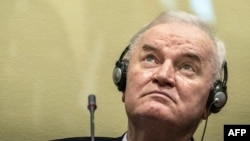
WASHINGTON/SARAJEVO -- Ratko Mladic, the Bosnian Serb wartime military commander whose forces laid siege to Sarajevo and carried out the 1995 Srebrenica massacre, has died at the age of 84 while serving a life sentence for genocide and crimes against humanity.
The United Nations confirmed that Mladic died at a UN prison hospital in The Hague on August 27. His death came more than three decades after the war in Bosnia-Herzegovina began and 15 years after he was finally arrested following nearly 16 years as a fugitive.
The UN secretary-general, through his spokesman Stephane Dujarric, said the international tribunal's findings against Mladic were final and formed part of the historical record.
"The secretary-general stands in solidarity with the victims, survivors and their families who suffered the crimes for which Mr. Mladic was found guilty," the statement said.
The UN also strongly condemned denial of the Srebrenica genocide and the glorification of people convicted of genocide, crimes against humanity, and war crimes by international courts.
"Accountability remains an essential step for lasting peace, trust and reconciliation in the region," the statement said.
Death Closes Chapter, Not Legacy Of His War
For former US officials who dealt with Mladic during and after the war, his death does not mark the end of the political struggle over the legacy of the conflict. One former US ambassador warns that some leaders in Bosnia-Herzegovina are still pursuing what he calls Mladic's "bloody objectives" through political means.
Retired US General Wesley Clark, who was then director of strategic plans and policy for the US Joint Chiefs of Staff, met Mladic face-to-face in September 1994 during a diplomatic mission aimed at advancing a peace plan.
Asked by RFE/RL on the day of Mladic's death what he saw in the room that revealed the Bosnian Serb commander's character, Clark said: "I saw a man who was irrationally motivated to fight against his fellow countrymen."
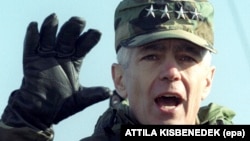
Clark said Washington was slow to grasp the scale of the unfolding tragedy in Bosnia, which began in 1992 after the breakup of Yugoslavia and followed the violence in Croatia the previous year.
"I think the United States was slow to grasp the tragedy that unfolded in Bosnia," Clark said, adding that the magnitude of what was happening had been difficult for Washington to understand.
He said the United States "should have appreciated what was happening much sooner than it did."
"There was a tendency on the part of many in power at the time when Yugoslavia broke up to be happy about it and just turn their back on it, and that was a mistake," Clark said.


‘Personally Directed Murder Of Thoursands’
Clark said Mladic's role went far beyond his command of the forces responsible for the Srebrenica massacre, in which some 8,000 Bosniak men and boys were killed.
“I think there's a great deal of understanding about him in Bosnia and in much of Europe," Clark said, describing Mladic as a man who "personally directed the murder of thousands of Bosnian men at Srebrenica.”
“But beyond that, he was leading the campaign of conquest and ethnic cleansing and murder," Clark said. "It was under his command that many of these horrendous crimes were committed as early as 1992 in the case of Bosnia.”
The UN-backed International Criminal Tribunal for the former Yugoslavia convicted Mladic in 2017 of genocide, crimes against humanity, and violations of the laws or customs of war. His life sentence was upheld by the Appeals Chamber of the International Residual Mechanism for Criminal Tribunals in June 2021.

His trial, which began in 2012, lasted 530 days. The court heard 592 witnesses and considered about 10,000 pieces of evidence documenting atrocities committed during the 1992-95 war.
Mladic became commander of the Bosnian Serb forces in 1992 and oversaw a campaign that seized large areas of Bosnia-Herzegovina. His forces subjected Sarajevo to a prolonged siege, shelling and sniping civilians, while non-Serb civilians and prisoners were detained and killed in a network of camps and other detention facilities.
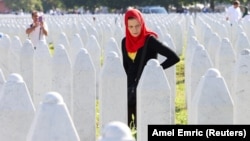
In Srebrenica, a UN-declared safe area, Bosnian Serb forces under Mladic's command murdered thousands of Bosniak men and boys in July 1995.
‘Mladic Legacy’ Survives
Richard Kauzlarich, who served as US ambassador to Bosnia-Herzegovina from 1997 to 1999, told RFE/RL that Washington and its NATO allies had devoted considerable resources to finding Mladic after the war.
“While I was US Ambassador, the US and our NATO allies expended considerable effort in tracking Mladic down and sending him to The Hague for trial," Kauzlarich said. "This effort was finally successful in 2011.”
Kauzlarich said Mladic's death should not be viewed as the end of the struggle over the political legacy of the Bosnian war.
"I would like to say that his death ends a chapter in the aftermath of the war in Bosnia and Herzegovina. It does not," he said.
"Today, there are leaders in BiH who pursue Mladic's bloody objectives through political means," Kauzlarich added.
He called on the countries that had led the effort to bring Mladic to justice to act together to prevent what he described as the "inheritors of the Mladic legacy" from succeeding politically where Mladic failed militarily.
Former Hague prosecutor Geoffrey Nice, who was involved in prosecuting war crimes cases before the tribunal, said Mladic's death should not diminish the importance of the court's record.
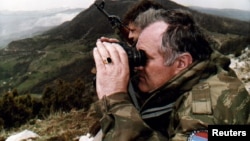
Asked whether the tribunal should ultimately be remembered more for punishing perpetrators or for leaving behind a record that politics could not erase, Nice said the record was more important.
"If I was given that binary choice, I would be much more concerned that the record, a reliable record, should be left," Nice told RFE/RL on August 27.
He said the tribunal's detailed evidence amounted to a valuable historical archive, despite the political pressures that sometimes surrounded its work. "The ICTY is to this extent a treasure trove for historians because of the detailed records it has available," Nice said.
Nice also cautioned that the wider system of international justice faces serious challenges. "I think there's no doubt that the world order has declined," he said, arguing that the prospects for international humanitarian law to have a meaningful effect had been significantly reduced.
Veteran US diplomat Daniel Fried, who served in senior national-security positions under seven US administrations and is now a distinguished fellow at the Atlantic Council, said the forces that drove the breakup of Yugoslavia and the ensuing bloodshed should not be viewed as inevitable.
"The surge of Serbian nationalism that destroyed Yugoslavia and left much ruin in its wake was a choice, not an inevitability," Fried told RFE/RL on August 27.
“Ratko Mladic and his patrons have left a bad legacy," Fried said. "While there is custom not to speak ill of the dead, I find I cannot do otherwise in this case.”
Mladic remained a hero to some Serbian nationalists even after his conviction. Bosnian Serb political leader Milorad Dodik said following news of his death that Mladic had been fighting for the freedom of the Serbian people.
That stands in stark contrast to the UN position, which says the court findings against Mladic are conclusive and warns against attempts to deny or relativize the crimes established by the tribunals.
Victims Say Death Does Not Erase The Crimes
For survivors and relatives of those killed, Mladic's death brought no sense that the consequences of his actions had disappeared.
Sahida Abdurahmanovic, who lost her husband in the Srebrenica massacre, told RFE/RL's Balkan Service that Mladic "never expressed remorse in a single sentence in his cell."
She said victims could regret only that Mladic had remained in The Hague for so long rather than being sent to what she regarded as a harsher prison.
An association representing relatives of those killed at Srebrenica said the memory of the victims must outlive both Mladic and policies seeking to justify or relativize the findings of international courts.
Mladic had suffered several strokes in recent months, prompting his family and Serbian officials to seek his release on humanitarian grounds. His latest request was rejected on August 26, one day before his death.
"The interests of justice and general legal principles do not require release merely because imminent death is expected," Judge Graciela Gatti Santana said in rejecting the request.
She said punishment should serve not only as a deterrent but also as an expression of the international community's condemnation of serious violations of international humanitarian law and human rights.
The tribunal said an inquiry into Mladic's death would be conducted according to standard procedures and Dutch law.
More than 100,000 people were killed and over 1 million displaced during the Bosnian war.
For the United Nations and the former US officials who watched the conflict unfold, Mladic's death closes the life of one of its most notorious commanders -- but not the unresolved questions over the political forces and ideas that fueled the war and continued to shape Bosnia-Herzegovina long after the guns fell silent.