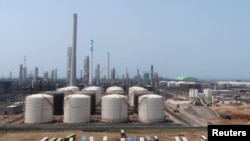
Beijing has pushed back on a US decision to sanction the Hengli oil refinery, rejecting Washington's accusations that the company "plays an outsized role" in buying Iranian oil.
The US Treasury Department last week sanctioned the Hengli Petrochemical (Dalian) Refinery, based in China's northeastern Liaoning Province, for having "purchased billions of dollars' worth" of Iranian petroleum.
Washington accuses Hengli of playing an instrumental role in sustaining Iran's oil economy since US and Israeli air strikes on Iran sparked a war that has spread through the Middle East. Hengli is China's second-largest "teapot" refinery -- the name for independent Chinese oil refineries -- and plays "an outsized role in purchasing crude oil from Iran's armed forces," according to the Treasury Department.
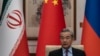
Chinese Foreign Ministry spokesman Lin Jian rejected the US decision to sanction Hengli at a news conference, saying Beijing has "always opposed illegal unilateral sanctions that are not based in international law." Lin urged Washington to "stop the indiscriminate application of sanctions."
Hengli also rejected the accusations, saying it "has never engaged in any trade with Iran," according to a company statement seen by the Chinese business news website Yicai Global.
The statement adds that "all of its suppliers have guaranteed that their crude oil does not originate from regions subject to US sanctions."
Targeting Iran's Shadow Fleet
Washington is targeting around 40 shipping firms and vessels that it accuses of forming part of Iran's shadow fleet, vessels that continue to transport oil to countries allied with Tehran despite international sanctions.
Maritime shipping has become a focal point for the war, with the Strait of Hormuz effectively blockaded by measures being taken by both Washington and Tehran. Twenty percent of global oil and liquefied natural gas (LNG) passes through the key naval chokepoint.
China's teapot refineries have been the target of US sanctions in recent years for their links to the Iranian regime.
The Trump administration previously sanctioned four teapot refineries, including Shandong Shengxing Chemical in April 2025, for purchasing Iranian crude oil.
At the time, Treasury chief Scott Bessent said the United States "is committed to disrupting all actors providing support to Iran's oil supply chain, which the regime uses to support its terrorist proxies and partners."
The European Union, meanwhile, included Chinese entities in its 20th package of sanctions against Russia on April 23.
The latest package, which focuses on measures to stop Russia circumventing earlier sanctions through third countries, places sanctions on six Chinese companies and one individual, as well as tighter export restrictions on dual-used goods from a further 21 entities. Dual-use goods refer to items which can have both civilian and military applications.
In response, Beijing warned on April 25 that it would "will take necessary measures to resolutely safeguard the legitimate rights and interests of [its] companies, and the EU will bear all the consequences."
The Chinese Commerce Ministry also placed seven EU-based companies of a restricted export list for dual-use goods from China for alleged "collusion" with Taiwanese authorities.