




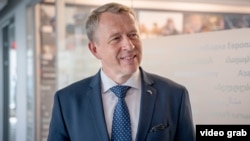
WASHINGTON --As Russia's war against Ukraine reshapes Europe's security landscape, Estonia remains one of the countries most closely watching the Kremlin's next moves. From Russia's first-ever unannounced live-fire exercise on Lake Peipus on Estonia's border to Tallinn's push for an EU-wide ban on Russian ex-combatants entering the Schengen area, Estonia argues that Europe must prepare not only for military threats but also for hybrid warfare, foreign influence operations, and long-term security risks.
In an interview with RFE/RL in Washington, Estonia's Undersecretary for Internal Security Joosep Kaasik discusses why Tallinn believes prevention is Europe's best defense, explains the reasoning behind Estonia's law severing the Estonian Orthodox Church's administrative ties to the Moscow Patriarchate, and assesses Russia's growing partnerships with countries such as Iran.
RFE/RL: Russia has conducted its first-ever live-fire military exercise on Lake Peipus without notifying Estonia. How seriously does Estonia view this development?
Joosep Kaasik: We have to understand that the Russian side is exercising all the time on the other side of the border. Yes, indeed, it happened for the first time on Lake Peipus in recent years, but they are doing similar exercises at sea as well. So this is something we simply have to understand as part of how they behave.
Of course, it would be nice if they informed their neighbors about those exercises, but on the other hand we also have to understand that every country is independent in these matters and decides how it conducts such activities. I'm quite sure that if we held an exercise on our side, I'm not sure we would want to inform the other side about every exercise either.
In that sense, we have to look at these things calmly and in a balanced way because this is normal military activity. Of course, for us it is worrying because it also means they are exercising how to use force on Lake Peipus, which is definitely not in our interests.
'They Don't Care About Anything And They Will Do Whatever They Think Is Necessary'
RFE/RL: Does this incident signal a broader shift in Russia's military behavior along NATO's eastern border?
Kaasik: When we look back at everything Russia has done so far, I think they have always signaled that they don't care. They don't care about anything, and they will do whatever they think is necessary -- first of all to create confusion in neighboring countries. As we can see from many of their activities, this is their modus operandi.
We can never say exactly what the aim of a particular activity is, but they have already achieved part of their goal when the whole world is talking about it. That is also why I think we should not always pay so much attention to these activities because it creates an atmosphere of fear everywhere.


We have to be realists. We know it is always possible that one day we might be attacked, but at the same time we will do everything necessary to prevent it. That is our way of thinking. And preparedness is not only about military capabilities. It is also about internal security, about identifying problems within our societies. We need a much broader perspective.
RFE/RL: What worries Estonia most today: the risk of direct military escalation or Russia's hybrid warfare campaign?
Kaasik: All of it. We think military escalation is not Russia's first choice. Throughout the years -- throughout our entire period of independence -- Russia has always been our neighbor, and we have seen that they try to use every possible means to gain influence over our country.
I think their preferred approach is to influence policymaking. They try to push certain ideas into our societies. They try to use local inhabitants in a way that makes them start believing things that are most useful for Russia.
Basically, they would prefer to influence our countries in a softer way, in circumstances that appear democratic. That is the method we have seen in many other countries as well.
'These Fighters Will Become Targets For Russian Intelligence'
RFE/RL: Estonia is leading efforts to ban Russian ex-combatants from entering the Schengen Area. Why is this necessary?
Kaasik: I'm quite confident that Europe is recognizing it more and more. Of course, politically it is a complicated issue because the European Union is not one country. It consists of very different cultures and different understandings. But we are keeping the issue on the agenda, and the good thing is that the European Commission has already taken some steps toward a more general approach.

RFE/RL: Do you believe Europe is beginning to recognize the long-term security risks posed by returning Russian fighters?
Kaasik: What we are doing now is using entry bans as the quickest way of limiting their movement to Estonia in the near future. It is also, I think, a strong message to the international community that if you have been fighting against Ukrainians in this war of aggression, you should never have access to Europe. So far, we have imposed entry bans on about 3,100 people. But we also understand that we cannot do this alone for everyone who has fought on Russia's side.
We see this as a very dangerous group of people for the future because, as you most probably know, Russian special services use people with battlefield experience. They are an easy target group for recruitment, and they are likely to follow instructions from Russian intelligence and security services. That is where we see the biggest threat -- that they could become involved in different kinds of attacks across Europe in the future and cause us many problems.
The second point is that we do not think Russians should be moving freely around Europe while this war is ongoing. These are two different aspects of the issue. As you know, there has also been discussion within the European Union about issuing visas to Russian citizens. We definitely support the idea that they should not receive tourist visas at the moment. How can it be that they are enjoying the sun somewhere in Nice while Ukraine is at war?
RFE/RL: What would you say to EU partners that remain reluctant to support Estonia's proposal?
Kaasik: I would say that sooner or later this problem will arrive on your soil, and by then it may already be too late. What we are trying to do is prevent future incidents. Prevention is always the cheapest and most effective way of avoiding problems.
I have personally discussed this issue with many colleagues from countries that think differently. Their arguments are understandable, but they are very naive.
RFE/RL: What are those arguments?
Kaasik: Their argument is that Europe should continue engaging with Russian citizens so they can experience democracy, study abroad, and perhaps one day bring democratic values back to Russia.
But when I look back over the last 200 years, I don't see a period when Russian society functioned in a genuinely democratic way. That is why I personally do not believe this will suddenly happen in the future.
Of course, we understand that there are Russians who think differently. But at least while this war continues, pressure also needs to be applied to Russian society more broadly.
RFE/RL: Estonia has passed legislation ending the Estonian Orthodox Church's administrative ties with the Moscow Patriarchate. Why was this considered an important national security decision?
Kaasik: Already at the beginning of the war in Ukraine, our government concluded that, based on the actions of the Russian government, it could be described as a terrorist regime. That is the basis of everything.
When we changed our legislation, the main principle was that no religious association operating in Estonia should have administrative ties to a terrorist power anywhere in the world. This is a general principle. It is not only about Russia.
The second point is that the patriarch of the Russian Orthodox Church has openly declared this to be a holy war. In other words, the Moscow Patriarchate has publicly supported this war of aggression and this regime. That is something we have to keep in mind when discussing churches in democratic countries.

According to their administrative structure, they receive their instructions directly from Moscow. I cannot imagine how that could function normally when those instructions come from an institution that supports the war being waged against Ukraine. No democratic society should tolerate that. That is why we changed the law so that religious organizations are not allowed to maintain direct administrative ties with foreign authorities that openly support terrorism or other forms of violent activity.
RFE/RL: How significant is the Kremlin's use of religious institutions as part of its broader influence and hybrid warfare strategy?
Kaasik: Of course, such structures can also become platforms for spreading ideology, but I think this is not the main issue. The main point is the administrative relationship itself. It is a matter of principle.
As I said, it is not only about Russia. We would not tolerate any religious organization that has direct administrative ties to a government openly supporting terrorism or violent activity.
This law is not specifically about Russia. It is based on general principles. Today we are talking about one church, but we could be talking about any other religious organization with similar administrative ties in the future.
Resilience, Iran, And Europe's Response
RFE/RL: Without revealing sensitive details, what are the most important lessons Estonia has drawn from Ukraine and, more broadly, from conflicts in the Middle East for its own security planning?
Kaasik: I would not like to reveal all the conclusions we have drawn, but in general the key lesson is that the whole of society has to be involved.
It is not only about military capabilities. It is also about civilian preparedness -- how people cope if there is no electricity, no water, or if homes are destroyed.
That is the essence of resilience. We have to be prepared for every scenario and know what to do. The longer a society is able to endure such conditions, the greater its chances of success.
When Russia launched its full-scale invasion of Ukraine (in 2022), the initial expectation was that the war would end very quickly. Thanks to the resilience of Ukrainian society, that has not happened. They are still holding on, and that resilience is definitely one of the key lessons.
Military capabilities are, of course, essential as well, and we must demonstrate that we will not hesitate to counterattack if necessary.
RFE/RL: How concerned is Estonia about Russia's growing strategic partnership with Iran and other countries supporting Moscow?
Kaasik: I would say most countries in the world are concerned about every partnership Russia develops.
The sanctions imposed on Russia have been helpful. They have made life more complicated in Russia in general -- economically, for its military industry, and in many other areas. The fewer partnerships Russia has and the fewer economic ties it maintains, the sooner it may begin thinking seriously about ending this war.
We do not welcome any partnerships that help Russia survive under sanctions because, ultimately, they represent a threat to our security.
RFE/RL: Do you believe Europe is adapting quickly enough to the changing security environment created by Russia and its partners?
Kaasik: I'm a state official, not a politician, so it is a difficult question for me to answer. Of course, we would all like to move faster in everything. But the European Union is a union of independent states, and we also understand that it is always difficult to reach agreement.
Naturally, we would welcome quicker decisions and stronger sanctions against Russia to make the situation even more difficult for them. But we also have to accept that there has to be a balanced approach.
Our challenge is that, although we try to explain what it means to live next to Russia, people in parts of Europe that are much farther away do not necessarily experience or fully understand this threat. We see it every day. Countries that are geographically farther from Russia often do not.

