


A visit to Afghanistan by a former US special envoy that included meetings with senior Taliban officials and a major oil and gas deal has touched a raw nerve on the eve of the 25th anniversary of 9/11.
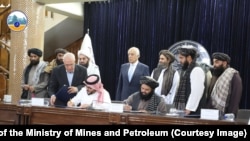
Zalmay Khalilzad, US special envoy to Afghanistan 2018-21, was in Kabul on September 7 for the signing of an agreement between a Saudi energy group and the Taliban authorities that could lead to billions of dollars of investment.
During his visit, he also met with the Taliban's foreign minister, Amir Khan Muttaqi.
The United States does not recognize the Taliban as the legitimate government of Afghanistan, and Washington has distanced itself from Khalilzad's trip.
"Khalilzad is not a US government employee. As such, he does not represent the United States government," a State Department spokesman told RFE/RL.
"The Taliban remain designated as a Specially Designated Global Terrorist (SDGT) group. As such, we urge private companies interested in conducting business in Afghanistan to exercise extreme caution and ensure their transactions comply with applicable US law and regulation," the spokesman added.
Khalilzad's presence has raised questions about his role in the deal and speculation about a possible back channel in communications with the Taliban. He negotiated and signed the agreement with the Taliban in 2020 under which international forces would withdraw from Afghanistan, an operation that was completed the following year.
He has traveled to Taliban-ruled Afghanistan several times and held previous meetings with Taliban officials. He notably was present in Kabul at the release of 64-year-old American citizen Dennis Coyle from a Taliban prison on April 4 this year.
"Experience has shown that people who have worked at high levels of the American government in recent decades can sometimes influence the country's foreign policy and relations even after retiring," Mir Abdul Wahid Sadat, head of the Afghan Lawyers Association, told RFE/RL's Radio Azadi.
Tariq Farhadi, an Afghan political analyst based in Europe, said that even though Khalilzad's visit appeared private, his influence and contacts in the United States could be important to the Taliban.
The group is seeking both foreign investment and international legitimacy.
"He has about 40 years' experience in American politics and knows many people in the government and Congress," Farhadi told RFE/RL.
"History does not stand still, and it is not easy to predict the future course of US policy," he added, pointing to how Syrian President Ahmed al-Sharaa has gone from being hunted as a terrorist to being feted at the White House.
Khalilzad has posted news reports on the energy deal in which he says it is an "indication that Afghanistan is ready for business" and a significant development for the country.
It came days after the Financial Times reported that the Taliban had offered the Trump administration access to Afghan mineral resources in return for sanctions relief and release of frozen assets.
The deal brings together Saudi Arabia's Delta Energy Group and Afghanistan's Ministry of Mines and Petroleum for oil and gas exploration across some 23,000 square kilometers of territory in western Afghanistan. It includes a proposed 700-kilometer gas pipeline.
"[Khalilzad] is currently working as a consultant on the Delta project…and there is also a possibility that he will partner with a company in this project," said Farhadi.
His possible business role has raised some eyebrows.
Michael Rubin, director of policy analysis at the Middle East Forum, noted that Khalilzad was in the White House situation room on September 11, 2001, yet now "appears to profit" from the deal.
"Khalilzad's tone-deaf ceremony in the Taliban's capital as Americans mourn…demands congressional hearings if not greater investigation," he wrote.
Afghan war veteran Will Selber, writing for the Foundation for Defense of Democracies, also criticized his presence.
"Whatever his intentions, Khalilzad gave the Taliban something it has sought since returning to power: an appearance of American validation," he wrote.



