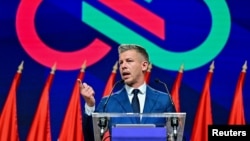
Just hours after election results showed opposition leader Peter Magyar had scored a landslide victory to end the rule of Viktor Orban and his right-wing Fidesz party, the man slated to become Hungary's next prime minister said there's "no time to waste" in forming a new government.
For Brussels, his words couldn't have come fast enough.
After 16 years of Orban's government sparring with the bloc over various issues -- often related to Ukraine and sanctions on Russia -- the hope in Brussels now is that Budapest will be more cooperative.
"Our country has no time to waste. Hungary is in trouble in every respect. It has been plundered, looted, betrayed, indebted, and ruined," Magyar told a news conference on April 13, the day after his center-right Tizsa party won a two-thirds majority in the 199-seat parliament amid a record voter turnout.
By law, Hungary's president must convene a new parliament within 30 days of an election. Lawmakers then elect a new prime minister who then nominates a cabinet.
Many hope that the stumbling blocks Orban erected will be removed, though there is also concern that Magyar, once a staunch loyalist of the defeated prime minister who split over anti-corruption concerns, won’t play ball all the time.
The main thing Magyar will try to focus on in Brussels is, after all, not foreign policy. It's to unblock some 18 billion euros ($21 billion) that the EU has frozen in recent years due to what is perceived as democratic backsliding in the country during the Orban years.
The reconstruction of the Hungarian judiciary will be front and center here with Magyar attempting to copy Poland. In an effort to unlock EU funding since coming back to power in late 2023, Warsaw's centrist government has been working to reverse controversial changes to the courts and public administration introduced by its populist predecessors.
"We will start working with the government as soon as possible," European Commission President Ursula von der Leyen said, "to make swift and overdue progress to the benefit of the Hungarian people."
"There's much work to be done as Hungary is coming back to the European path."
A Convenient Scapegoat?
However, there is a prevailing fear in Brussels corridors that the Orban government's vetoes were often a convenient scapegoat for the lack of action.
Slovak premier, and close Orban ally, Robert Fico has already indicated openly he may continue to veto many initiatives, but EU officials, speaking to RFE/RL on condition of anonymity, admit there were sometimes other member states hiding quietly behind Budapest.
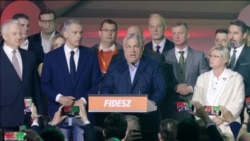

The first test might very well be the 90-billion-euro loan to Ukraine that EU leaders, including Orban, agreed to in December 2025.
The cash, which is meant to cover a large part of Kyiv's needs for this and next year, was subsequently vetoed by Hungary, as Budapest blamed Ukraine for not doing enough to repair the Soviet-era Druzhba pipeline carrying oil to Central Europe that Kyiv says was damaged in a Russian drone strike.
The EU has promised the money will still come in April after pledging financial aid to fix the pipeline and dispatching a team to Ukraine. Ukrainian President Volodymyr Zelenskyy recently noted that it will be repaired "in the spring."
But until Russian oil flows back to Hungary, neither Magyar nor Orban, who still will be in charge for a few more weeks, will green-light that aid package for Kyiv.
While EU officials RFE/RL has spoken to think Magyar will approve the loan, they also point to the fact that his Tisza party members in the European Parliament voted against the proposal in a vote in the chamber earlier this year.
As Clotilde Warin, an associate research assistant at the Institut Jacques Delors in Paris, puts it, "Hungary will no longer use systematic vetoes, but all its positions will not change fundamentally."
Then there is the fact that during the election campaign Magyar talked about phasing out Russia energy in 2035, not next year as Brussels has envisioned.
That move is done by qualified majority, however, meaning he doesn't have a veto. Even so, with the energy crisis stemming from the blockage of the Strait of Hormuz threatening Europe's economies, Magyar might be far from the only one wanting to hold off on swiftly cutting reliance on cheaper Russian energy imports.
The issue of high energy costs will also water down the EU's 20th sanctions package on Russia.
Initially scheduled to be approved ahead of the fourth anniversary of the Russia's full-scale invasion of Ukraine in February 2022, Hungary has kept vetoing it.
But it isn't alone here.
The centerpiece of the proposal was a maritime services ban related to Russian petroleum products that would prohibit EU-based companies from providing services to any vessel transporting these products from Russian ports.
Amid spiraling energy costs in the bloc, several southern member states have issues with this. So, while it may very well get approved with a new Hungarian government in place, it is far from certain that it will pack any punches.
Future Russia Sanctions?
More interestingly, potential future Russia sanctions packages are an area where a Magyar government will be truly tested.
Do they, for example, want to reverse some Orban-era vetoes, such as blacklisting the Russian Patriarch Kirill or people heading various Russian sports organizations and federations, which has been a Hungarian no-go thus far?
Also, expect new attempts to impose sanctions on violent Israeli settlers in the West Bank, vetoed by Budapest since 2024, and an attempt from 2025 to slap asset freezes and visa bans on leading figures in the ruling Georgian Dream party in Georgia, also shot down by the Hungarians. There are others, however, who might block the latter effort, notably the Czech Republic, Italy, and Slovakia.
Then there is Hungary's complicated relationship with Ukraine.
While Magyar has clearly indicated he will distance himself from the close relationship the Orban government had with Moscow, he has hardly been complementary when it comes to Kyiv so far.
When Orban and Zelenskyy, who welcomed Magyar's victory, verbally sparred during the election campaign, he took the side of his compatriot stating that "no foreign leader can threaten any Hungarian."
A large part of the Hungarian population is still deeply skeptical of Ukraine, with polls showing a majority of respondents being against both Ukrainian EU membership and more financial aid being sent to the country.
Magyar is well aware of these sentiments.
In his first press conference after the election, Magyar said it's clear Ukraine "is a victim of this war" and that he will meet with Zelenskyy and they will "establish relations."
But he was quick to add that Hungary seeks to establish "allied, and if possible, friendly relations with all neighboring countries, including through Hungarian minorities living abroad."
"This applies to Ukraine, Serbia, and all other countries," he said.
Lethal Weapons
It will therefore be interesting to see how he approaches some military proposals stuck in Brussels, largely due to Fidesz, such as a nearly three-year blockage of 6.6 billion euros' ($7.7 billion) worth of lethal aid from the bloc's European Peace Facility slated for Kyiv, the possibility of sharing satellite images with Ukraine from the EU's Satellite Center, and revising the mandates of the two EU missions to Ukraine to include them in future European security guarantees for Kyiv.
Magyar is, however, expected to allow Ukraine (and Moldova) to at least start accession talks as early as this year, something Orban's government has vetoed for the last couple of years.
But expect him to use the term "merits-based" when speaking of future EU enlargement, which is Brussels-lingo used by most EU capitals to mean "you will get in when we decide so -- and we haven't decided yet."