


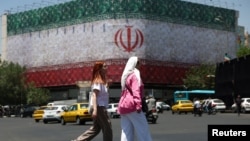
Qatari negotiators flew to Tehran early on June 14 in a bid to finalize an agreement between the United States and Iran to end the monthslong conflict, according to multiple news outlets, but renewed Israeli attacks on Iran's ally Hezbollah in Lebanon earlier the same day could potentially delay the signature.
The news that senior Qatari Foreign Ministry officials had been dispatched to the Iranian capital comes a day after US President Donald Trump posted on social media that a deal with Iran would be signed on June 14 -- his 80th birthday.
Writing on Truth Social on June 13, the American president noted that "The Deal is scheduled to get signed tomorrow, and immediately after it is signed, the Hormuz Strait is OPEN TO ALL," adding that "A WALL TO NO NUCLEAR WEAPON" for Iran.

Hopes for an imminent deal were further boosted when Pakistani Prime Minister Shehbaz Sharifi added that Islamabad was ready to prepare for an "electronic signing" to be followed by technical-level talks in the coming week.
Both Qatar and Pakistan have been mediating between the two sides in a bid to end the war that began with US-Israeli strikes on Iran on February 28.
Iran Plays Down Chances Of Signing Deal
However, Iran's Foreign Ministry has played down the chances of an agreement being signed on June 14 but added it could happen "in the coming days."
Some details about the content of a memorandum of understanding between the Washington and Tehran have emerged, with Reuters quoting a "senior Iranian official" as saying the text stipulates that Tehran would immediately open the Strait of Hormuz in exchange for the United States lifting its naval blockade of Iranian ports.

Washington would also release $25 billion of Iran's frozen assets, including via direct cash transfers, impose no new sanctions until a final deal is reached, and waive oil sanctions that it has imposed on Tehran.
On the nuclear issue, the text reportedly includes Iran agreeing to neither produce nor purchase nuclear weapons, enrich no new uranium until a final deal is concluded, and dilute its highly enriched uranium stockpile inside the country -- although an exact mechanism for that still needs to be worked out.
A final deal would then be discussed within the 60 days of agreement by the two sides.
Israel, Hezbollah Exchange Strikes
Any agreement could, be in jeopardy after Israel and Lebanon's Hezbollah exchanged fire again over the weekend. Hezbollah is both a militant group and political party that controls much of southern Lebanon. It is considered a terrorist organization by the United States, although the European Union has only blacklisted its armed wing.
Iran's chief negotiator and speaker of Parliament Mohammad Baqer Qalibaf lashed out against the United States in a post on X after Israel launched new attacks on Hezbollah targets in Dahiyeh, a southern suburb of Beirut earlier on June 14.
Qalibaf said Israel's "incursion into Dahiyeh has once again shown that America either lacks the will to fulfill its commitments or the ability to do so. By giving the green light to the regime, you cannot gain concessions. The game of bad cop and good cop is outdated. If you lack the will and ability to fulfill your commitments, speaking of continuing the path is not possible."
Israel said it had attacked the southern parts of Lebanon after Hezbollah launched three projectiles toward communities in northern Israel.
"Israel will not tolerate firing at its territory," Israeli Prime Minister Benjamin Netanyahu and Defense Minister Israel Katz said in a statement issued on June 14.
Mohammad Jafar Assadi, deputy commander of Iran's top joint military command, Khatam al-Anbiya Central Headquarters, also told Iranian state media that the Israeli attacks "won't go unanswered."
In a Truth Social post later in the day, Trump said the attack on Beirut "should not have happened, particularly on a special day when we are so close to a Peace Deal with Iran."
While highlighting that Israel has "the right to defend itself against threats," the US president questioned the scale of the attack to which Israel "was responding."
"Very small and meaningless, nobody was hurt, injured, or killed, and should not disrupt this important process," Trump wrote, warning against further attacks by both Israel and Lebanon.