


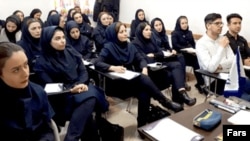
For Iranians hoping to study or work abroad, the first hurdle is now simply finding a seat at an English-language exam.
International language tests have all but vanished from Iran over the past year.
Applicants are paying to travel to neighboring countries, while those who cannot afford the trip are stuck. Afghans living in Iran face even steeper obstacles.
The squeeze began with the IELTS English-proficiency test in late December 2025, when IDP Education, the Australian firm that jointly administers the test with the British Council, said it would stop offering the exam in Iran, citing financial and regulatory problems.
Then in late August, Washington suspended a sanctions license that had allowed American educational providers to serve people in Iran since 2014, cutting off the TOEFL and GRE exams, both run by the US-based Educational Testing Service (ETS). Access to Duolingo's English test has also been restricted.
The ETS says it cannot process registrations or payments for anyone living in Iran, even if they plan to take the test in another country.
Iranians affected by the restrictions told RFE/RL’s Radio Farda that the measures have upended their education and emigration plans.
Locked Out Abroad As Well
Under British Council rules, Iran residents cannot take its IELTS exam even in neighboring Turkey or Armenia. Only people with legal residency outside Iran are eligible.
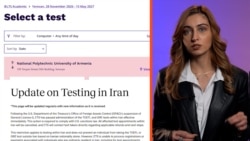


A master's student in dramatic literature, who had studied English full time for two years ahead of a planned move to Canada, chose Armenia after the IELTS was halted at home. Her name, like those of other interviewees, has been withheld for security reasons.
"Of the two centers I could choose from in Armenia, the British Council one wouldn't let me register or take the exam, so I had only one option," she told Radio Farda.
In October, on top of roughly $300 in exam fees, she paid another $300 for travel and a tour package -- bringing the total to about $600, equivalent to more than six months of the average wage in Iran. Visa rules and travel costs, she said, dictated where she could go.
Debts, War, And Blackouts
A source familiar with IELTS operations in Iran told Radio Farda that the trouble started in 2025, when IDP required test centers to pay from within their own country. Banking sanctions made transfers from Iran impossible, and the centers' mounting debts to IDP led to cuts in registration.
The 12-day war with Israel in June 2025, state-imposed Internet shutdowns, and the imposition of UN "snapback" sanctions in September after Britain, France, and Germany accused Iran of violating the 2015 nuclear deal made things worse. After the halt was announced, only candidates already registered could sit the exam through March.
But a nationwide Internet blackout in January slowed connections so badly that capacity at one point fell to three test takers a day, the source said. The US-Israeli war against Iran that began in late February and further outages disrupted the remaining sessions.
"Canceled exams, Internet cuts, and closed embassies meant many candidates missed university admissions and the start of their semesters," the source said.
A computer-science graduate paid around $265 for a four-day exam tour to an Arab country, flying out on February 26.
"I traveled afraid the war would start again, that flights would be restricted and I'd miss the exam," he said. "The result was decisive for my immigration case."
He took the test the next day. A day later, as he prepared to fly home, the war broke out, and flights were grounded. He never went back and has since emigrated to Canada.
Schools Struggle, Tour Operators Cash In
Iran's once-thriving market for exam preparation is now in a slump, as rising living costs put classes out of reach for many.
"With the halt of language exams, the schools' finances took a serious hit," the founder of a school specializing in IELTS and TOEFL courses told Radio Farda. The number of private and semiprivate classes he offers has fallen by about 80 percent.
A laboratory-sciences graduate who worked part-time while finishing her thesis said she could not save enough to travel and has shelved her plans to emigrate.
Travel agencies, meanwhile, now sell "IELTS tours" to Doha, Istanbul, Ankara, Van in eastern Turkey, Dubai, Yerevan, and Tbilisi, bundling the exam fee, flights, hotels, transport, and visa services.
But barriers to language testing extend beyond Iran's borders, affecting Iranians already living abroad.
Duolingo does not accept test takers whose only identity documents were issued by Iran. Its support team confirmed to Radio Farda that "the use of an Iranian passport to take the test is not permitted," even for those with foreign residency or a work or study permit.
Immigration lawyers are now steering clients toward alternative tests.
Not Just English
While Iranians’ access to English-language tests has been limited due to US sanctions, Iranian authorities have made matters worse by curbing access to other languages.

In September, not long after the new US sanctions, the French Language Center in Tehran, run by the French Embassy's cultural section, was shut down, according to the judiciary's Mizan news agency. Officials accused it of using its status as a language school to identify Iranian elites and help them leave the country.
France's Foreign Ministry called the move “unjustifiable,” telling Euronews that it was a "unilateral escalation" of pressure on France's cultural presence in Iran. Authorities had already shut the German language center in Tehran in 2024.
Unlike Iranians, Afghans living in Iran need visas in advance to enter Turkey and Armenia, putting the exams even further out of reach.
A 23-year-old Afghan woman who hoped to study abroad said she has begun talks with a smuggler to get her into Pakistan to take a language test there, despite the risks.
"To escape from here," she said, "what other choice do I have?"