





China Urges Restraint In Middle East As War Fallout Damages Fuel, AI Sectors
- By Colin Hood

Beijing has called on all sides of the war in Iran to “avoid escalating the conflict” amid fresh strikes as China's crude oil imports hit a 10-year low and helium shortages threaten its AI chip manufacturing.
The United States and Iran have escalated strikes as Washington prepares to reinstate a naval blockade against all maritime traffic through the Strait of Hormuz on July 14.
Chinese Foreign Ministry spokesperson Lin Jian told reporters on July 14 that China will “make unremitting efforts to cool and stabilize” the situation in the Middle East.
During an emergency briefing of the UN Security Council on July 13, China’s deputy ambassador to the UN, Sun Lei, called on both Washington and Tehran to “resume follow-up negotiations” in an attempt to end hostilities.
Sun added that “resuming safe and free passage in the strait at an early date serves the interests of all sides."
China has maintained a consistent line of de-escalation since US and Israeli strikes hit Iran on February 28.
Since then, Beijing has played a moderating role largely behind the scenes, working closely with Pakistan, a close ally, as well as Persian Gulf states.
The disruption to shipping through the Strait of Hormuz has taken its toll on China's economy.
Before the war, around 20 percent of global oil trade passed through the chokepoint, and Beijing purchased 80 percent of Iranian shipped oil.
Beijing's Commerce Ministry scrambled to mitigate shortages by banning helium exports on July 10 as strikes intensified. Qatar, which provides China with more than half of its supply of helium, has seen exports interrupted since the war began.
Imports of crude oil have slumped 41.3 percent, their lowest point in a decade.
Fuel export restrictions, in operation from March to protect domestic supply, had damaged local industry and put pressure on Asian markets, where China is a major supplier of refined oil products.
Reuters reported on July 8 that China had lifted export restrictions for the rest of July to normalize supply lines. Hours later, US President Donald Trump told reporters at the NATO summit in Ankara that the peace agreement with Iran was “over” following renewed strikes.
We are now closing the live blog for the day. We'll be back at 7:30 a.m. Central European time to cover the latest events across the Middle East.
Iran Raising Gasoline Prices For Heavy Users As Sanctions, Blockade Bite
The Iranian government said it is raising fuel prices for heavier consumers -- those using more than 110 liters a month -- as US sanctions and a blockade of the country's ports continue to cripple the domestic economy.
Government spokeswoman Fatemeh Mohajerani said the price of the first and second quotas, which allow up to 110 liters, will remain unchanged.
However, the price of the third quota will be doubled to 100,000 Iranian rials per liter -- about 4.5 US cents based on free-market rates.

The new rates will take effect on September 8, officials said.
Other motorists will still be able to purchase 60 liters at 15,000 rials a liter and an additional 50 liters at 30,000 rials a liter, Mohajerani said.
Iranian gasoline prices are among the lowest in the world. A wider increase in prices was discussed, but the authorities held off, likely worried it could lead to new street protests.
Iran is a major producer of oil and has for years heavily subsidized prices, meaning that any changes can be politically sensitive. In 2019, widespread protests erupted after a previous price hike.
With reporting by RFE/RL's Radio Farda and Reuters
Qalibaf Threatens 'Heavier' Response To US Attacks
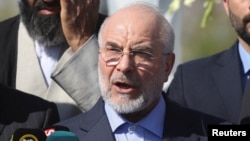
Iranian Parliament Speaker Mohammad Baqer Qalibaf has warned that Iran will respond more forcefully to any further attacks on its interests and security, saying the era of “proportionate responses” was over.
Speaking during an open parliamentary session on September 6, Qalibaf said: “Any aggression against Iran’s interests and security will receive a faster, heavier and more painful response.”
Qalibaf spoke a day after the US military said it had targeted and destroyed three Iranian oil tankers near the islands of Khark and Jask as well as in the Gulf of Oman.
The US military's Central Command (CENTCOM) said the strikes came in response to ballistic missile attacks by the Islamic Revolutionary Guards Corps (IRGC) against two US warships, which caused no American casualties.
CENTCOM commander Brad Cooper warned that continued Iranian attacks on US vessels would be met with greater economic costs and the destruction of Iranian oil tankers.
Iran’s Foreign Ministry condemned the US strikes as “illegal and aggressive,” while a spokesman for the Khatam al-Anbiya Central Headquarters -- Iran’s military central command -- warned that attacks on the US military could intensify and expand if the naval blockade continued.
Hormuz Oil Exports Recovering But Remain Below Pre-War Levels, Shipping Tracker Says
- By Kian Sharifi
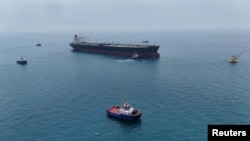
Middle East crude oil exports recovered significantly in August but remained well below pre-disruption levels, according to TankerTrackers, a maritime intelligence service.
Exports from Saudi Arabia, Iraq, Iran, Kuwait, Oman, the United Arab Emirates, and Qatar were down 39 percent in August compared with a January-February baseline of 18.5 million barrels per day, before Iran effectively closed the Strait of Hormuz in response to the war launched by the United States and Israel.
The shortfall from that baseline has narrowed to 7.2 million barrels per day, from a peak deficit of 12.4 million in May, when exports were down 67 percent.
TankerTrackers said exports from most countries could recover further in the coming months.
Iran, however, is likely to remain a major exception.
Iran’s baseline exports stood at 1.68 million barrels per day, but TankerTrackers estimates they have now fallen to zero. The company said Iranian exports could remain at that level “for the foreseeable future,” depending on the outcome of any agreement.
Iran's Revolutionary Guards Claim Attack On Unmanned US Vessel In Hormuz Strait
Iran’s Islamic Revolutionary Guard Corps (IRGC) claimed on September 6 that it had targeted an unmanned US military vessel which was attempting to enter what it called the “protected area of the Strait of Hormuz.”
The Revolutionary Guards made the claim in a statement carried by Iran’s state broadcaster but provided no details on the extent of damage to the vessel or where exactly it was struck.
The US military's Central Command (CENTCOM) has yet to comment.
The claim comes a day after US Defense Secretary Pete Hegseth warned Tehran that the United States “will destroy” Iranian oil tankers if Iran attacks US ships.
CENTCOM said its forces struck three oil tankers belonging to the IRGC on September 5 after Iran fired missiles at US Navy vessels.
At Least 10 Killed In Fuel Tanker Accident In Western Iran
At least 10 people were killed when a fuel tanker exploded on a highway in western Iran as a result of a traffic accident, state media reported on September 5.
The tanker was traveling on the Hamedan-Sanandaj Highway and was involved in an accident due to a technical fault in the braking system, state media reported, citing the governor of Sanandaj.
Six people were also injured in the incident, the governor said.
Authorities said they had launched an investigation into the accident, which highlights concerns about road safety and the transportation of materials in the mountainous region of western Iran amid the US war with Iran.
There was no immediate information as to whether the incident was directly related to the war.
With reporting by Reuters
Iranian Currency Sinks Further As Economic Pressure Mounts

Iran's currency fell further on the open market on September 5, with the US dollar reaching 228,000 tomans -- equivalent to 2.28 million rials -- as the country grapples with soaring inflation and mounting economic pressure from US sanctions and restrictions on its oil exports.
The latest slide came just a day after Iranian Central Bank Governor Abdolnasser Hemmati denied that the country was facing a serious shortage of foreign currency for imports. He attributed much of the pressure on the rial to increased “precautionary” and speculative demand as well as capital flight.
The dollar crossed the 200,000-toman mark in late August and has continued to rise despite attempts by Iranian officials to reassure markets.
Hemmati said earlier this week that Iran had “enough” foreign currency and that the central bank was prepared to inject up to $2 billion into the market if necessary. But his comments have failed to halt the continued rise in exchange rates.
The Iranian currency's decline comes amid mounting pressure on Iran’s economy from years of US sanctions, the war, and a US naval blockade that has sharply curtailed Iranian oil exports, a major source of foreign currency.
The currency crisis threatens to further drive up the cost of everyday goods. Iran’s official statistics agency put year-on-year inflation in August -- before the latest fall in the rial -- at 89 percent, while food and beverage prices had risen by more than 127 percent over the previous year.
A group of Iranian lawmakers warned in a letter to the heads of the country’s three branches of government on August 31 that persistent volatility in currency, gold, and coin markets had “increased uncertainty among the public and economic actors.”
The rial is Iran’s official currency, but Iranians commonly quote prices in tomans, with one toman equal to 10 rials.
Report: More Than 60 Killed As Fighting Escalates In Yemen
Fighting between Yemen’s Saudi-backed government forces and Iran-backed Houthi rebels killed more than 60 people, including civilians, on September 5, AFP reported, citing medical and military sources.
The renewed clashes in southwestern Yemen came a day after 129 people were killed in some of the deadliest fighting in years, according to an AFP tally.
Three Yemeni military sources said 26 government troops were killed in several hours of fighting, while Houthi medical and military sources reported 31 rebel fighters dead. A medical source in government-held Taiz said a missile strike killed six civilians traveling by bus and wounded seven others. A government official blamed the Houthis for the strike.
The Houthis have seized positions near Taiz as they seek to cut off the government-held port of Mokha and advance toward areas bordering the strategic Bab al-Mandab strait. Saudi Arabia carried out three air strikes on recently captured Houthi positions, a military official told AFP.

The renewed fighting follows the collapse in July of a fragile truce that had largely held since 2022.
Yemen descended into civil war in 2014 when the Houthis seized the capital, Sanaa, ousting the internationally recognized, Saudi-backed government.
The latest escalation began in July after the Houthis welcomed an Iranian plane in Sanaa, setting off a spate of attacks. They later announced a maritime blockade of Saudi Arabia and launched attacks targeting Saudi ships, airports, and oil facilities.
With reporting by AFP
US Forces Blast 3 Iranian Oil Tankers In Response To IRGC Missile Launch
US forces destroyed three oil tankers belonging to Iran's Islamic Revolutionary Guards Corps (IRGC) after the hard-line military entity fired missiles at US Navy vessels, the Pentagon said on September 5.
A statement by US Central Command (CENTCOM) said its forces struck the three crude oil carriers after the IRGC launched ballistic missiles toward two US warships patrolling regional waters.
CENTCOM said that a US aircraft carrier and guided-missile destroyer successfully evaded "multiple unprovoked" IRGC attacks and that no American personnel were injured.
The IRGC later said it had retaliated for the US strikes, claiming they had attacked several vessels, including some linked to the United States, in the Strait of Hormuz. The US did not immediately comment on the claim and details were scarce.
In its statement, CENTCOM did not specify what US assets were used in the strike on the IRGC vessels but said its forces "permanently disabled" the tankers in three locations -- off the coast of Kharg Island, near the port city of Jask, and in the Gulf of Oman.
The statement said the vessel hit in the Gulf of Oman, the unladen crude oil carrier M/T Kylo, was struck in multiple critical locations to render it inoperable after the crew was directed to abandon ship.
A CENTCOM video posted online showed explosions and fireballs after what it said were the strikes on the three Iranian vessels.
“Let the message to the IRGC be clear: If you shoot at two of our ships, we will impose an even higher economic cost -- taking out three of yours,” CENTCOM commander Admiral Brad Cooper said in the statement.
Earlier, Iranian media had reported explosions near Kharg Island, the country’s main oil export hub in the Persian Gulf.
The Tasnim news agency, which is closely affiliated with the IRGC, reported that an Iranian tanker had been struck by four US projectiles in the Kharg Island anchorage area, while other Iranian outlets also reported a strike on a tanker.
The activity comes amid military exchanges that resumed after US strikes on Iran on August 30, prompting retaliatory Iranian attacks on US targets in the Middle East.
This blog entry has been updated.
US State Department Approves $5B Sale Of Bombs, Equipment To Saudis
The US State Department announced the approval of a $5 billion sale of bombs, guidance kits, and other hardware to Persian Gulf ally Saudi Arabia, which has often been the target of attacks by Iran and Tehran-allied Houthi rebels during the US-Israeli war with Iran.
"The proposed sale will improve Saudi Arabia's airborne defense capability to counter current and future regional threats, strengthen its homeland defense, and improve interoperability with systems operated by US forces and other Gulf region partners," the State Department said in a statement.
It will also "support the foreign policy goals and national security objectives of the United States by improving the security of a Major non-NATO Ally," the department said.
The State Department said it has notified the Congress of the proposed sale, which still must be approved by US lawmakers. Some supporters of Israel could oppose the deal, seeing it as strengthening a potential Arab enemy of Tel Aviv.