





Iran Claims US Accepted Some Terms For Talks, But Calls Response 'Inadequate'
The secretary of Iran's Supreme National Security Council (SNSC) claimed the United States has agreed to some of Iran's conditions to restart negotiations aimed at ending the more than seven-month war.
In a late-night post on X on October 11, Mohsen Rezaei wrote on X that Iran still finds the US response insufficient to resume diplomacy.
"The US has agreed to some of Iran's seven conditions, but we consider its response INADEQUATE," Rezaei wrote in English. "Iranian diplomacy has changed and there will be no return to the status quo ante."
RFE/RL has reached out to the White House for comment.
Rezaei last month publicly outlined five of the seven conditions, which include releasing Iran's frozen assets, ending the war on all fronts, halting interference in Iranian affairs, stopping attacks on Iranian territory, and lifting the US naval blockade.
President Donald Trump said last week that the United States will not launch further military strikes against Iran prior to the November midterm elections, though he insisted Iran has yet to offer the right terms to finalize a broader deal.
Saudi Allies Issue Stark Warning Against Houthis
Terming the latest Houthi attacks on Saudi Arabia that claimed several lives and damaged key infrastructure a "dangerous escalation," Saudi allies Pakistan, Turkey, and Egypt said such attacks "cannot be justified or accepted under any pretext."
In a joint statement on October 11, the R4 Group reaffirmed its support for Riyadh's "all legitimate measures and steps it takes to counter these attacks, deter the source of their threat and prevent their recurrence."
"The Group holds the Houthi militia fully accountable for the results of these attacks and any repercussions that come with it that threaten regional and international peace and security," the statement said.
Saudi authorities said one person was killed and 11 others injured in a fresh attack on Riyadh's international airport early on October 12.
Key Saudi infrastructure has been under missile attacks from the Iran-aligned Houthis over the past week. On October 10, a strike on King Khalid International Airport killed 13 people and wounded more than 300.
The latest flare-up in the conflict started following the September capture of the Red Sea port city of Mocha and other area around the Bab-el-Mandeb Strait by the Houthi rebels. The waterway is a key route for Saudi oil exports to Asia.
Earlier this month, Saudi defense forces claimed the retaking control of the strait from the Houthis.
The Houthis, who control much of northern Yemen, including the capital, Sanaa, have fought forces backed by a Saudi-led coalition since 2015, although large-scale fighting eased following a UN-brokered truce in 2022.
US President Donald Trump on October 10 said the United States "may" join Saudi strikes on the Houthis in the conflict, although he said no decisions have been made on the matter.
2 Indian Sailors Missing After Oil Tankers Attacked In Strait Of Hormuz
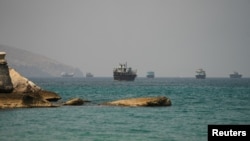
India has condemned attacks on two commercial vessels carrying Indian crew members in the Strait of Hormuz, after two sailors went missing following a drone strike on an oil tanker.
In a statement issued on October 11, India's Foreign Affairs Ministry condemned the attacks and called for an immediate reduction in tensions and a resolution of regional conflicts through dialogue and diplomacy.
The ministry said the MT Petro Dolphin, which was carrying 11 Indian seafarers, had been struck by a drone. Two crew members were reported missing, and search-and-rescue operations were under way.
The second vessel, the MT Valthera, which flies the Marshall Islands flag, was struck by an unidentified projectile, causing a fire onboard. All 11 Indian sailors aboard the tanker were reported safe.
India called for attacks on commercial vessels, seafarers, and civilian infrastructure to cease, emphasizing the importance of protecting maritime safety and international navigation.
Separately, the United Kingdom Maritime Trade Operations (UKMTO) reported an incident involving a tanker near the port of Sohar in Oman on October 11. Following confirmation that an unmanned surface vessel had struck the tanker, UKMTO reclassified the incident as an attack. At the time of its report, the crew's status, the extent of damage and the environmental impact remained unknown.
Iran's Islamic Revolutionary Guards Corps (IRGC) Navy also claimed that a crude-oil supertanker had struck a sea mine while attempting to leave the Strait of Hormuz through a route it described as unauthorized. According to the IRGC's statement, the vessel had switched off its navigation and positioning systems before the incident.
The IRGC Navy warned that vessels passing through the strait with their navigation and identification systems switched off would be regarded as hostile and would face a severe response.
Latest Attack By Iran-Aligned Houthi Rebels On Saudi Airport Kills 1, Injures 11
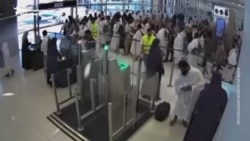
Saudi authorities said one person was killed and 11 others injured in a new attack on Riyadh's international airport, a day after an strike claimed by Iran-allied Houthi rebels killed 13 people and wounded more than 300 at the site.
Saudi-led coalition forces said an unidentified projectile had targeted King Khalid International Airport's Terminal 4 on October 11, igniting a blaze.
Coalition forces early on October 12 said Saudi air defenses had intercepted a cruise missile near the same airport.

The coalition also said its forces had intercepted and destroyed a drone in Saudi Arabia's Eastern Province and that a ballistic missile launched toward Khamis Mushait had been intercepted.
The Yemen-based Houthi rebels have been intensifying drone and missile attacks on Saudi territory in recent months, with an apparent focus on Saudi airports. The rebels are also fighting against the internationally recognized, Saudi-backed Yemeni government.
Separately, the US Federal Aviation Administration urged US airlines to exercise caution when flying to or over Saudi Arabia amid increased safety threats linked to military activities and the potential for navigational system interference.
The Saudi-Houthi conflict is a spillover from the US-Israeli war with Iran that began at the end of February.
US President Donald Trump on October 10 said the United States "may" join Saudi strikes on the Houthis in the conflict, although he said no decisions have been made on the matter.
With reporting by Reuters and AFP
US Authorities Urge Airlines Of Potential Risks Over Saudi Airspace
The US Federal Aviation Administration (FAA) urged US airlines to exercise caution when flying to or over Saudi Arabia amid increased safety threats linked to military activities and the potential for navigational system interference.
The FAA Notice to Airmen, which lasts until December 10, came after attacks on October 10 and 11 on Riyadh's international airport. The October 10 attack killed 13 people and injured more than 300 and was blamed on missiles fired by Iran-allied Houthi rebels based in Yemen.
"Threats could pose a potential risk to aircraft at all altitudes, including overflight, the arrival, and departure phases of flight," the FAA said.
Top Iranian, Saudi Diplomats Talk by Phone As Violence Escalates
The top diplomats of Iran and Saudi Arabia have spoken by phone to discuss the latest escalations in the region in their first publicly reported contact since the Tehran-aligned Houthi rebels intensified attacks against the kingdom.
The talks were reported by Saudi state media and by Iranian Foreign Minister Abbas Araqchi on his Telegram channel.
Araqchi said Tehran is ready to provide any assistance to facilitate dialogue between Saudi Arabia and Yemen. Sunni-Muslim Saudi Arabia and Shi'a-led Iran are long-time bitter rivals for influence in the Middle East.
The Yemen-based Houthi rebel group has been launching deadly strikes against Saudi sites, most recently on the international airport in the capital, Riyadh.
The Houthi movement has warned airlines, shipping companies, aviation personnel, and travelers against using Saudi Arabia’s airports and airspace, describing them as potential targets and a “theater of operations” for its forces.
The warning follows a missile attack on Riyadh’s King Khalid International Airport on October 10 that killed 13 people and injured 309, according to Saudi authorities and another strike on October 11 that killed one person and injured 11.
Saudi civil aviation authorities reported reported another attack on Dammam airport in the east of the country.
With reporting by Reuters
UN, European And Regional Leaders Condemn Deadly Riyadh Airport Attack
The United Nations, European leaders, and governments across the Middle East and beyond have condemned the October 10 attack on Riyadh's King Khalid International Airport, which killed 12 people and injured more than 300.
UN Secretary-General António Guterres said he was “deeply shocked” by the incident and condemned it, saying “attacks on civilians and civilian infrastructure are a violation of international law.” UN Yemen envoy Hans Grundberg described the incident as a “grave escalation.”
European Commission President Ursula von der Leyen condemned the actions of “Iran’s proxies,” warning that they were pushing the region into a “spiral of violence.”
GermanForeign Minister Johann Wadephul described the attack as “a terrorist act against Saudi Arabia and civil aviation,” while British Defense Secretary Wes Streeting called it a “dangerous escalation” and condemned the targeting of civilians.
“Condemnations also came from Pakistan, Turkey, the United Arab Emirates, and Qatar.
Pakistan’s Prime Minister Shehbaz Sharif called it a “heinous attack" and a “flagrant violation of international law.” Turkey condemned the strike “in the strongest terms.” The United Arab Emirates denounced it as a “flagrant violation” of Saudi sovereignty, while Qatar described it as "a direct threat to regional security, the safety of civilians, civilian infrastructure, and air navigation."
The Gulf Cooperation Council and the Organization of Islamic Cooperation also expressed solidarity with Saudi Arabia.
The condemnations came as further explosions were reported in the Saudi capital on October 11. Two blasts were heard in Riyadh, according to AFP journalists and three residents. Separately, the Saudi-led coalition said air defenses had intercepted a missile near Riyadh airport.
With reporting by Reuters and AFP
Houthis Threaten More Saudi Airport Strikes As Riyadh Flights Canceled
Yemen’s Iran-aligned Houthi movement has again warned airlines, shipping companies, aviation personnel, and travelers against using Saudi Arabia’s airports and airspace, describing them as potential targets and a “theatre of operations” for its forces.
The warning follows a missile attack on Riyadh’s King Khalid International Airport on October 10 that killed 12 people and injured 309, according to Saudi authorities.

The Houthis had previously warned airlines to avoid Saudi airspace on October 5 and repeated the threat on October 8, amid a series of attacks on Riyadh’s airport.
In a statement published on X, Houthi military spokesperson Yahya Saree reiterated the warning to international carriers, airport employees, and travelers, describing Saudi airports and airspace as potential targets. He exempted airports serving the Islamic holy cities of Mecca and Medina.
The Houthis, who control much of northern Yemen, including the capital, Sanaa, have fought forces backed by a Saudi-led coalition since 2015, although large-scale fighting eased following a UN-brokered truce in 2022. The latest threats come amid a renewed escalation in the conflict.
The violence has disrupted civilian life and air travel in Saudi Arabia.
Schools across the Saudi capital were reportedly ordered to switch to distance learning from Sunday through Thursday, while the US Embassy introduced restrictions requiring government employees to obtain authorization before using major Saudi airports, including those in Riyadh, Jeddah, and Dammam.
Flight cancellations continued on October 11 following the closure of King Khalid International Airport.
Figures from the aviation tracker Flightradar24 cited in reports showed 606 flights to and from Riyadh listed as canceled on October 11, including 293 departures and 313 arrivals.
Iran Executes Man Convicted Of Killing Police Officer
Iran has executed a man convicted of killing a police officer during clashes with fuel smugglers in 2022, the judiciary said on October 11, amid a surge in executions since war erupted in February and anti-government protests broke out late last year.
The man, identified in court as Danial, was convicted of deliberately running over officer Reza Ehterami in the southern city of Bandar Abbas, the semiofficial Tasnim news agency reported, citing local prosecutor Aref Akbari. Iran's Supreme Court upheld the death sentence.
Iran executes more people annually than any country except China, according to rights groups.
The country's heavily subsidized fuel prices are among the world's lowest, encouraging widespread smuggling to neighboring countries.
With reporting by AFP
US Military Disables Cargo Vessel Departing Iranian Port
The US military said it had disabled a commercial cargo ship in the Gulf of Oman after the vessel's crew ignored warnings and attempted to run the US naval blockade against Iran.
"A US military fighter jet struck the stern of Panama-flagged M/V Ocean Molica (also known as the “Arika Sun”) with a precision munition, fully disabling the ship’s propulsion without harming the crew," the US Central Command (CENTCOM) wrote on X.
CENTCOM said the vessel had departed from an Iranian port and had attempted to transit regional waters.
"All mariners are advised to heed blockade warnings from CENTCOM forces. Crews should also continue to monitor Notice to Mariners broadcasts and contact U.S. naval forces on bridge-to-bridge channel 16 when operating in the Gulf of Oman and Strait of Hormuz approaches," it said.