



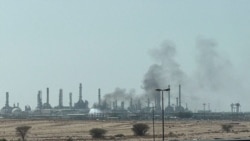

Saudi Arabian Oil Giant Evacuates Headquarters Amid Houthi Attacks, Sources Say
Saudi state-owned oil company Aramco has told its remaining staff to evacuate its headquarters in the country's east amid continuous attacks by Yemen's Houthi rebels, sources told Reuters and AFP.
The reports on October 22 come hours after the Saudi-led coalition and the country's military forces fighting the Iran-aligned Houthis said that their air defenses had intercepted and destroyed at least nine drones.
According to Saudi authorities, one of the drones was targeting an Aramco facility at the Shaybah oil field. Falling debris from the drone killed two people and injured two others.
The Houthis had already targeted the company's headquarters earlier this month. An air strike had caused extensive damage to the building, with fire spreading across several floors.
The developments come amid escalating hostilities between Saudi Arabia and the Houthis.
Yemen descended into civil war in 2014 when the Houthis seized the capital, Sanaa, ousting the internationally recognized, Saudi-backed government. A 2022 truce had mostly held until recently.
This summer, a spate of attacks began after the Houthis welcomed an Iranian plane in Sanaa. They later announced a maritime blockade of Saudi Arabia and launched attacks targeting Saudi ships, airports, and oil facilities.
With reporting by Reuters and AFP
IRGC Says 7 Ships Hit Amid Reports Of New Attack Plans
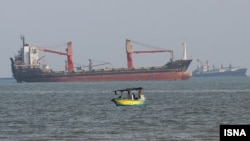
Iran's Islamic Revolutionary Guard Corps (IRGC) Navy said on October 22 that seven vessels had been hit in the Persian Gulf region, as reports emerged that the United States and Israel were preparing plans for renewed strikes against Iran.
The IRGC said four ships involved in transferring oil cargoes in the northern Persian Gulf had been struck simultaneously and caught fire. Three other vessels had reportedly hit naval mines west of the Strait of Hormuz, according to Reuters. The claims have not been independently verified.
The announcement came amid heightened tensions over the ongoing conflict and shipping through the strategically important waterway.
On October 21, The New York Times reported that the US and Israeli militaries had developed specific plans for renewed strikes against Iran following the US midterm elections on November 3.
Citing US officials and others briefed on the deliberations, the newspaper said the two militaries had stepped up exercises, including flights over Iraq to practice strike maneuvers. Potential targets could include Iran's energy infrastructure, nuclear facilities, and missile and drone arsenals.
The report said another major round of attacks could further damage Iran's economy and pressure its government to make diplomatic concessions. However, the reported plans do not establish that an attack has been authorized.
US Defense Secretary Pete Hegseth also met with Israeli Prime Minister Benjamin Netanyahu during an unannounced visit to Israel on October 19, according to Axios. The meeting took place at Ovda Air Base in southern Israel, amid discussions about potentially resuming major military operations against Iran.
President Donald Trump said on October 8 that the United States would not attack Iran before the midterm elections, while indicating that discussions with Tehran were under way. The latest reports suggest that military planning is continuing despite his public commitment.
US Sanctions Shipping Networks Over Iranian Cargoes
The US Treasury Department on October 21 imposed sanctions on a law firm operating in Panama and Greece, a shipping management company, shipping agents, and five individuals over their alleged roles in transporting Iranian goods and helping conceal vessel ownership.
The measures, announced under Operation Economic Outcast, target the Karnakis & Karnakis law firm, which Treasury says established shell companies to obscure the owners of vessels carrying hundreds of millions of dollars' worth of Iranian oil, petrochemicals, and steel.
The department also sanctioned the firm's five associated individuals and Roxette Maritime Shipping and Trading, which manages seven Panama-flagged cargo vessels identified as blocked property.
Two shipping agents were also targeted: Singapore-based Amigoz Singapore and Dubai-based Whales Shipping Line. Treasury said Amigoz helped arrange a shipment of Iranian crude oil, while Whales acted as an agent for a company involved in purchasing Iranian petrochemicals. Two vessels owned by Whales were also designated.
"Whether you are conducting illegal oil transfers at sea or sitting in the corner office of a law firm, if you are supporting the Iranian regime, we will find you and sanction you," Treasury Secretary Scott Bessent said.
Separately, the Treasury Department's Financial Crimes Enforcement Network (FinCEN) issued an administrative subpoena as part of an investigation into a Greek bank's potential ties to Iran and its proxies. The bank was not named. FinCEN also requested information from six other European banks about their relationships with Iranian financial institutions subject to US sanctions.
The sanctions generally block the designated parties' property under US jurisdiction and prohibit US persons from conducting transactions with them, subject to applicable exceptions and authorizations.
Putin Says Iran Deal Still Possible After Talks With US Envoy
Russian President Vladimir Putin said diplomacy remained a viable way to resolve the Iran crisis during a meeting with US special envoy Steve Witkoff on October 21, as Tehran reiterated that progress in negotiations and reopening the Strait of Hormuz depended on Washington meeting its conditions.
Putin said the potential for diplomacy was far from exhausted and that an agreement with Tehran was both possible and necessary, Kremlin aide Yuri Ushakov told reporters.
Russia reaffirmed its readiness to help find a political and diplomatic solution to the crisis, Ushakov said. The meeting in St. Petersburg lasted nearly three hours and also focused on the war in Ukraine and prospects for restoring economic cooperation between Moscow and Washington.
In Tehran, Iranian Foreign Minister Abbas Araqchi said Iran had already presented its proposal to the United States.
"If the Americans are honest about the progress of the negotiations and the opening of the Strait of Hormuz, they should act on our conditions," he said in an interview with Iranian state broadcaster IRIB.
Araqchi outlined a seven-day proposal in an article published by the Financial Times. Under the plan, the Strait of Hormuz would reopen and negotiations toward a broader agreement would resume within a week, provided Washington accepted Tehran's conditions.
The proposal was conveyed to the United States through mediators, Araqchi said. He did not detail all the conditions in his public remarks but called on Washington to demonstrate that it was serious about a diplomatic settlement.
Araqchi said Tehran had little confidence in Washington's intentions, citing previous US military action during periods of diplomatic engagement. He said Iran remained prepared to defend itself against renewed attacks.
Other Iranian officials have also insisted that negotiations depend on Washington meeting Tehran's demands. Mohsen Rezaei, secretary of Iran's Supreme National Security Council, said the country's enriched nuclear material would not be transferred abroad, while parliament speaker Mohammad Baqer Qalibaf said the United States must implement Iran's existing conditions.
The fate of Iran's enriched uranium stockpile, limits on its nuclear program, and the future of the Strait of Hormuz remain central issues in efforts to reach an agreement.
1 Killed, 8 Injured In Attack On Saudi Arabia's Dammam Airport
An attack on King Fahd International Airport in Dammam, eastern Saudi Arabia, killed one person and injured eight others on the evening of October 21, the country's civil aviation authority said.
The attack also caused material damage to airport facilities, according to the authority. Officials did not immediately identify those responsible or provide further details about the nature of the attack. The Iran-allied Houthi militia in Yemen has not claimed responsibility.
It was the second reported attack on the airport in less than two weeks. Saudi authorities reported an attack on the facility on October 11, as attacks on the kingdom's aviation infrastructure escalated.
The Saudi-led coalition fighting Yemen's Houthi movement said early Thursday that its air defenses had intercepted and destroyed four drones over the Eastern Province. Coalition spokesman Turki al-Maliki announced the interceptions without providing further details.
Separately, falling debris from an intercepted drone targeting an Aramco facility at the Shaybah oil field killed two people and injured two others, Saudi authorities said.
The incidents come amid escalating hostilities between Saudi Arabia and the Houthis, who have claimed responsibility for several recent attacks on Saudi airports and other infrastructure.
Report: Iran Ranks Among Worst Countries For Internet Freedom
Iran recorded the largest decline in Internet freedom among 38 countries assessed by Freedom House in its 2026 report, with its score falling from 13 to nine out of 100. The report places Iran alongside China and Myanmar at the bottom of the rankings.
Internet freedom declined globally for the 16th consecutive year, with conditions worsening in 16 of the 38 countries surveyed and improving in eight, according to the report. Estonia scored 91, followed by Costa Rica with 86 and Taiwan with 78.
Freedom House said Iran's 88-day nationwide Internet shutdown, which began during the January 2026 protests and continued through the US-Israeli war that began in February, was the longest nationwide shutdown recorded during its 16 years of reporting. Although restrictions were partially eased in late May, most Iranians remained limited to a restricted selection of websites.
The report also examined Iran's so-called class-based Internet system, under which most citizens face restrictions while privileged groups retain access to global services. It cited increased prices for government-backed VPN services and interference with Starlink satellite signals.
Freedom House said thousands of people were killed and about 50,000 arrested during the January protests. Iran Human Rights has separately documented more than 4,200 deaths, including at least 420 women and 281 people under 18.
The report warned that governments are increasingly using technology, including artificial intelligence, to restrict online expression. It called for stronger anti-censorship tools, emergency satellite Internet access, and improved digital security for journalists and human rights defenders.

With War In Limbo, Influential Iranian Officials Openly Call For A Nuclear Bomb
- By Kian Sharifi
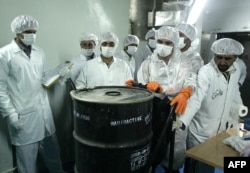
It was once taboo in Iran to publicly speak about developing nuclear weapons. The authorities would often point to former Supreme Leader Ayatollah Ali Khamenei's religious edict barring the development of weapons of mass destruction. Iranian officials have long insisted the country's nuclear program is solely for civilian purposes.
Open calls for a bomb from sitting lawmakers and senior security officials would have been unthinkable a few years ago. But with the war with the United States in limbo, that's no longer the case.
After almost eight months of conflict and with Washington reportedly weighing strikes on Pickaxe Mountain, a deep underground site where US and Israeli officials say Iran has moved thousands of centrifuges, the talk is even growing.
Kamal Kharazi, an adviser to Khamenei who was killed in Israeli strikes earlier this year, said in 2024 that Tehran "might review our nuclear doctrine" if it felt an existential threat. The US-Israeli war against Iran this year seems to be seen by some as that very existential threat.
Read more here
Iraq Closes Border Crossing With Iran
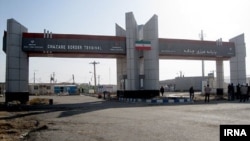
Iraq closed a major border crossing with Iran on October 21, citing security concerns, amid reports that Washington is pressing Baghdad to restrict cross-border trade as part of efforts to increase economic pressure on Tehran.
An Iraqi border official told Reuters that the Al-Sheeb crossing, known as Chazabeh in Iran, had been shut to allow a security review and the installation of equipment to detect smuggled materials.
The crossing will remain closed to passengers and commercial traffic until further notice. Iranian officials confirmed the closure, saying discussions were underway to reopen it and advising travelers and truck drivers to use the nearby Shalamcheh crossing.
Two Iraqi political sources separately told AFP that the United States was pressing Baghdad to close additional crossings with Iran, potentially leaving only two operational.
Iraq and Iran share a border of more than 1,400 kilometers and maintain close economic and political ties.
With reporting by AFP and Reuters
Tanker Struck Near Hormuz Strait, Says Shipping Monitor
A tanker was struck by "an unknown projectile" off the coast of Oman near the Strait of Hormuz on October 21, sparking a fire, British maritime security agency UKMTO said.
The vessel, about 20 kilometers off the town of Bukha, was "now at anchor," with all crew safe and no reported environmental damage.
Also on October 21, the UKMTO reported another tanker being struck the previous day southeast of Al Faw in Iraq, The crew were "reported as safe," and there was no was "no reported damage or environmental impact."
Attacks on shipping in and around the strategic Strait of Hormuz and across the wider Persian Gulf have intensified amid the Middle East war, which began with US-Israeli strikes on Iran in late February.
Tehran has restricted passage through the strait, a vital oil and gas route, while Washington maintains a blockade on Iranian ports.
With reporting by AFP
Lavrov In Tehran Amid Questions Over Whether Moscow Is Helping Iran In War With US
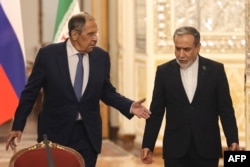
Russian Foreign Minister Sergei Lavrov traveled to Iran on October 19, meeting with President Masud Pezeshkian and Foreign Minister Abbas Araqchi amid questions over what support Moscow is providing Tehran to fight its war with the United States.
Lavrov traveled to the Iranian capital directly from Manama, Bahrain, where he had attended a meeting with Gulf Cooperation Council officials. Gulf states have urged Moscow to use its influence to press Tehran to halt attacks on its neighbors.
Following talks in Tehran with his Russian counterpart, Araqchi said they discussed regional and international issues, including Lebanon, Palestine, Ukraine, and Yemen, as well as expanding economic and nuclear cooperation.
"Never in our history have Iran and Russia worked as closely as now," Araqchi wrote in a post on X on October 20.
To read the full report, click here.