



Trump Says Tehran 'Not Going To Make The Kind Of Deal I Think Is Necessary'
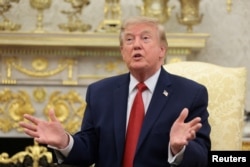
US President Donald Trump said Washington is not seeking an extension of the expiring framework agreement with Tehran, voicing pessimism about the prospects for a satisfactory deal.
The Islamabad Memorandum of Understanding (MOU), signed on June 17, included a 60-day period for talks aimed at resolving the key issues of opening the Strait of Hormuz and Iran's nuclear ambitions.
However, the deadline passed with no sign of progress in negotiations.
"They're not going to make the kind of deal that I think is necessary," Trump told reporters on August 17, referring to Iranian officials.
Speaking to Fox News earlier in the day in a phone interview, he said that Iran should just "surrender."
"They should put up the white flag of surrender," Trump said.
He also issued a profane warning to US ally Oman, which has been working with Iran on a plan to restore commercial shipping routes through the Strait of Hormuz, a vital waterway that lies between the two countries and has been effectively closed for most of the time since the start of the US-Israeli war with Iran on February 28.
"If Oman gets in the way, we'll bomb the s**t out of them," Trump told Fox.
Gas Production At Iran's South Pars Facilities Decreased By A Third
Gas production capacity at Iran's South Pars facility is down by roughly a third due to damage sustained in strikes during the war against the United States and Israel earlier this year, according to the head of the Iranian Petroleum Industry Federation.
Erfan Afazeli, speaking in an interview with Entebbe News Agency, said that "in the recent war, four of our refineries were affected by the enemy's attack, and this factor has [reduced South Pars' production capacity by] almost one-third due to the lack of processing facilities."
He announced that the reconstruction and repair of these refineries will take at least "one and a half to two years," adding that the resources needed for this purpose "are not fully available domestically, or at least are not a priority in the current circumstances."
Afazeli emphasized that the country will face a gas shortage in the fall and winter.
Israel targeted South Pars facilities in late March. US President Donald Trump said the United States and Qatar had no role in it.
However, in retaliation for these attacks, Iran targeted energy infrastructure in Qatar and Saudi Arabia with missile and drone attacks.
Trump Repeats Main Goal: 'Iran Cannot Have A Nuclear Weapon'
US President Donald Trump has again said the primary US aim in dealings with Iran is that Tehran must not develop or acquire nuclear weapons.
"The number one Goal is, and always will be, that Iran cannot have, in any way, shape, or form, a Nuclear Weapon," Trump wrote in a short post on his Truth Social platform on August 17.
The comment coincides with the expiration of the memorandum of understanding signed between Washington and Iran on June 17, which gave a 60-day deadline for further talks to reach an agreement to end the war, now in its sixth month.
Iran and the United States have not negotiated an agreement on Tehran's nuclear program within the 60 days agreed by the two parties for a broader deal, and the initial stated goal of the memorandum -- to open the Strait of Hormuz -- has not been achieved.
Iran Blames US For Breakdown Of Talks, Says It 'Violated' Framework Agreement
Following the expiration of the 60-day deadline set out by a framework agreement between the Washington and Tehran, an Iranian official claimed on August 17 that "there is no 60-day deadline."
The deadline to reach a final deal, which had been repeatedly emphasized in the Islamabad Memorandum of Understanding (MOU) fell on August 17. Iran and the United States were unable to reach an agreement.
Foreign Ministry spokesman Esmail Baqaei said the US government is responsible for the "gross violation of the memorandum of understanding" and said: "Due to the gross and widespread violation of the June 18 memorandum of understanding by the United States, no talks began just a few weeks after its signing, and as a result, the discussion of the 60-day deadline has completely lost its relevance."
"Despite America's previous breaches of promises, intensive negotiations between Iran and Oman are continuing in earnest to finalize a joint statement and establish a safe mechanism that protects mutual interests," Baqaei added, referring to efforts by Iran and Oman to propose new shipping routes through the Strait of Hormuz, control over which has been has been at the heart of tensions during the nearly six-month war.
In the MOU, the United States and Iran also committed to negotiating and reaching a final agreement within a maximum of 60 days, extendable by mutual agreement.
Iranian officials have repeatedly said that no negotiations with US officials are taking place and that messages have only been exchanged through mediators.
Iran-backed Houthis Claim Attack On Saudi Ship
The Iran-backed Houthi rebels said on August 17 that they had targeted a Saudi landing ship along with four escort vessels in the Red Sea. There is no immediate comment from the Saudi authorities.
The group's military spokesman, Yahya Saree, posted on social media that the Saudi ship was attacked with missiles off Yemen's Mocha coast.
Meanwhile, quoting local media, Al-Jazeera reported that four people had been killed and eight injured in overnight attacks by Houthi rebels in the Yemeni cities of Marib and Mocha.
Local authorities say six ballistic missiles and four drones hit Marib, wounding four people. Reports suggest that the city of Mocha has also been under Houthi attacks for the past several days.
Earlier, six people were reported dead, including three Pakistanis, and 10 injured when the Yemen-based Houthis attacked a cargo ship south of the port of Mocha in the in the Red Sea.
Last month, the Houthis announced their blockade of Saudi ports.
Iranian Army Sets Bounty For Killing, Capturing US Troops
The chief commander of the Iranian army has announced a $30,000 reward for killing or capturing American soldiers, adding that the reward would be doubled if the action is carried out by a woman.
Amir Hatami made the announcement on August 16 but provided no further details, stating only that the army would offer these rewards following "pledges of support" from the public to help fund them.
The announcement comes despite no indication of any attempt by US forces to enter Iranian territory. During the 40-day war, a rescue operation for the crew of a downed American fighter jet inside Iran was completed without any US casualties or captures.
Iranian Parliamentary Deputy Apologizes To Mahsa Amini's Family
An Iranian parliamentary deputy has apologized to the parents of Mahsa Amini for statements he made about her 2022 death, which sparked Iran's Women, Life, Freedom protests.
Ahmad Ariainejad recently said in a television debate that Amini had "gone to hell" and fueled months of "riots."
Amini, a 22-year-old Kurdish woman, was arrested on September 13, 2022, by Iran's so-called morality police for not wearing her hijab properly. She died in custody days later.
The movement sparked by her death campaigned for an end to compulsory hijab laws and was brutally suppressed by the Iranian authorities.

At the end of their message, Amini's parents said:"Our daughter's name, along with thousands of other innocent people, will forever be immortalized in the history of this country."
In a subsequent video statement following the TV debate, Ariainejad said he had “unconsciously” used “inappropriate language” about Amini and asked her parents to accept his apology.
The deputy's comments prompted a reaction from Amini's parents on August 15 who addressed the deputy and the Iranian government, saying: "May your tongue be cut for sending an entire country to hell. You have not only been deprived of wisdom and understanding but haven’t even benefited from a modicum of shame.”
Hormuz Traffic Grinds To Near Halt Again As Talks Stall
Data showed that shipping through the Strait of Hormuz slowed over the weekend as attacks continued in the important waterway and as talks stalled between Washington and Tehran on ways to end the crisis.
Shiptracking data from Kpler showed that five commodity vessels transited the strait on August 15, with none registered for August 16.
Kpler data showed that an empty Very Large Crude Carrier with its Automatic Identification System switched off and an Indian-flagged Very Large Gas Carrier used the Iranian route through the strait.

A small tanker holding Iranian fuel oil exited the waterway, data showed.
An attack last week on three vessels operated by the Abu Dhabi National Oil Company was the latest incident helping to dissuade ships from attempting to transit the waterway.
Tehran has effectively blocked the strait following the US-Israeli air strikes against Iran beginning on February 28, although periodic agreements have allowed some vessels to transit. The agreements between the US and Iran have regularly collapsed, bringing on tit-for-tat air attacks in the region.
Washington is also maintaining a blockade of Iranian ports, saying that mission will last indefinitely.
Tehran has insisted that Washington meet Iran's conditions regarding the strait in order for shipping to resume. Prior to the war, some 20 percent of the world's crude oil and natural gas supplies transited the strait.
Trump Welcomes Saudi, Turkey, Pakistan Defense Pact
US President Donald Trump said he was pleased by the recent signing of a defense agreement between Saudi Arabia, Turkey, and Pakistan -- which the participants said was not aimed at Tehran but which comes amid attacks by Iran on Saudi and other Gulf Arab nations.
"Very happy to see that Saudi Arabia, Turkey, and Pakistan have recently, and finally, signed the Mecca Joint Defence Agreement," he wrote on Truth Social August 16.
"It shows how the Middle East is coming together, and how Countries will finally be able to defend themselves in a more meaningful way," he wrote, saying, "THIS IS A BIG, BOLD, IMPORTANT FIRST STEP."
The pact was signed on August 7 in Mecca and comes as the US-Israeli war with Iran has widened throughout the Middle East and includes attacks inside Saudi Arabia by Iran-backed Houthi rebel attacks in Yemen.
Participants in the agreement have said it is similar to NATO's Article 5, meaning that an attack on any member would be regarded as an attack on all. Pakistan has said it was possible Egypt and other nations could eventually join the pact.
The member nations are majority Sunni Muslim, while Iran is mostly Shi'ite. Saudi Arabia and Iran have long competed for religious, military, and political dominance in the region.
Iran Moves To Jail Those Who Speak To Foreign Media
Iran’s parliament approved a bill on August 16 that would criminalize interviews and other contact with foreign media outlets deemed “hostile” by the authorities, with offenders facing up to two years in prison.
The measure was approved by 183 lawmakers in the 290-seat parliament and would prohibit interviews, participation in discussions, or other communication with media described as American, Israeli, or funded by the United States or Israel.
Violations would carry a Grade 6 prison sentence, which under Iranian law ranges from more than six months to two years.
The bill would also criminalize sending videos, photographs, audio recordings, or other data to non-Iranian media outlets or people engaged in media activities outside the country.
Contact with other foreign media would require prior notification to the Intelligence Ministry through a government system, effectively requiring Iranians to inform the authorities before giving an interview.
The legislation names the Intelligence Ministry and the intelligence arm of the Islamic Revolutionary Guards Corps as the entities responsible for investigating alleged violations.
Iran already imposes sweeping restrictions on independent journalism and access to information. Reporters Without Borders ranks the country 177th out of 180 in its 2026 World Press Freedom Index, citing arrests, surveillance, harassment, censorship, and heavy prison sentences targeting journalists.