





Trump Says Tehran 'Not Going To Make The Kind Of Deal I Think Is Necessary'
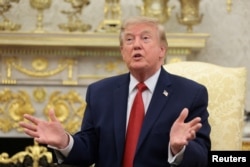
US President Donald Trump said Washington is not seeking an extension of the expiring framework agreement with Tehran, voicing pessimism about the prospects for a satisfactory deal.
The Islamabad Memorandum of Understanding (MOU), signed on June 17, included a 60-day period for talks aimed at resolving the key issues of opening the Strait of Hormuz and Iran's nuclear ambitions.
However, the deadline passed with no sign of progress in negotiations.
"They're not going to make the kind of deal that I think is necessary," Trump told reporters on August 17, referring to Iranian officials.
Speaking to Fox News earlier in the day in a phone interview, he said that Iran should just "surrender."
"They should put up the white flag of surrender," Trump said.
He also issued a profane warning to US ally Oman, which has been working with Iran on a plan to restore commercial shipping routes through the Strait of Hormuz, a vital waterway that lies between the two countries and has been effectively closed for most of the time since the start of the US-Israeli war with Iran on February 28.
"If Oman gets in the way, we'll bomb the s**t out of them," Trump told Fox.
We are now closing the live blog for the day. We'll be back at 7:30 a.m. Central European time to cover the latest events across the Middle East.
Iran Working With Oman On The New Hormuz Maritime Traffic Settings
“The Strait of Hormuz has no more than two coastal countries, and these two countries are simply the Islamic Republic of Iran and the Sultanate of Oman,” declared Iran’s Deputy Foreign Minister Kazem Gharibabadi to the country’s state media on August 25.
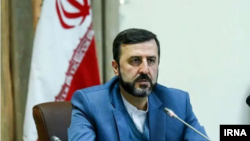
Gharibabadi’s interview came hours after foreign ministers of Oman and Iran said in a joint statement on Tuesday that they had discussed a phased framework, including the establishment of a temporary joint shipping corridor and the implementation of a joint project to clear mines from the Strait of Hormuz to resume "safe passage" for ships through the waterway.
Deputy foreign minister said Iran is still in the state of war and that the Strait of Hormuz is now a matter of Iran’s national security and fundamental changes must be made in the entry and exit routes.
According to the official, the working agreement between Oman and Iran is that the new naval traffic route will work like a “round-trip highway” - the entry route to the Persian Gulf will be through Iranian waters and the exit route through Omani territorial waters, and ships will pass through Iranian waters on both routes.
The southern route of the Strait of Hormuz is to be closed and the matter will be reported to the International Maritime Organization.
This arrangement is supposed to be temporary and Tehran and Muscat allow themselves up to 60 days to come up with a permanent agreement.
Gharibabadi reiterated that the entire traffic through Hormuz will remain closed until the United States among other things lifts the economic blockade of Iran and ends the war on all fronts, including Lebanon.
Omani Foreign Minister Badr Al Busaidi discussed the Strait of Hormuz with Iranian Foreign Minister Abbas Araqchi on August 25 in Tehran.
Following the meeting, Araqchi wrote on X that he hoped to soon be able “to announce the establishment of a temporary corridor for the Strait of Hormuz and practical arrangements to restore safe shipping.”
US President Donald Trump announced on Truth Social on August 25 —citing reports from the US Navy and US Central Command (CENTCOM)—that "all mines have been removed and/or detonated from within the International Waters of the Strait of Hormuz" and declared the shipping lanes open for maritime traffic. Gharibabadi rejected that as propaganda.
Britain Supports US Actions Against Iran
The United Kingdom supports US efforts to achieve a diplomatic solution on Iran and welcomes moves to step up pressure on Tehran, British Finance Minister John Healey said.
In comments on August 25, Healey said that includes the new sanctions announced a day earlier by US Treasury Secretary Scott Bessent.
Healey also urged Iran to stop its "destabilizing activity" in the Strait of Hormuz and across the Middle East.
Bessent said the United States was launching a campaign to “sever every economic lifeline that sustains this tyrannical regime until Tehran stands alone." He said countries would be given timelines to “shut down” activity that props Iran's regime up.
Bessent On Iran: 'The Pressure Is Working'
US Treasury Secretary Scott Bessent asserted on September 25 that Iran's leadership has acknowledged the effectiveness of US pressure on the Islamic republic.
In a post on X, Bessent wrote: "Iran's leadership is admitting what the world can now see: the pressure is working."
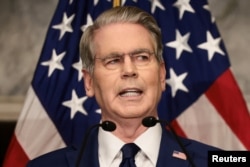
Referring to remarks by Iranian President Masud Pezeshkian on August 21 saying "the war must come to an end at some point," Bessent said Pezeshkian had acknowledged Iran's economic difficulties.
Bessent also cited remarks by Mohammad Baqer Qalibaf, the speaker of Iran's parliament, saying he had been "even more direct."
"No matter how much military power we have, if people are hungry and we do not have financial circulation, economic growth and domestic production, we will not endure," Bessent quoted Qalibaf as saying.
Bessent added: "Under President Trump, Treasury will continue to sever every economic lifeline sustaining this regime until Tehran stands alone."
The comments came a day after the Trump administration launched Operation Economic Outcast, a new campaign aimed at intensifying economic pressure on Iran through sanctions and other measures.
Bessent had previously said the administration's goal was to "collapse this regime" through economic pressure.
Oman, Iran Outline Plan to Restore Safe Navigation in Hormuz
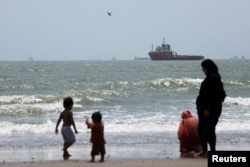
Iran and Oman announced an agreement on a proposed framework to resume safe navigation through the Strait of Hormuz.
In a joint statement on August 25, the two countries said the plan includes establishing a joint temporary shipping lane and a project to remove mines from the vital waterway.
"The proposed framework includes creating a temporary joint operation through the Strait of Hormuz for the purpose of implementing...a joint corridor through the Strait, with the goal of managing a single corridor for permanent and future management of the Strait, as well as providing mechanisms for information exchange, traffic management, and security-related services," the joint statement read.
Omani Foreign Minister Sayyid Badr bin Hamad Al Busaidi traveled to Iran on August 25, where he met with his Iranian counterpart, Abbas Araqchi.
Both sides emphasized the importance of including regional states bordering the waters of the Gulf in the discussions.
Oman and Iran have been in talks for weeks on arrangements to restore safe commercial navigation through the Strait of Hormuz.
Earlier this month, Tehran said the two sides had reached an understanding on the geographical coordinates of a proposed shipping route.
The negotiations have centered on expanding safe passage while addressing Iran's concerns over sovereignty and security in the strategic waterway, control over which has been a central sticking point in the conflict between Iran and the United States.
Meanwhile, US President Donald Trump said on August 25 that he had been told that the Strait of Hormuz had been completely demined, claiming that "Iran has been notified that any ship or boat placing new mines will be immediately and systemically destroyed."
Iran Sentences Another Protester To Death
Iran's Supreme Court has upheld the death sentence of political prisoner Arghavan Fallahi, raising renewed concerns over the use of capital punishment against political detainees, according to the Human Rights Activists News Agency (HRANA).
Fallahi, 24, was sentenced to death in July by Branch 15 of the Tehran Revolutionary Court, headed by Judge Abolqasem Salavati, on a charge of "baghi," or armed rebellion, according to HRANA. The Supreme Court has now upheld that sentence.

The case dates back to Fallahi's arrest in early 2025, when Iranian security forces detained her and transferred her to Ward 209 of Evin Prison, according to HRANA. She was subsequently held in Wards 209 and 241, both associated with Iran's security and intelligence apparatus.
According to an informed source cited by HRANA, Fallahi was subjected to attempts to force her to confess to involvement in the January 2025 killings of two senior Iranian judges, Mohammad Moghiseh and Ali Razini.
Rights groups have also reported that Iranian authorities accused Fallahi of links to Mojahedin-e Khalq. The allegations have not been independently verified.
Fallahi had previously been arrested during the nationwide protests that followed the death in custody of Mahsa Amini in September 2022. She was later sentenced to prison, according to rights groups.
Her death sentence can now be carried out unless she receives a judicial reprieve or another form of intervention.
The charge of "baghi" is defined under Iranian law as an armed uprising against the Islamic republic and can carry the death penalty. Iranian courts have increasingly used national-security charges, including "baghi," against political activists and people accused of involvement in anti-government protests.
The confirmation of Fallahi's sentence comes amid growing concern from rights organizations about executions in Iran following the nationwide protests in December and January. Human rights groups have documented death sentences against protesters and political prisoners, while warning that those already sentenced to death face an imminent risk of execution.
Trump: Iran Killing Protesters 'Even When They Are Not Protesting'
US President Donald Trump said Iran's "failing" regime is killing protesters "even when they are not protesting" at an unprecedented rate.
In a post on Truth Social on August 25, Trump wrote: "The failing Islamic Republic of Iran is not paying large segments of their military, while at the same time killing protesters, even when they are not protesting, at levels not seen before. It is a humanitarian crisis of epic proportions, and must be stopped, NOW."
Trump did not provide further details or evidence for his claim. It was unclear whether he was referring to people killed during the mass crackdown on protests earlier this year or to new, unreported killings.
The protests began on December 28, 2025, and continued into January, prompting a deadly crackdown by Iranian security forces.
Iran has since executed protesters and others arrested in connection with the uprising. The UN human rights chief said earlier this month that Iran had executed at least 56 people on national-security charges since March 19, including 27 people linked to the anti-government protests.
In total, Iran has executed 494 people this year, according to the latest data.
Qatar Calls US Sanctions Against Iran 'Unilateral'
The Qatari government considers the new US sanctions against Iran "unilateral," but Doha supports continued mediation efforts to resolve the dispute between the US and Iran, said a spokesman for the Qatari Foreign Ministry on August 25.
Despite being the target of missiles by Iran's Islamic Revolutionary Guards Corps in recent months, Qatar, along with Pakistan and Turkey, has tried to bring Tehran and Washington closer together through mediation.
"Across the globe, our goal is to cut off all the economic arteries that sustain this tyrannical regime until Tehran is completely alone," US Treasury Secretary Scott Bessent said at a press conference on September 2, about the new pressure campaign against Iran.
Alongside the renewed economic pressure, efforts at mediation continue. On September 24 , the Pakistani Army chief Asim Munir traveled to Tehran, and on September 25 Omani Foreign Minister Sayyid Badr bin Hamad Al Busaidi arrived in the Iranian capital to meet with officials.
USS Abraham Lincoln To Dock In Thailand After Long Iran War Deployment
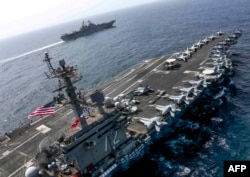
The US aircraft carrier USS Abraham Lincoln, which left the Middle East on August 22 after a prolonged deployment supporting US military operations against Iran, is scheduled to dock in Thailand next week for crew rest and recreation, a Thai official said.
The ship, carrying roughly 5,000 sailors and Marines, has gone more than 200 days without a port call, setting a modern-day record for consecutive days at sea. The carrier has been deployed for 274 days since leaving its home port of San Diego in November.
Reports in recent weeks have cited food and water shortages, plumbing problems, disrupted mail, and deteriorating morale among the crew. Families of sailors have also raised concerns about mental health. The Pentagon has disputed reports that conditions aboard the ship have significantly deteriorated.
Democratic lawmakers have demanded answers from the Pentagon over the prolonged deployment and conditions aboard the carrier. Senator Richard Blumenthal, a Connecticut Democrat, sent Defense Secretary Pete Hegseth a list of questions about the deployment and its impact on the crew.
US President Donald Trump has downplayed concerns about the sailors, saying the ship was "beautifully maintained and beautifully taken care of," while Hegseth said reports of deteriorating conditions had "completely misrepresented" the situation.
US Suspends Sports Exchanges License for Iran

The US Treasury Department has indefinitely suspended a general authorization for professional and amateur sports activities and exchanges between the United States and Iran, effective August 24.
General License F previously authorized certain services supporting sports activities and exchanges between the two countries, including sports matches and events, sponsorship of players, coaching, refereeing, and training. The suspension means activities that are not otherwise authorized will require a specific license from the US Treasury Department's Office of Foreign Assets Control.
OFAC also indefinitely suspended General License G, which covered certain academic exchanges and educational services, as well as separate authorizations covering certain educational activities in third countries, noncommercial personal remittances to or from Iran, and services related to conferences.
The suspensions are part of the Trump administration's broader campaign to increase economic pressure on Iran. Treasury Secretary Scott Bessent has warned that Washington intends to cut off Iran's economic lifelines.
OFAC issued a separate general license allowing transactions ordinarily incident and necessary to wind down activities that had previously been authorized under the suspended provisions through September 8.