



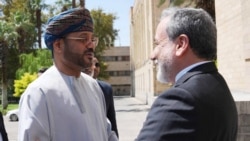

Trump Calls Strait Of Hormuz 'American Territory'

US President Donald Trump said on August 21 that he views the Strait of Hormuz as "American territory," as US forces continued a naval blockade of Iran.
"We don't even know if we won, because I view the Strait of Hormuz as an American territory right now," Trump said at a campaign rally in South Carolina. He added: "It's an American territory."
US Central Command said that American forces had redirected 68 commercial vessels as of August 21 to comply with the blockade.
The Strait of Hormuz is one of the world's most important energy waterways, with roughly one-fifth of the world's seaborne oil supply normally passing through it. The waterway is bordered by Iran and Oman. Iran's Deputy Foreign Minister Kazem Gharibabadi dismissed Trump's claims about the strait as "delusions."
Trump also reiterated that Iran must not obtain a nuclear weapon. He said that "as soon as we're finished with the Islamic Republic of Iran, as soon as we're finished, oil is gonna be down at lower than it was even just a little while ago."
Later in his speech in South Carolina, which he delivered in support of the candidacy of Darline Graham, sister of the late Senator Lindsey Graham, Trump joked about carrying out more strikes on Iran. He told the audience: "Look, it's a Friday night. We have plenty of time, right? What the hell do I have to do? Go back, bomb Iran a little bit more?"
Netanyahu Says Diplomatic Agreement Cannot Be Reached With Iran
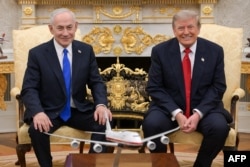
Israeli Prime Minister Benjamin Netanyahu welcomed the new US economic pressure campaign on Iran and expressed doubts about the possibility of a diplomatic agreement with Tehran.
In a speech on Augugust 25, Netanyahu referred to his July 28 meeting with US President Donald Trump, saying they had discussed three options for dealing with Iran: an agreement, military action, and "tightening the siege" on Tehran.
Netanyahu said he told Trump: "I doubt that you can make a deal with that bunch over there, with those savages. I'm telling you: You can't make a deal."
Netanyahu then praised expanded US sanctions against Iran, saying the president had "reaffirmed that decision with something very, very, very powerful." He said the measures amounted to tightening the siege not directly on Iran but on those helping what he called "that terrible dictatorship."
Pezeshkian Reiterates Need To End War With US
Iranian President Masud Pezeshkian reiterated his previous position on the need to end the war with the United States, saying, "War is not always the solution. A knot that can be untied with the hands should not be untied with the teeth."
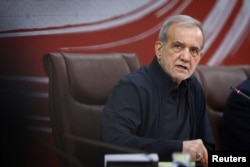
At a public ceremony on August 26, Pezeshkian once again called Iran "victorious in the field," adding that this path can be crossed with "measurement and thought."
After the 40-day war, Iran and the United States signed a memorandum of understanding to stop the war and negotiate an end to the conflict, but this memorandum collapsed due to tensions in the Strait of Hormuz, and negotiations between the two sides have been at least publicly stalled since then.
In his remarks today, Pezeshkian cited the command of Ali ibn Abi Talib, the first imam of the Shi'a, to Malik Ashtar in defense of peace, saying: "Do not reject the peace that the enemy proposes and that God is pleased with, because peace brings comfort to the armies and security to the people and the market."
He also emphasized that accepting peace does not mean trusting the other side, and said that even after an agreement, one must be vigilant about the possibility of surprise from the enemy.
11 Sanctioned Iranian Oil Tankers 'Stranded' Near Sri Lankan Coast
Sri Lanka is monitoring a fleet of 11 Iranian oil tankers under US sanctions near the island's southern coast, the country's foreign minister, Vijitha Herath, said on August 26.
Herath said the tankers have not entered Sri Lanka's territorial waters and are in international waters, where, under the principle of freedom of navigation, they have the right to remain.
According to media reports, the tankers are stranded because of the US blockade and are unable to return to their home port.
An unnamed Sri Lankan military official told AFP that the military had deployed reconnaissance aircraft and patrol boats to monitor the vessels outside the country's territorial waters.
"There is no indication of ship-to-ship oil transfers or the illegal dumping of pollutants, so there is no basis for the Sri Lankan authorities to take action against them," the official said.
In its latest report, US Central Command (CENTCOM) said that since July 14, when the US naval blockade of Iranian ports and shipping was reinstated, it has diverted more than 70 vessels, disabled three vessels, and boarded two vessels.
With reporting by AFP
More Cafes In Tehran Forced To Close
A cafe worker in Tehran has reported that cafes in Tehran's Vanak Park complex in the capital had been closed.
Masud Delpasand, a barista and cafe management instructor, posted a video in which he cited the poor economic conditions in Iran, saying the sealing of the Vanak Park cafes "has deprived at least 200 people of work and income."
After posting the video and protesting the sealing of the cafes, Delpasand posted a story on his Instagram account on September 25, writing that “there was no intention to provoke or protest” and that "any cafe that was sealed must have had a health problem."
The authorities criticized his post, saying saying any page that publishes the video is "hostile" and that it was only created for "exploitation."
Delpasand posted this story even though the video had been deleted from his page.
Along with the release of the video, he wrote: "In these economic circumstances, with the high cost of raw materials, skyrocketing rents, and a thousand obstacles in front of business owners, what is the plan to seal off Vank Park cafes?"
In recent days, a new wave of sealing off cafes and businesses has been launched under the pretext of not complying with the "mandatory hijab" and has drawn criticism.
Iran, Oman Working On New Hormuz Maritime Traffic Settings
"The Strait of Hormuz has no more than two coastal countries, and these two countries are simply the Islamic Republic of Iran and the Sultanate of Oman,” declared Iran’s Deputy Foreign Minister Kazem Gharibabadi to the country’s state media on August 25.
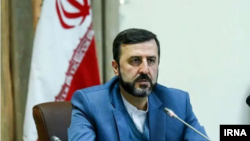
Gharibabadi's interview came hours after foreign ministers of Oman and Iran said in a joint statement that they had discussed a phased framework, including the establishment of a temporary joint shipping corridor and the implementation of a joint project to clear mines from the Strait of Hormuz to resume "safe passage" for ships through the waterway.
Gharibabadi said Iran is still in the state of war and that the Strait of Hormuz is now a matter of Iran's national security and fundamental changes must be made in the entry and exit routes.
According to the official, the working agreement between Oman and Iran is that the new naval traffic route will work like a "round-trip highway" with the entry route to the Persian Gulf through Iranian waters and the exit route through Omani territorial waters and ships passing through Iranian waters on both routes.
The southern route of the Strait of Hormuz is to be closed and the matter will be reported to the International Maritime Organization.
This arrangement is supposed to be temporary, and Tehran and Muscat allow themselves up to 60 days to come up with a permanent agreement.
Gharibabadi reiterated that the entire traffic through Hormuz will remain closed until the United States among other things lifts the economic blockade of Iran and ends the war on all fronts, including Lebanon.
Omani Foreign Minister Badr Al Busaidi discussed the Strait of Hormuz with Iranian Foreign Minister Abbas Araqchi on August 25 in Tehran.
Following the meeting, Araqchi wrote on X that he hoped to soon be able "to announce the establishment of a temporary corridor for the Strait of Hormuz and practical arrangements to restore safe shipping."
Separately, US President Donald Trump announced on Truth Social on August 25 -- citing reports from the US Navy and US Central Command (CENTCOM)-- that "all mines have been removed and/or detonated from within the International Waters of the Strait of Hormuz" and declared the shipping lanes open for maritime traffic. Gharibabadi rejected that as propaganda.
Britain Supports US Actions Against Iran
The United Kingdom supports US efforts to achieve a diplomatic solution on Iran and welcomes moves to step up pressure on Tehran, British Finance Minister John Healey said.
In comments on August 25, Healey said that includes the new sanctions announced a day earlier by US Treasury Secretary Scott Bessent.
Healey also urged Iran to stop its "destabilizing activity" in the Strait of Hormuz and across the Middle East.
Bessent said the United States was launching a campaign to “sever every economic lifeline that sustains this tyrannical regime until Tehran stands alone." He said countries would be given timelines to “shut down” activity that props Iran's regime up.
Bessent On Iran: 'The Pressure Is Working'
US Treasury Secretary Scott Bessent asserted on September 25 that Iran's leadership has acknowledged the effectiveness of US pressure on the Islamic republic.
In a post on X, Bessent wrote: "Iran's leadership is admitting what the world can now see: the pressure is working."
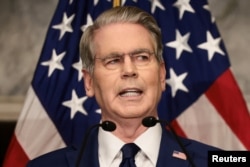
Referring to remarks by Iranian President Masud Pezeshkian on August 21 saying "the war must come to an end at some point," Bessent said Pezeshkian had acknowledged Iran's economic difficulties.
Bessent also cited remarks by Mohammad Baqer Qalibaf, the speaker of Iran's parliament, saying he had been "even more direct."
"No matter how much military power we have, if people are hungry and we do not have financial circulation, economic growth and domestic production, we will not endure," Bessent quoted Qalibaf as saying.
Bessent added: "Under President Trump, Treasury will continue to sever every economic lifeline sustaining this regime until Tehran stands alone."
The comments came a day after the Trump administration launched Operation Economic Outcast, a new campaign aimed at intensifying economic pressure on Iran through sanctions and other measures.
Bessent had previously said the administration's goal was to "collapse this regime" through economic pressure.
Oman, Iran Outline Plan to Restore Safe Navigation in Hormuz
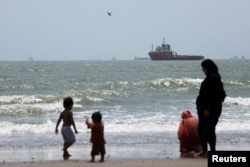
Iran and Oman announced an agreement on a proposed framework to resume safe navigation through the Strait of Hormuz.
In a joint statement on August 25, the two countries said the plan includes establishing a joint temporary shipping lane and a project to remove mines from the vital waterway.
"The proposed framework includes creating a temporary joint operation through the Strait of Hormuz for the purpose of implementing...a joint corridor through the Strait, with the goal of managing a single corridor for permanent and future management of the Strait, as well as providing mechanisms for information exchange, traffic management, and security-related services," the joint statement read.
Omani Foreign Minister Sayyid Badr bin Hamad Al Busaidi traveled to Iran on August 25, where he met with his Iranian counterpart, Abbas Araqchi.
Both sides emphasized the importance of including regional states bordering the waters of the Gulf in the discussions.
Oman and Iran have been in talks for weeks on arrangements to restore safe commercial navigation through the Strait of Hormuz.
Earlier this month, Tehran said the two sides had reached an understanding on the geographical coordinates of a proposed shipping route.
The negotiations have centered on expanding safe passage while addressing Iran's concerns over sovereignty and security in the strategic waterway, control over which has been a central sticking point in the conflict between Iran and the United States.
Meanwhile, US President Donald Trump said on August 25 that he had been told that the Strait of Hormuz had been completely demined, claiming that "Iran has been notified that any ship or boat placing new mines will be immediately and systemically destroyed."
Iran Sentences Another Protester To Death
Iran's Supreme Court has upheld the death sentence of political prisoner Arghavan Fallahi, raising renewed concerns over the use of capital punishment against political detainees, according to the Human Rights Activists News Agency (HRANA).
Fallahi, 24, was sentenced to death in July by Branch 15 of the Tehran Revolutionary Court, headed by Judge Abolqasem Salavati, on a charge of "baghi," or armed rebellion, according to HRANA. The Supreme Court has now upheld that sentence.

The case dates back to Fallahi's arrest in early 2025, when Iranian security forces detained her and transferred her to Ward 209 of Evin Prison, according to HRANA. She was subsequently held in Wards 209 and 241, both associated with Iran's security and intelligence apparatus.
According to an informed source cited by HRANA, Fallahi was subjected to attempts to force her to confess to involvement in the January 2025 killings of two senior Iranian judges, Mohammad Moghiseh and Ali Razini.
Rights groups have also reported that Iranian authorities accused Fallahi of links to Mojahedin-e Khalq. The allegations have not been independently verified.
Fallahi had previously been arrested during the nationwide protests that followed the death in custody of Mahsa Amini in September 2022. She was later sentenced to prison, according to rights groups.
Her death sentence can now be carried out unless she receives a judicial reprieve or another form of intervention.
The charge of "baghi" is defined under Iranian law as an armed uprising against the Islamic republic and can carry the death penalty. Iranian courts have increasingly used national-security charges, including "baghi," against political activists and people accused of involvement in anti-government protests.
The confirmation of Fallahi's sentence comes amid growing concern from rights organizations about executions in Iran following the nationwide protests in December and January. Human rights groups have documented death sentences against protesters and political prisoners, while warning that those already sentenced to death face an imminent risk of execution.
Trump: Iran Killing Protesters 'Even When They Are Not Protesting'
US President Donald Trump said Iran's "failing" regime is killing protesters "even when they are not protesting" at an unprecedented rate.
In a post on Truth Social on August 25, Trump wrote: "The failing Islamic Republic of Iran is not paying large segments of their military, while at the same time killing protesters, even when they are not protesting, at levels not seen before. It is a humanitarian crisis of epic proportions, and must be stopped, NOW."
Trump did not provide further details or evidence for his claim. It was unclear whether he was referring to people killed during the mass crackdown on protests earlier this year or to new, unreported killings.
The protests began on December 28, 2025, and continued into January, prompting a deadly crackdown by Iranian security forces.
Iran has since executed protesters and others arrested in connection with the uprising. The UN human rights chief said earlier this month that Iran had executed at least 56 people on national-security charges since March 19, including 27 people linked to the anti-government protests.
In total, Iran has executed 494 people this year, according to the latest data.