




Damascus Says Iran Must Acknowledge Actions In Syria Before Ties Improve
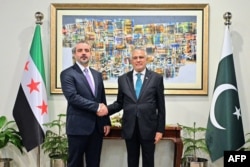
Syria says relations with Iran will improve only after the regime agrees to "recognize and admit what it has done to Syria and to the Syrian people."
The statement came from Syrian Foreign Minister Assad Hassan Al-Shaibani during his recent visit to Pakistan while replying to questions from journalists in Islamabad.
Asked if there was any mediation offer from Pakistan to bring a patch up between Damascus and Tehran, Al-Shaibani said "there was no offering of mediation" between the two countries during his current Islamabad visit.
"In the future, if the causes of such mediation or such talk with Iran are in place, and if Iran recognized and admitted what it has done to Syria and to the Syrian people, and if Pakistan is willing to have a role in such talks, so we have no problem," he said.
He added that his country was not currently seeking improved relations with Tehran. However, "if Iran changes its policy, we would have no objection," he added.
Relations between Tehran and Damascus took an about-turn following the overthrow of Bashar al-Assad regime in December 2024. Tehran remained Assad's key partner by providing military and financial support during his country's nearly 14-year civil war.
Shaibani did not rule out diplomacy with Tehran but added that an exchange of visits depended on Iran's admission of its role in Syria under the Assad regime.
"Diplomacy has no limits," he said while adding that the current Syrian government would determine that whether it would be in the interests of Syria and Syrian people.
Shaibani is the first Syrian foreign minister to visit Pakistan in nearly two decades. He arrived in Islamabad on August 19 for talks with the Pakistani authorities, meeting with Prime Minister Shehbaz Sharif and the powerful army chief, Asim Munir.
Pakistan hosted the first-ever direct talks between the United States and Iran since 1979 in April in its capital, Islamabad. The nuclear-armed country remained one of the active mediators struggling to resolve the ongoing conflict in the Middle East.
Iran Warns France As Diplomatic Row Deepens
Iran warned France on August 23 that the expulsion of two Iranian diplomats would further damage relations between Tehran and Paris.
Iranian Foreign Ministry spokesman Esmail Baqaei made the remarks during a joint press conference with the head of Iran’s Social Affairs Organization, according to Tasnim News Agency.
Baqaei described France’s decision as unjustifiable and warned of destructive consequences for bilateral ties.
The dispute began in July, when Iranian authorities detained two French Embassy staff members in Tehran. France said they were attending a meeting linked to the Villa Zadig cultural-exchange program and accused Iran of violating their diplomatic protections. Iran rejected the allegations, accusing the French personnel of subversive activities, ordering them to leave the country and declared them persona non grata.
France expelled two Iranian diplomats on August 18 in retaliation.
Baqaei also accused Western countries of using civil society and nongovernmental organizations as tools for interference in Iran's internal affairs.
Saudi Crown Prince Travels To Paris To Discuss Middle East War
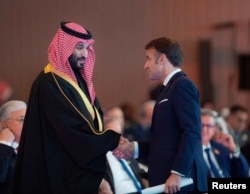
Saudi Crown Prince Mohammed bin Salman begins a two-day visit to France on August 23 to discuss developments in Iran and the situation in the Middle East with French President Emmanuel Macron.
The French presidential palace announced that Macron and bin Salman will discuss "key regional issues," negotiations that, according to Paris, require close coordination between France and its partners in the Persian Gulf countries in the current circumstances to strengthen stability and peace in the Middle East.
Saudi Arabia, a close ally of the United States that has a long history of tension with Iran, is closely following developments in the region.
Bin Salman and Macron will also chair the first meeting of the Saudi-French Strategic Partnership Council on August 24. Several agreements in the fields of health, transport, and energy are also expected to be signed during the trip.
Iran Hangs Another January Protester As Surge In Executions Continue
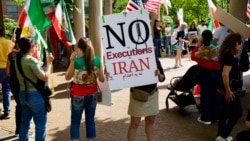
Iran's judiciary announced on August 23 that another protester arrested during the nationwide protests in January has been executed.
According to Iranian media, Majid Adineh was arrested on January 9 in the Mohammadshahr area of Karaj.
The judiciary accused Adineh of collaborating with “hostile groups,” the United States and Israel, and “inciting war." It also claimed he had "a Colt revolver, three magazines, 30 bullets, two tasers, two tear gas canisters, a rechargeable chainsaw, and a bottle of gasoline" in his possession upon his arrest.
The judiciary says his sentence was upheld after an appeal to the Supreme Court and was carried out early on August 23.
Adineh's execution is the latest in a surge of judicial killings. According to the latest data, 483 people have been put to death by the Iranian authorities this year, many of whom were sentenced to death in connection with the January protests where thousands were killed by security forces and tens of thousands more detained.
Since the start of the war with the United States and Israel on February 28, Iran has witnessed a surge in executions of people human rights groups consider political prisoners -- from demonstrators to alleged members of banned groups and those convicted of spying.
Pakistan Army Chief To Visit Tehran
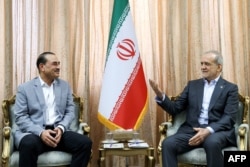
Pakistani Army chief Asim Munir will visit Tehran on August 24, Reuters reported, citing a statement by Iranian Foreign Ministry spokesman Esmail Baqaei.
Baqaei said the visit was a continuation of Pakistan’s efforts to strengthen peace and security in the region.
The visit follows an August 23 phone call between Munir and Iranian Foreign Minister Abbas Araqchi. Iranian media said the two discussed regional developments and security but gave no further details.
Pakistan has played a key role in mediating between Washington and Tehran. Islamabad is seeking to revive the Islamabad Memorandum of Understanding, which was intended to halt the fighting and provide a framework for further talks.
The 60-day deadline for reaching a final agreement expired on August 17 without a deal.
Chile Closes Embassy In Tehran Over 'Security Considerations'
Chile's Foreign Ministry announced that the country's embassy in Tehran will cease its functions and activities as of August 31 and that consular procedures related to Iran will be reassigned to the Chilean Consulate in Ankara, Turkey.
Announcing the decision on August 22, Santiago emphasized that the closure of the embassy does not imply the cessation of diplomatic relations with Iran.
According to its statement, the decision was made on the basis of “operational reorganization” aimed at directing available resources toward achieving the government's foreign-policy objectives, as well as preventive considerations arising from security factors in the Middle East.
The Chilean Foreign Ministry said the measure is intended to optimize resources allocated to Chile's missions abroad and “guarantee the due protection and safeguarding of the personnel of the mission in Tehran.”
Iranian Official Calls Any Country Cooperating With US An 'Enemy'
Mohsen Rezaei, the secretary of Iran's Supreme National Security Council, said the Iranian government views any country that cooperates with the United States in creating further economic restrictions against Iran is considered an "enemy" and threatened that in such a case, these countries will be targeted for attack.
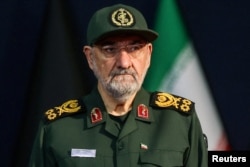
In a television interview broadcast on August 21, Rezaei also threatened that if the new US plan against Iran to impose further sanctions is implemented, Tehran will not allow "a single drop of oil to leave not only the Strait of Hormuz but the entire Persian Gulf."
These statements are the latest response from Tehran officials to the sanctions, the details of which the US government is set to announce on August 24 and which US Treasury Secretary Scott Bessent has already called "the toughest sanctions in history" against Iran.
"We are telling all surrounding countries not to engage in an economic war against Iran, and whoever does, we consider that country an enemy. First, we will negotiate so that they do not do this, and if they continue, we will target that country," said Rezaei.
US Refueling Planes Leave Bulgaria After Nearly A Month
Two US Air Force refueling planes have left Bulgaria after a temporary deployment to Bezmer Air Base, nearly a month ago.
Bulgarian Defense Minister Dimitar Stoyanov said on August 23 that two KC-135 aircraft left the country on August 21.
A month earlier, on July 22, the Bulgarian parliament approved the temporary deployment of the aircraft under an agreement governing the joint use of military facilities with the United States. The authorization allowed for up to eight KC-135 aircraft and up to 250 US military personnel.
The Iranian government had warned at the time that the US use of Bulgarian territory for military operations against Iran would make the country complicit in what Tehran called "aggression and war crimes." Bulgaria rejected the accusation.
Stoyanov said all flights by the two aircraft during their deployment were purely training missions over allied countries and that Bulgaria had "no information about direct threats to our national security."
He added: "We are working in full coordination with the US government and had prior information, which is why all our decisions were well-founded."
The departure of the aircraft comes amid heightened concern over possible Iranian retaliation against US interests and facilities in the region.
Iranian Olympic Runner Says Authorities Prevented Her From Attending World Championships

Olympic runner Farzaneh Fasihi says the Iranian authorities have prevented her from registering for the world championships and that she is also withdrawing from the Asian Games.
Fasihi posted a message on her Instagram page on August 22 saying she had been warned many times in recent months: "Be careful with your behavior! You know that the world championships and the Asian Games are coming up."
She added: "That's it. The world championship, which is the biggest dream and aspiration of every athlete, was taken from me; I will also present the Asian Games to you."
The Iranian runner says she was prevented from registering despite being the only Iranian athlete to qualify for the world championships and finish the season as the top runner in the Asian rankings.
Fasihi had previously expressed her anger and sadness over the killing of protesters following the government's violent crackdown on protesters in January.
She did not explicitly mention the issue in her new post, but she wrote that she had been pursuing her rights through legal means for months and that she would "never allow" her rights as an Iranian female athlete to be violated.
We are now closing the live blog for the day. We'll be back at 9:30 a.m. Central European time to cover the latest events across the Middle East.
Egypt Stresses Need For Diplomacy In Call With Iran Foreign Minister
In a call with his Iranian counterpart, Egypt's foreign minister underlined the importance of diplomatic efforts aimed at ending the US-Iran conflict and the need to ensure freedom of navigation in the Gulf region, the ministry in Cairo said.
Egyptian Foreign Minister Badr Abdelatty stressed in the call with Iran's Abbas Araqchi the importance of de-escalating the current situation as part of efforts to reach "peaceful understandings" that would contribute to "restoring security and stability in the region."
He pointed out the "great importance of ensuring the movement and freedom of international navigation, and respecting the security and stability of the Gulf countries, in order to achieve the interests of all the peoples of the region."

Egypt has so far not played an official mediating role between Washington and Tehran, as Pakistan and Qatar have undertaken those efforts. But the disruptions to shipping and the widening violence have caused concerns among countries in the region.
The leaders of Sunni Muslim nations Saudi Arabia, Pakistan, and Turkey came together on August 7 to sign a joint defense agreement in order to "strengthen collective deterrence against any act of aggression," although they stated it was not aimed at Shi'ite majority Iran.
Pakistani Prime Minister Shehbaz Sharif said that Egypt and other countries could eventually join the Mecca Joint Defense Agreement, which stipulates that "any armed attack against any one of the three states shall be regarded as an attack against them all."
Talks between the US and Iran have largely collapsed, with US President Donald Trump and other administration leaders threatening major new economic measures against Tehran.
A key issue facing all sides is the effort to restore freedom of navigation in the Strait of Hormuz, which Iran has effectively blocked since the outbreak of war at the end of February. Trump has said US forces now control the waterway, although Tehran disputes the claim.