





Iranian Rial Hits Record Low As US Pressure On Tehran Intensifies
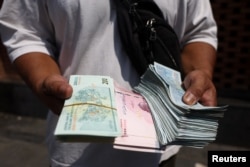
The Iranian rial hit new lows against major foreign currencies on September 2, with the euro exceeding 2.55 million rials for the first time.
Websites tracking exchange rates reported the US dollar at more than 2.2 million rials, while the UAE dirham surpassed 600,000 rials.
The rial's decline has accelerated amid mounting economic pressure on Iran, including the US campaign known as Operation Economic Outcast, launched by the Treasury Department on August 24. The campaign is aimed at cutting Iran's economic lifelines and pressuring foreign governments and businesses to reduce their dealings with Tehran.
The price of the Imami gold coin, a widely traded store of value in Iran, reached about 2.26 billion rials on September 2, according to market reports, despite a decline in international gold prices.
A day earlier, Central Bank Governor Abdolnaser Hemmati rejected claims that Iran was facing a shortage of foreign-exchange resources or that its economy was on the verge of collapse. He said the Central Bank was prepared to inject up to $2 billion into the foreign-exchange market to stabilize the rial.
The Iranian currency had lost nearly 10 percent of its value over the two weeks preceding August 24, according to AFP, and has continued to fall since then.
We are now closing the live blog for the day. We'll be back at 7:30 a.m. Central European time to cover the latest events across the Middle East.
Netanyahu Says Iran Regime Change Is 'Central Task' And 'Within Reach'
Israeli Prime Minister Benjamin Netanyahu said overthrowing the Iranian leadership was "the central task" still facing his country six months after the start of the war and that the goal is "within reach."
"This regime is currently teetering. It is weaker than ever. It is fighting for its survival," Netanyahu said at an event with Israeli military chiefs on September 3.
"I am convinced that we can remove this threat once and for all -- that is, to overthrow this regime. That is the central task that still lies ahead of us, but it is close. It is not impossible. It is within reach," he said.

"We faced the threat of annihilation by a regime that aspires to eradicate us and wants to arm itself with nuclear bombs to destroy us. We have pushed back this threat and other threats as well," he said.
The prime minister added that the Tehran regime's weakness is the main reason Iran is no longer launching attacks on Israel.
Iran's supreme leader, Ayatollah Ali Khamenei, was killed during the first day of US-Israel air strikes on Iran on February 28. Dozens of other regime and military leaders have been killed in attacks since then.
US President Donald Trump has said preventing Iran from obtaining a nuclear weapon is the main goal of the war, although he has recently pointed to the reopening of the Strait of Hormuz as a key objective.
With reporting by AFP and dpa
Vance Says US Probing Iran's Claims Of Wedding Party Attack, But He's 'Skeptical'

US Vice President JD Vance said that the United States is investigating Iranian claims that an air strike hit a wedding party, but that he is "skeptical" of reports coming out of Tehran.
"We're investigating it because obviously we care. We want to know," Vance told reporters at the White House on September 3. "I know that we're investigating, I will say that the Iranian state media has not been a very good scribe about what's happened in the conflict thus far. So I'm extremely skeptical of this."
"If we do make mistakes, again, this is a big difference between us and Iran, when our military makes mistakes, they learn from them to try to get better from them," he added.
Read more here
US Official Apologizes For Saying No Americans Killed In Iran War
US Commerce Secretary Howard Lutnick apologized for incorrectly stating that no Americans had been killed in the Iran war, acknowledging that 18 US service members had been killed.
"I misspoke. Eighteen members of our military have died, and to those families my heart breaks and I am so very sorry for their loss. I was thinking about the Venezuelan military operation where no service members died," Lutnick wrote in a post on X on September 3.

Lutnick made the erroneous comments during an interview with CNBC on September 2, in which Venezuela was not mentioned.
"I think the way the president is playing Iran…there haven't been American deaths. It's really just an economic choke-out, which the administration is now executing more broadly, and I think it'll be very effective," Lutnick told CNBC.
Moments before Lutnick's apology, US President Donald Trump defended the commerce secretary on social media.
"Sec. Lutnick had Venezuela on his mind when he said nobody was killed. 18 people were killed in Iran!" Trump wrote.
The United States has so far reported that 18 military personnel have been killed and more than 750 wounded in the Iran war, which began on February 28.
UN Special Rapporteur: Iranian People Caught Between Foreign Aggression And Internal Repression
Referring to the renewed US attacks on Iran, Mai Sato, the UN special rapporteur on human rights in Iran, called an end to "external attacks" and "internal repression" in the country.
In a post on X on September 3, Sato wrote: "The people of Iran are caught between foreign aggression and domestic repression; both foreign aggression and domestic repression must end, but above all, the war must end."
Citing figures from Iran's Health Ministry, which reported that 18 people had been killed and 108 others injured in US attacks on the evening of September 1, Sato said the strikes had targeted Kuhestak, a fishing town on the Strait of Hormuz. She added that "a house where a family was holding a wedding celebration was also targeted."
Sato said the new attacks had compounded the suffering of ordinary Iranians.
"In reflecting on this year, what stands out most is the scale of the violence and the number of lives lost," she wrote.
Sato's comments come amid renewed US-Iran hostilities and her continuing warnings about the human rights situation in Iran. She has also stressed that military action should not be viewed as a solution to Iran's problems.
IRGC Vows to Avenge 'Civilian Deaths'
Iran’s Islamic Revolutionary Guards Corps (IRGC) has vowed to avenge the killing of "civilians" in an air strike allegedly carried out by the United States earlier this week.
Iranian authorities say at least four people, including a child, were killed and 68 others injured in an strike that hit a wedding party in the country's south in the night of September 1-2.
The US Central Command said that its forces "never target civilians." Captain Tim Hawkins, spokesperson for the US CENTCOM, told RFE/RL that "we are aware of reports, which originated from Iranian state media. The US military never targets civilians, unlike the IRGC."
In a statement carried by Iran's state television, IRGC chief Ahmad Vahidi said the "blood of these oppressed martyrs will not go unanswered."
The midnight strike was carried out in Kuhestak, a town along the coast of the Strait of Hormuz. Earlier, Iranian officials labeled the attack a "war crime," alleging it was carried out by the Untied States.
Iran and the United States have resumed tit-for-tat attacks following a lull of several weeks since July.
On September 3, Iran launched missile and drone attacks against neighboring Kuwait and the United Arab Emirates, calling them retaliation for US strikes on targets inside Iran.

w
Qatar Condemns Iranian Attacks on Kuwait
Qatar has condemned Iran's latest attacks against Kuwait and called them a breach of international law that represents a "dangerous escalation" in the region.
The Qatari Foreign Affairs Ministry said in a statement on September 3 that the renewed attacks would complicate efforts to contain tensions and undermine political and diplomatic efforts to end the conflict.
Earlier on September 3, the Iranian military announced that it had carried out strikes on US bases in Kuwait and the United Arab Emirates.
The statement said the US military's satellite communication systems, equipment depots, and fighter aircraft hangars were hit at the Ahmed Al-Jaber base in Kuwait in the fresh attacks using missiles and drones.
Qatar called the attacks a "flagrant violation" of the sovereignty and territorial integrity of Kuwait, adding that Qatar "holds the Islamic republic of Iran legally responsible for these attacks and their repercussions and consequences."
Expressing solidarity with the state of Kuwait, the statement announced Qatar's support for "all measures it takes to safeguard its sovereignty and security."
Several Gulf countries, including Qatar, have been targeted by Iranian missiles and drones since the beginning of the US-Iran conflict on February 28.
The state of Qatar has served as a key mediator alongside Pakistan, in efforts to resolve the conflict.
On August 27, Qatari Prime Minister Sheikh Mohammed bin Abdulrahman bin Jassim Al Thani visited Tehran and held talks with senior Iranian officials in a bid to de-escalate tensions.
Oil Prices Hit 5-Week High Amid Renewed US-Iran Strikes
Oil prices reached their highest levels in about five weeks amid renewed fighting between the United States and Iran and concerns about disruptions to crude supplies through the Strait of Hormuz.
Brent crude briefly rose above $97 per barrel on September 2, reaching a roughly five-week high, before retreating a day later. U.S. West Texas Intermediate crude also rose sharply earlier in the week but remained around $91 per barrel on September 3.
Early on September 3, Brent was trading at about $95.20 a barrel, down around 0.45 percent, while WTI was at about $90.77, down 0.26 percent, according to Reuters.
The increase in oil prices came amid renewed US-Iran hostilities and concerns that further fighting could disrupt oil supplies from the Middle East, particularly through the Strait of Hormuz.
On September 2, US President Donald Trump said the United States was prepared to carry out another attack on Iran "anytime we want," while also saying the renewed US military campaign would not last "too long."
Iran, meanwhile, launched retaliatory attacks against US positions in the Gulf. The Islamic Revolutionary Guards Corps and Iranian military authorities said they had targeted US facilities in Kuwait and the United Arab Emirates on September 3.
Iran Says 18 People Killed In Latest US Strikes
The spokesman for Iran's Health Ministry said the death toll from the latest US attacks had reached 18.
Hossein Kermanpour posted a message on X saying that between 8:30 p.m. on August 30 through 8:30 p.m. on September 2, "18 people were killed and 142 injured" as a result of the attacks.
In his message, the government official did not differentiate between whether the dead were military or civilian, but he wrote that the number included two women and a child.
Iranian officials had previously said four people, including a child, were killed in a strike on a wedding ceremony in the Kuhestak area of Hormozgan Province. Iranian officials said dozens of others were wounded in the alleged September 1 strike in Kuhestak, a town along the coast of the Strait of Hormuz, a major flashpoint in the confrontation with the United States.
The Iranian Red Crescent Society said shrapnel from the alleged US attack struck a residential home where a wedding party was being held.
The deputy security and law enforcement officer of the Khuzestan governor's office had reported that "seven people were killed" in Ahvaz and Aghajari, and news agencies close to Iran's Islamic Revolutionary Guards Corps (IRGC) had also reported the killing of "four IRGC aerospace officers" in Kermanshah, as well as "three Basij forces" on Lavan Island.
Tasnim News Agency, which is close to the IRGC, reported that three Iranian Army pilots were killed in a US attack on Iran on the night of September 1.
The news agency, publishing the names and pictures of these pilots, said two of them were naval pilots and one was an air force pilot, but did not say where or how they were killed.
6 Ships Passed Through Strait of Hormuz On September 2, Kpler Says
The passage of ships through the strategic Strait of Hormuz remained at its lowest level -- just six ships a day -- on September 2, compared with data from the previous 10 days.
Data collected by the Kpler ship-tracking company on September 2, which was released on September 3, showed only six ships passed through the waterway as compared to 11 on September 1 and an average of 13 ships a day in the past 10 days.
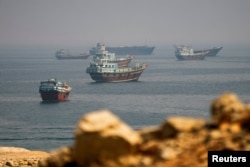
Because some ships turn off their locator transmitters while passing through the strait, the data may not reflect the exact number of ships.
The Strait of Hormuz has effectively been closed by Iran since the beginning of the Middle East conflict in late February. The vital waterway previously accounted for 20 percent of global oil and gas supplies.
Earlier, US President Donald Trump claimed an average of 30 ships pass through the strait each night with the help of the US military. Trump did not specify the average time frame for the passing of the ships through the strait.
The US-Iran conflict has disrupted a major part of global oil supplies and caused fuel prices to skyrocket on international markets.