





Pakistan Vows 'Unwavering Support' For Saudi Arabia
Pakistan has “strongly” condemned Iran's July 13 missile attack against Saudi Arabia and warned such “reprehensible actions” constitute a violation of the sovereignty and territorial integrity of the country.
In an , Prime Minister Shehbaz Sharif said such actions “have the potential to further undermine regional peace and stability.”
While reiterating his country’s efforts for peace and security in the region, Sharif reaffirmed Islamabad’s “unwavering support” for the security of the kingdom.
Pakistan and Saudi Arabia have close religious, economic, and strategic ties. Last year, Islamabad and Riyadh formally entered a Strategic Mutual Defence Agreement, which stipulates that "any aggression against either country shall be considered an aggression against both."
On July 13, the Iran-aligned Houthi militia in Yemen, fired missiles at Saudi Arbia after they accused the kingdom of bombing an airport under their control. The missile strike apparently brought an end to the four-year truce between the Yemen-based Houthis and the Saudis.
Since the beginning of the conflict in late February, Pakistan remained one of the active players in arranging a cease-fire between the United States and Iran by hosting delegations from the two countries for face-to-face talks in Islamabad in April.
Pakistani army chief Asim Munir, once described by President Donald Trump as his favorite field marshal, paid several trips to Tehran to shore up the temporary cease-fire announced by the US president on April 7.
US Completes Another Round Of Strikes On Iranian Military Targets
US Central Command (CENTCOM) said it had completed another round of overnight strikes on Iranian military targets near the Strait of Hormuz and along Iran's coast, while reimposing a naval blockade on vessels traveling to or from Iranian ports, as Tehran said it had targeted US military facilities in Bahrain and Kuwait.
"US fighter aircraft, drones, and naval vessels launched precision munitions against Iranian missile and drone sites, naval capabilities, and coastal defense systems during the seven-hour wave to further degrade Iran's ability to threaten commercial shipping and civilian crews," CENTCOM said in a post on X.
"There are currently more than 20 US Navy warships and hundreds of military aircraft operating across the Middle East," CENTCOM added.
Iran's Islamic Revolutionary Guards Corps (IRGC) said it launched strikes against US military facilities in Bahrain and Kuwait, including sites used by the US Fifth Fleet, while Jordan's military reported on July 15 it intercepted and shot down three Iranian missiles.
CENTCOM Commander Admiral Brad Cooper also said Iran had intentionally attacked seven commercial ships over the past seven days across the region, leaving nearly a dozen civilian crew members killed, injured, or missing.
He said that Iranian forces also launched dozens of missiles and drones toward neighboring Gulf countries.
Meanwhile, US President Donald Trump warned that unless Tehran returns to the negotiating table, the United States could expand its campaign to target Iranian civilian infrastructure, including power plants and bridges. Speaking in an interview with Fox News on July 14, Trump said the United States would strike Iran "very hard" over the coming nights. Trump added that military strikes against Iran will continue "until I say it's enough."
New US Measures Target Iran's Sanctions Evading Network
- By RFE/RL
The US Treasury has announced a series of moves to increase pressure on Iran's sanctions evading network, especially targeting Mohammad Hossein Shamkhani, which it says remains a "major force" behind Tehran’s oil exports while expanding into global containerized shipping and commodities trading.
“The Iranian regime survives on deception, and the Shamkhani network is one of its most profitable engines,” Treasury Secretary Scott Bessent said in the statement announcing the sanctions on July 14. “Treasury is shutting down the financial infrastructure that allows the regime to continue its threats to U.S. national security and global shipping.”
In all, the action includes more than 50 individuals, entities, and vessels that Washington says enable Shamkhani and the Iranian regime "to continue profiting while the Iranian people remain burdened under the economic yoke imposed by their government."
"This action is part of Treasury’s ongoing efforts to ramp up economic pressure on the Iranian regime after it resumed destabilizing attacks in the Strait of Hormuz," the Treasury said in the statement.
By threatening and attacking international shipping in the Strait of Hormuz, Iran has brought maritime traffic to a virtual standstill, giving it significant leverage over its neighbors in the Persian Gulf and the global economy, making it one of the main battlegrounds of the conflict.
Saudi Arabia Denounces Iranian Attacks On Gulf Countries, Warns Of Consequences
Saudi Arabia's Foreign Ministry has expressed "strong condemnation" of Iran's attacks on several Arab countries, holding Tehran "responsible for the consequences of continuing these cruel attacks."
In a statement on July 14, Riyadh specifically mentioned strikes against of a number of Kuwaiti border posts, an offshore drilling platform belonging to the Kuwaiti Oil Company, and attacks on the Kuwaiti Consulate General in the Iraqi city of Basra.
Citing Iran's attacks on Jordan, Bahrain, Qatar, and two Emirati oil tankers while they were passing through the Strait of Hormuz, the Saudi government criticized "Iran's continued threat to regional security and stability."
"The Kingdom holds Iran responsible for the consequences of these ongoing hostilities" and demands an immediate halt to the violations, the statement went on to say, emphasizing Riyadh's full solidarity with the targeted countries.
Iranian Media Report Explosions On Qeshm Island And In Andimeshk
Iranian media has reported that explosions were heard on Qeshm Island and in the southwestern city of Andimeshk, without providing further details.
Citing the Hormozgan provincial governor's office, Islamic Republic of Iran Broadcasting said that at 7 p.m. local time on July 14, a "location" on Qeshm Island was targeted in a US attack.
The state broadcaster also reported that an explosion was heard in Andimeshk, although it later reported that these were "controlled explosions" and not an enemy attack.
Also in the evening of July 14, Kuwait's General Staff issued a warning saying that "hostile aerial targets" had been intercepted over the country.
In a statement, the Kuwaiti military urged citizens to follow security instructions, saying that any explosion sounds they might hear were the result of air defense operations "intercepting hostile attacks."
With reporting by RFE/RL's Radio Farda, Reuters, and AFP
Trump Drops Threat Of Hormuz Transit Fee, Turns To Gulf Investment Deals
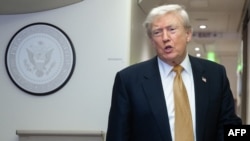
US President Donald Trump has walked back his plan to charge a 20 percent fee on cargo shipped through the Strait of Hormuz, replacing it with proposed trade and investment agreements with Persian Gulf states.
The reversal came a day after Trump said the United States would act as “THE GUARDIAN OF THE HORMUZ STRAIT” and seek reimbursement for protecting shipping through the key oil and gas route.
“Based on highly productive conversations with Middle East leadership, I have decided to replace the 20% United States Reimbursement Fee with Trade and Investment Deals that the various Gulf States will be making into the United States,” Trump wrote on Truth Social on July 14.
He provided no details of commitments by Persian Gulf governments but said the investments would be “MASSIVE.”
Iran's military command had earlier said it would not allow the United States to “interfere” in the strait and warned Gulf neighbors against cooperating with Washington.
Trump said the strait would remain open to commercial traffic except vessels linked to Iran.
Washington would maintain a “FULL Blockade” on ships entering or leaving Iranian ports, or carrying Iranian cargo, he said.
The UN shipping agency had opposed imposing fees on vessels using international waterways.
With reporting by AFP and Reuters
US Employs Sea Drones As Strikes Escalate In Strait Of Hormuz
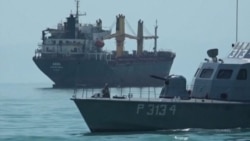
In addition to a night of renewed US strikes on Iran, the American military's Central Command reports that its forces targeted a submarine and ship maintenance facility in the Iranian port of Bandar Abbas using sea drones, which marks a first in American combat weapons technology. Three Corsair drones reportedly hit the port naval base. Iran has also claimed hits on at least two commercial ships in the Strait of Hormuz.(Video by RFE/RL's Radio Farda and Will Tizard)

China Urges Restraint In Middle East As War Fallout Damages Fuel, AI Sectors
- By Colin Hood
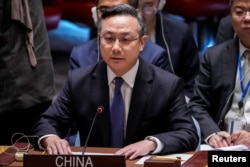
Beijing has called on all sides of the war in Iran to “avoid escalating the conflict” amid fresh strikes as China's crude oil imports hit a 10-year low and helium shortages threaten its AI chip manufacturing.
The United States and Iran have escalated strikes as Washington prepares to reinstate a naval blockade against all maritime traffic through the Strait of Hormuz on July 14.
Chinese Foreign Ministry spokesperson Lin Jian told reporters on July 14 that China will “make unremitting efforts to cool and stabilize” the situation in the Middle East.
During an emergency briefing of the UN Security Council on July 13, China’s deputy ambassador to the UN, Sun Lei, called on both Washington and Tehran to “resume follow-up negotiations” in an attempt to end hostilities.
Sun added that “resuming safe and free passage in the strait at an early date serves the interests of all sides."
China has maintained a consistent line of de-escalation since US and Israeli strikes hit Iran on February 28.
Since then, Beijing has played a moderating role largely behind the scenes, working closely with Pakistan, a close ally, as well as Persian Gulf states.
The disruption to shipping through the Strait of Hormuz has taken its toll on China's economy.
Before the war, around 20 percent of global oil trade passed through the chokepoint, and Beijing purchased 80 percent of Iranian shipped oil.
Beijing's Commerce Ministry scrambled to mitigate shortages by banning helium exports on July 10 as strikes intensified. Qatar, which provides China with more than half of its supply of helium, has seen exports interrupted since the war began.
Imports of crude oil have slumped 41.3 percent, their lowest point in a decade.
Fuel export restrictions, in operation from March to protect domestic supply, had damaged local industry and put pressure on Asian markets, where China is a major supplier of refined oil products.
Reuters reported on July 8 that China had lifted export restrictions for the rest of July to normalize supply lines. Hours later, US President Donald Trump told reporters at the NATO summit in Ankara that the peace agreement with Iran was “over” following renewed strikes.
Jordan Says Downs Iranian Ballistic Missiles Targeting US Base
The government of Jordan said it intercepted four Iranian ballistic missiles targeting a US air base in the country after a warning by Iran's Islamic Revolutionary Guards Corps (IRGC) that Amman dismantle American bases in the kingdom.
Jordanian state media quoted a government statement as saying the missiles were shot down on July 14 after they entered the country's airspace.
The IRGC confirmed the attack in a statement released through the Fars news agency, though it added that the strikes were not intended to harm Jordanians.
"You know very well that not only do we not have any enmity with your country, but we also love you, the noble people, who understand the pain and oppression of the Palestinian people more than any other nation," the IRGC said in the statement.
There were no immediate reports of casualties from falling debris after the missiles were shot down.
US Military Says Naval Blockade Against Iran To Resume At 4 P.M. Eastern Time
The US Central Command (CENTCOM) said a naval blockade against all maritime traffic entering and exiting Iranian ports will be reinstated from 4 p.m. Eastern Time on July 14.
"CENTCOM forces will enforce the blockade against vessels transiting to or from Iranian ports and coastal areas. The U.S. military continues to support traffic flow through regional waters for all vessels not violating the blockade," CENTCOM said in a statement.
The move comes after President Donald Trump said on July 13 that US forces would become the "Guardian Angel" of the Strait of Hormuz, where Iran has struck commercial vessels in recent days.
The UK maritime security agency UKMTO reported another tanker being struck by a missile while transiting the strait near Oman's coast on July 14.