




Iran Executes Two More Men In Connection With January Protests
Iranian state media reported on July 28 that Abolfazl Sepahi Badjani and Amirhossein Safari Hosseinabadi had been executed in connection with the January 2026 protests in Isfahan's Malek Shahr district.
State media described the two men as being "among those responsible for the killing of four police officers" in Alikhani Square, claiming they had "injured the officers and set them on fire" during the January 8 protests.
The details of the legal proceedings, the defendants' access to lawyers and the circumstances under which their confessions were obtained could not be independently established.
Videos shared on social media appeared to show crowds gathering near the execution site to protest the hangings amid a heavy security presence.
Some showed protesters chanting "Without honor! Without honor!" as the dawn call to prayer was broadcast and security forces rode motorcycles through the crowd.
Social media users also reported clashes between protesters and security forces and internet disruptions in Isfahan.
RFE/RL's Radio Farda could not independently verify these reports.
The executions were carried out early on July 28, hours after Mai Sato, the UN special rapporteur on human rights in Iran, said a group of UN experts had urged Tehran to immediately halt the death sentences of the remaining 10 defendants in the Isfahan case.
Twelve protesters, who were in their late teens or early twenties when arrested, were sentenced to death in a closed group trial.
Two others, Gol Mohammad Mohammadi and Erfan Esfandiari, were executed on July 19.
UN experts have said the proceedings failed to meet fair trial standards, arguing the convictions relied on forced confessions broadcast on state television and did not clearly establish each defendant's individual responsibility.
Separately, the Human Rights Activists News Agency (HRANA) and the Iran Human Rights Society said prisoners in Unit 2 of Qezel Hesar Prison in Karaj continued a hunger strike and sit-in for a fifteenth consecutive day on July 27, protesting executions and the transfer of prisoners to solitary confinement.
The reports said hundreds of prisoners sentenced to death have refused prison food since July 13.
Iran's judiciary and prison authorities have not commented.
We are now closing the live blog for the day. We'll be back tomorrow at 7:30 a.m. Central European time to cover the latest events across the Middle East.
An Iranian Colonel Was Killed In January Protests. Now 16 People Face The Death Penalty.

On the night of January 8, a colonel in Iran’s Islamic Revolutionary Guards Corps (IRGC) was killed in the central city of Isfahan as mass anti-government protests raged across the country.
Months later, 16 people have been charged with moharebeh, or “enmity against God,” and could be hanged over the death of Colonel Abbas Kamrani and the violent demonstrations that night in Isfahan.
The case comes as Iran has witnessed a surge in executions of what human rights groups consider political prisoners -- from demonstrators to alleged members of banned groups and those convicted of spying -- since the start of the war with the United States and Israel on February 28.
Activists say the rise in executions is an attempt by the authorities to create fear among Iranians and prevent a repeat of the nationwide demonstrations that rattled the country’s clerical rulers earlier this year.
Rights organizations have condemned the trials of those executed, saying many of them were marked by torture, forced confessions, and the absence of due process.
Read more here
Trump Says He Will Ask Putin If Russia Supplied Satellite Images To Iran
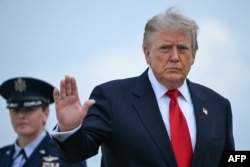
US President Donald Trump has said that he would seek clarification from Russian President Vladimir Putin about reports that Moscow had provided satellite imagery to help Iran target US bases in the Middle East.
Speaking to reporters aboard Air Force One while travelling to the state of Michigan on July 27, Trump said: "I'll ask Putin about it. We'll find out."
During the US-Israeli conflict with Tehran earlier this year, reports emerged alleging that Russia had provided intelligence assistance to the Islamic republic to help target US military assets in the Middle East.
Ukrainian President Volodymyr Zelenskiy also said on July 25 that Ukraine had obtained information indicating Russian satellites had extensively monitored US military bases in the Middle East and that Moscow had supplied the resulting intelligence and imagery to Iran for attacks on these facilities.
Trump also told reporters that the United States was having "good talks" with Iran "right now."
Asked about the prospects for reaching an agreement with Iran, Trump said: ""There's a good chance that something could happen."
Earlier on July 27, Trump also told the news outlet Axios that if the current negotiations with Iran failed, the United States "will go back to very strong military action."
With reporting by Reuters
US Says It Redirected 17 Ships While Enforcing Iran Blockade
The US military's Central Command said on July 26 that its naval forces enforcing Washington's blockade against Iran had redirected 17 commercial vessels, disabled two and boarded two others in the Arabian Sea to ensure compliance.
CENTCOM released the figures in a post on X but has not yet provided no further details.
Baghdad Opens Probe Into Saudi Claim Of Drone Attack From Iraqi Territory
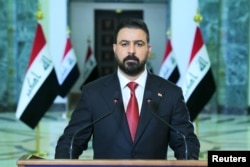
Iraqi Prime Minister Ali al-Zaidi has ordered an investigation into Saudi Arabia's claim that drones targeting the kingdom had been launched by pro-Iran groups from Iraqi territory, his spokesman said on July 27.
Zaidi directed "the competent security authorities to investigate the statement issued by the ministry of defence of the Kingdom of Saudi Arabia regarding the targeting of the kingdom with drones launched from Iraqi territory," Sabah al-Numan said in a statement.
Earlier on July 27, Saudi Arabia said it had intercepted and destroyed several drones targeting oil facilities in the kingdom's Eastern Province and the capital, Riyadh.
Defense Ministry spokesperson Turki al-Maliki said the attacks were carried out by "Iran-backed terrorist militias" operating from Iraq. He added that Saudi Arabia reserved the right to respond "at the appropriate time and place."
Saudi authorities gave no immediate details on damage or casualties, and no group has yet claimed responsibility.
The Saudi Foreign Ministry condemned the alleged attacks and urged Iraq to prevent its territory from being used to launch attacks against the kingdom.
In a separate development on July 27, Yemen's Iran-backed Houthi rebels said they had launched drone attacks on Saudi oil infrastructure.
The Houthis said they had launched the attacks in response to what they described as incursions by Saudi drones.
Spokesman Yahya Saree said "a number of sensitive targets and points involved in the supply and transport of crude oil from eastern Saudi Arabia to Yanbu were struck using several drones."
Saudi authorities did not immediately comment on the Houthi claim.
The Houthis had earlier claimed to have downed a Saudi drone over northwest Yemen and fired a missile at the southern Saudi city of Jizan over the weekend.
With reporting by AFP. This blog entry has been updated.
US State Department Calls For Halt To Executions Of Protesters In Iran
The US State Department sharply criticized the execution of Iranians by authorities and called for Tehran to release political prisoners amid signs it has ramped up its use of the death penalty in recent months to sow fear and quell dissent.
Iran is one of the world's leading executioners, according to human rights groups, who say Tehran is using the cover of the current war with the United States to justify increased usage of capital punishment and spread fear among Iranians.
According to the latest data, 424 people have been put to death so far in Iran in 2026.
In a post on July 26, Riley Barnes, US assistant secretary of state for democracy, human rights, and labor, called for a halt to the execution of individuals "for peacefully exercising human rights and fundamental freedoms."
"We condemn the Iranian regime's action in executing its own citizens, brave young Iranians who dared to speak out," Barnes wrote on X.
"We join the people of Iran in calling on the regime to release all political prisoners and stop executing individuals for peacefully exercising human rights and fundamental freedoms. The world is watching," he added.
To read the full report, click here.
Pentagon Revises Casualty Figures Sparking Transparency Debate
The Pentagon has revised down its official casualty figures from the war with Iran, updating the number of US military personnel killed and wounded during the five-month-old conflict.
The move has sparked questions about the Pentagon's methodology and concerns over transparency, from Democratic lawmakers and others.
According to the latest Defense Department figures, as of July 27, 14 US personnel have been killed and more than 400 wounded.
That is fewer than the official Pentagon database showed as of July 21 -- 18 -- a figure that was cited by President Donald Trump on July 23 and again on July 26.
The Defense Casualty Analysis System, which the Pentagon has referred to as the definitive source on casualties, also added a new category called “Overseas Operations.”
That category is for those killed and wounded starting from July 7, officials said. Four servicemen and women – three killed in an Iranian missile attack in Jordan and one killed in Iraq during a mission to detonate Iranian ordinance – appear in this category.
Explanations for the new category are not entirely clear.
To read the full story, click here.
IRGC Says It Prevented 6 Ships From Passing Through Strait Of Hormuz
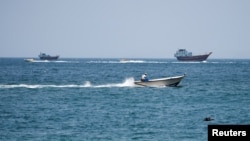
Iran's Islamic Revolutionary Guards Corps (IRGC) prevented six ships from passing through the Strait of Hormuz on their way out of the Persian Gulf early on July 27, according to reports in Iranian state media.
"In the early hours of this morning, Monday, July 27, six offending ships, by turning off their navigation and positioning systems...intended to pass through the illegal and unsafe route south of the Strait of Hormuz," the Iranian Broadcasting Agency (IBA) wrote on its Telegram channel.
The report refers to the southern part of the Strait of Hormuz near the coast of Oman, which has declared itself subject to international rules for the use of waterways. Iran, on the other hand, insists that ships must navigate along a route determined by the IRGC.
IBA also wrote that one of the six ships "suffered an accident," but no other source has confirmed this news so far.
On July 26, the Tasnim news agency, which is closely affiliated with the IRGC, claimed that an oil tanker in the Strait of Hormuz had exploded after hitting a naval mine.
Shipping Slows In Red Sea Following Houthi Attacks On Saudi Vessels
Ship traffic through Bab el-Mandeb fell after Iran-allied Houthi rebels in Yemen attacked Saudi oil installations along the Red Sea coast, adding to the woes caused by separate disruptions in the Strait of Hormuz, shipping data showed.
Kpler, a commodity intelligence company, said 11 commodity vessels passed through the Bab el-Mandeb strait on July 26, the lowest level in months.
Traffic in the Red Sea has been disrupted off the Yemeni coast for the past week by the Houthi rebels, who have announced a blockade of Saudi ports -- a move that has expanded the US-Iran conflict that has already hit oil supplies that normally transit the Strait of Hormuz.
Houthi military spokesperson Yahya Saree said the group had launched missiles at sites belonging to Saudi state oil company Aramco in the cities of Jizan and Yanbu on July 25.
Meanwhile, fewer than 10 commodity vessels passed through the Strait of Hormuz daily over the weekend, even though Washington and Tehran have paused strikes in the Middle East, Kpler data showed.