



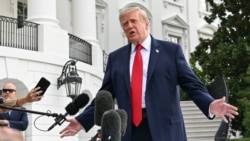

Saudi PM Urges De-Escalation In Call With Trump
Saudi Arabia's prime minister, Crown Prince Mohammed bin Salman bin Abdulaziz Al Saud, urged de-escalation in the US-Iran war during a phone call with US President Donald Trump, the Saudi Press Agency reported on August 2.
The two leaders discussed "developments in the region and their regional and international implications," the report said.
Al Saud "stressed the need to prioritize dialogue to reduce escalation and the importance of making every possible effort to achieve calm that paves the way for diplomatic solutions, preserves the region's security and stability, and prevents a wider conflict whose repercussions would affect regional and international security and stability," it continued.
We are now closing the live blog for the day. We'll be back tomorrow at 9:30 a.m. Central European time to cover the latest events across the Middle East.
Rubio Says Iran Regime 'Has To Change,' Even If No 'Regime Change'
The Iranian regime "has to change" its ways, even if there is not an official "regime change" in Tehran, US Secretary of State Marco Rubio said in a Fox News interview conducted by Lara Trump, the US president's daughter-in-law.
When asked whether Washington can bring about the "denuclearization" of Iran without regime change in Tehran, Rubio said:
"I think what does -- the regime has to change. You might not have a regime change, but the regime has to change," Rubio said.
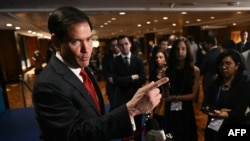
"The Iranian regime traditionally has been expeditionary. In essence, their view is they don’t want to just govern Iran; they want to govern the region. They view them -- they want to export the revolution.
"That does have to change, and the only way you’re going to change that is if you make the price of it too high for them to be able to pay," he added.
"Iran wants a nuclear weapon, and they were building a conventional missile shield that they were going to hide behind. In essence, they wanted to be in a position a year and a half from now to be able to say: 'We have so many drones and so many missiles, you can’t possibly defend against them.'"
"That’s the place they wanted to get to. President [Donald] Trump said we’re not -- I’m not going to let you get to that place, and he went after -- wiped out their navy, wiped out their air force, wiped out their missile defenses, wiped out their launchers, wiped out their factories that make all of these things, and severely degraded their defense capabilities," Rubio said.
Trump Says He Has Decided To 'Cancel' Impending Attack On Iran, Insists Deal Is Close
US President Donald Trump said he has decided to "hold off" on any new attacks on Iran, saying that "the perimeters" of a deal have been agreed to with Tehran and adding that Israel was joining him in the commitment.
"The U.S.A. is locked and loaded and ready to go against the Islamic Republic of Iran, at levels of Military Terror, Strength, and Power not seen since World War II. Despite this, we have just been asked by Iran, and other Middle Eastern Countries, to hold off any attack in that the perimeters of a deal has been agreed to," Trump posted on Truth Social late on August 1.
"This would include the Immediate, Complete, and Total OPENING OF THE HORMUZ STRAIT, and an end to Iran’s nuclear threat."
"Based on this request, I have agreed, for the future benefit of the WORLD and, likewise, the survival of a successful and prosperous Iran, to cancel the attack, subject to being able to rapidly make a DEAL," he wrote.
"The Country of Israel joins me in this commitment. Get to work, everybody, and get it DONE!" Trump added.
Trump has often threatened major attacks on Iran only to call them off, claiming that an agreement between Washington and Tehran was imminent. Until now, a lasting peace agreement has been elusive, with tit-for-tat strikes by both sides resuming.
Although Trump initially said the elimination of Tehran's nuclear threat was the major aim of the US-Israeli war with Iran, which began on February 28, in recent weeks he has focused on the free flow of traffic through the important Strait of Hormuz.
More than 20 percent of the world's oil and gas supplies moved through the strait prewar, but Iran has at times effectively shut down the waterway, including with attacks on ships it said had not received proper approval from Tehran. Iran has also threatened to impose fees or tolls on ships in the strait.
The US and other countries have insisted that the strait is an international waterway and is not under the control of any nation.
The United States and Iran signed a 60-day memorandum of understanding (MOU) on June 17 aimed at ending hostilities and reopening the strait. However, disputes over the meaning of the terms in the agreement have led to fresh attacks by both sides.
Trump told Axios on July 23 that he was seriously considering “a massive attack” on Iran. But he later backed down from the threat, saying on July 27 that a new round of diplomacy with Iran could produce a breakthrough, although he has always kept open the possibility of further strikes.
Israel, which is conducting a separate war with Hezbollah militants in Lebanon, has often resisted peace deals suggested by the US administration, saying it would continue its attacks as long as necessary.
Iran-backed Hezbollah, a militant group and political party that controls much of southern Lebanon, is considered a terrorist organization by the US, while the European Union has blacklisted its armed wing but not its political branch.
Iranian Foreign Minister Holds Calls With Turkish, Pakistani, Saudi Officials
Iranian Foreign Minister Abbas Araqchi held separate calls with senior Turkish, Pakistani, and Saudi officials, telling them that Tehran would retaliate if Washington follows through on threats by US President Donald Trump to launch new waves of attacks.
Araqchi on August 1 told powerful Pakistani Army Chief Field Marshal Asim Munir and Turkish Foreign Minister Hakan Fidan that Iran would act decisively to any "aggression" and “destabilizing actions" by US forces.
Later the Iranian diplomat told Saudi Foreign Minister Prince Faisal bin Farhan that any attacks by the U.S. and Israel or participation by other Gulf nations in strikes would be met with a “proportionate response.”
At a cabinet meeting on July 31, Trump said he believed US negotiators could still reach a peace deal with Iran.
But ha also warned that he was losing faith in the Iranians, saying that "they break their word so often."
The comments come after US embassies in Jordan, Israel, and Iraq issued a security alert to US citizens in those countries, warning of the "potential for unforeseen escalation" amid "heightened tensions" in the Middle East.
"Americans currently in the Middle East should exercise caution and heightened vigilance and should be prepared for flight cancellations, periodic airspace closures, and potential travel disruptions," read the security alert, which was posted on the embassies' websites.
With reporting by Reuters
Prison Hunger Strike Ends After Iran Agrees To Temporary Halt In Drug Executions
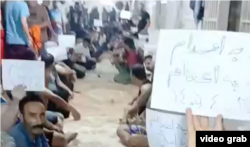
A hunger strike by hundreds of death-row prisoners at Ghezel Hesar Prison has ended after Iranian authorities met with the striking inmates and promised a temporary halt to drug-related executions at the facility, according to the Iran Human Rights organization (IHRNGO).
IHRNGO announced on July 29 that six prisoners sentenced to death in drug-related cases were transferred back from solitary confinement to the prison's general wards following the meeting. The authorities also pledged to suspend executions related to drug offenses at Ghezel Hesar for the time being.
The hunger strike began on July 12 after six death-row prisoners were transferred to solitary confinement in Unit 2 of Ghezel Hesar Prison, a section that houses around 1,500 prisoners sentenced to death in drug-related cases. The protest became a rare instance of collective action by prisoners facing execution and drew attention from rights groups and international observers.
IHRNGO Director Mahmood Amiry-Moghaddam welcomed the temporary halt, saying it demonstrated that authorities were capable of stopping executions when the political cost of carrying them out increased.
To read the full report, click here.
US Embassies In Middle East Warn Of 'Potential Unforeseen Escalation'
The US embassies in Jordan, Israel, and Iraq issued a security alert to US citizens in those countries on August 1, warning of the "potential for unforeseen escalation" amid "heightened tensions" in the Middle East.
"Americans currently in the Middle East should exercise caution and heightened vigilance and should be prepared for flight cancellations, periodic airspace closures, and potential travel disruptions," read the security alert, which was posted on the embassies' websites.
It warned US citizens in the region to "consider departing, or be prepared to depart should there be escalation," adding that "Americans outside the Middle East should seriously reconsider travel to and through the region."
The Baghdad embassy additionally advised: "In the event of an attack, seek shelter in a safe location and avoid approaching debris or falling objects."
The alert comes as the United States and Iran have traded strikes, with Iran threatening to target US interests in the region in retaliation for its strikes on Iran.
Iran Military Commander Says Countries Who Aid US 'Will Burn In The Fire Of War'
An Iranian military commander warned on August 1 that countries in the region cooperating with the United States could face the consequences of the escalating conflict.
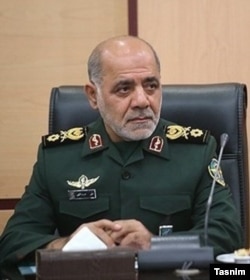
Major General Ali Abdollahi, commander of Iran's Khatam al-Anbiya Central Headquarters, urged Muslim countries to reconsider their cooperation with Washington, saying countries that make themselves a “defensive shield” for the United States would “burn in the fire of war,” according to the ISNA news agency.
Abdollahi accused the United States of using regional countries and their infrastructure to support its military operations. His comments came amid escalating hostilities between Iran and the United States and heightened security concerns across the region.
Several regional countries have stepped up efforts to protect maritime traffic as concerns over the security of key shipping routes continue to grow.
Kuwait Says Air Defenses Engage Iranian Drones As 2 Tanker Incidents Reported Off Oman
Kuwait said on August 1 that its air defenses were engaging Iranian drone attacks, while the United Kingdom Maritime Trade Operations (UKMTO) reported two separate maritime incidents involving tankers off the coast of Oman amid heightened tensions in the Gulf.
Kuwait's military said its air defenses were confronting hostile drones following what it described as Iranian aggression. It said explosions heard in the country were caused by air-defense systems intercepting incoming attacks and urged residents to follow official safety instructions.
Separately, UKMTO said a tanker was struck by an unknown projectile about 20 kilometers northeast of Lima, Oman, damaging its engine room and leaving the vessel unable to maneuver. No casualties or environmental impact were reported.
Later, UKMTO reported a second incident about 39 kilometers northeast of Khasab, where a tanker crew saw a large splash and an explosion close to the vessel. No damage was reported.
Lima and Khasab are on Oman's Musandam Peninsula at the entrance to the Strait of Hormuz, a key shipping route through which about a fifth of global oil consumption passes.
Shipping through the Strait of Hormuz has faced increased risks in recent weeks as Iran and the US have stepped up hostilities, with some shipowners taking additional precautions.
With reporting by AFP and Reuters
We are now closing the live blog for the day. We'll be back tomorrow at 9:30 a.m. Central European time to cover the latest events across the Middle East.