





Bessent Says 'Toughest Sanctions In History' Will 'Collapse' Iranian Regime
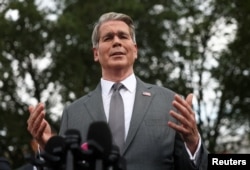
Treasury Secretary Scott Bessent said the United States will impose "the toughest sanctions in history" on Tehran and suggested plans to turn up the economic pressure mean major US military attacks on Iran are unlikely to resume soon.
"It is a one-two punch. We have the blockade [on Iranian ports], and we are going to have the toughest sanctions in history," Bessent told US network CNBC on August 20. "It is going to work in Iran and we are going to collapse this regime."
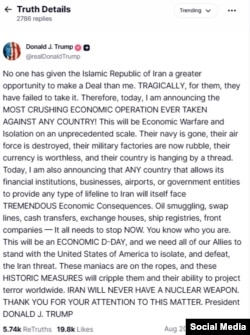
Bessent's comments came a day after President Donald Trump threatened Iran with “Economic Warfare and Isolation on a tremendous scale” and warned that any country providing support to Iran will face severe economic fallout.
In addition to pressure on Tehran, "ANY country that allows its financial institutions, businesses, airports, or government entities to provide any type of lifeline to Iran will itself face TREMENDOUS Economic Consequences," Trump wrote on his Truth Social platform late on August 19.
"This is going to be the greatest coordinated economic isolation in the history of the world," Bessent said. "And we are going to [allies] and saying you are either with us or against us."
Neither Trump nor Bessent offered much detail.
Bessent told CNBC he would hold a press conference on August 20 "to talk about exactly what we're going to do."
As oil prices rose on August 20, Bessent said he believed oil markets were "misinterpreting what this economic pressure means. If we are doing the maximum economic pressure, then that means that likely there will not be a large-scale kinetic restart."
"Kinetic" in this context refers to military action.
Trump's warnings came in a social media post in which he said Tehran had failed to agree to a deal with United States.
That post came hours after Trump said that negotiations with Iran could possibly resume "at some point" but expressed satisfaction with the current state of affairs, saying, “Right now, I think the situation is so good."
A 60-day negotiating period established under a US-Iran memorandum of understanding (MOU) signed in June expired earlier this week. The MOU was intended to establish a framework for ending the conflict, preventing Iran from obtaining a nuclear weapon, and restoring freedom of navigation through the Strait of Hormuz.
The United States says Iran violated the June understanding by attacking neutral commercial vessels in the strait in July, prompting renewed US military action. The US-Israeli war with Iran began on February 28.
This blog entry has been updated to include Scott Bessent's comments. With reporting by AFP and Reuters.
Iran's Qalibaf Meets With Iraqi Prime Minister
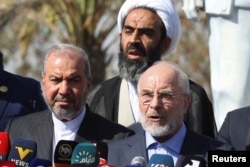
Mohammad Baqer Qalibaf, speaker of the Iranian parliament, held talks with Iraqi Prime Minister Ali Faleh Al-Zaidi on August 19, the first day of his visit to Iraq.
Qalibaf described the purpose of his visit as "to strengthen the new order in the region and accelerate the strengthening of cooperation between all countries in the region without foreign interference."
However, efforts to disarm Iranian-backed Iraqi armed groups have become a prominent issue in relations between Baghdad and Washington in recent months.
The Iraqi government, under pressure from the United States, has given these groups until September 30 to hand over their weapons. This date coincides with the end of the US-led international coalition mission against Islamic State.
Iran Estimates War Damages To Property, Excluding Tehran, At $196 Billion
Iran's Islamic Revolution Housing Foundation says that the damage caused during the 40-day war with the United States and Israel to "residential units, commercial premises, and people's belongings throughout Iran except for the capital" is estimated at more than 37 trillion tomans (approximately $196 billion).
An official of the foundation, Majid Jodi, told the state-run IRNA news agency on August 19 that more than 140,000 damage assessment files had been filed so far, of which about 110,000 are related to homes and commercial units, and about 35,000 are related to damage to people's livelihoods and belongings.
Jodi said that 25 Iranian provinces suffered damage during the war, with provinces of Ilam, Kermanshah, and Kurdistan hit the hardest.
The foundation's statistics do not include damage to infrastructure, industrial and military facilities, or the complete statistics of damage in Tehran.
Global Oil Prices Hit Highest Level In 2 Weeks
The upward trend in global oil prices continued as the fate of negotiations regarding the reopening of the Strait of Hormuz became more uncertain, and the price of a barrel of Brent crude oil increased by 1 percent to $92 on August 19 compared to the previous day.
US oil prices also reached $85 per barrel. These figures are the highest oil prices in the past two weeks.
On August 17, US President Donald Trump said, "There are no talks or conversations going on, or scheduled, with the Islamic Republic of Iran."
At the same time, tensions have increased in recent days in the Strait of Hormuz with the continued attacks on several ships and the UAE's announcement that it will counter new missile attacks from Iran.
NATO Responds To Reports Of Possible Iran Threats Against Bulgaria, Cyprus
NATO said it was prepared to respond to any threat and take the necessary action to defend its members after a report said Iran had considered targeting US military assets in Bulgaria and Cyprus if its conflict with the United States escalated further.
An unnamed NATO official, speaking to Reuters, also said that NATO's deterrence and defense posture was "strong and effective."
The comments came in response to a report published by the Financial Times, which cited sources inside the Iranian government as saying Tehran had considered possible strikes against targets in Europe, including Bulgaria and Cyprus, if Washington escalated the conflict. The report did not say that an Iranian attack was imminent.
Bulgaria last month allowed US military refueling aircraft to use Bezmer Air Base. Cyprus is also home to British military bases and has played a strategic role during regional tensions and military operations.
The Financial Times further reported, citing Iranian sources, that Tehran had separately considered the possibility of attacking undersea fiber-optic cables in the Strait of Hormuz in the event of further escalation.
Responding to the report, the NATO official told Reuters that the alliance was "prepared to address any threat" and would "take necessary action to defend all its members," adding: "Our deterrence and defense posture is strong and effective."
The remarks underscore NATO's concern about the possibility that an escalation between Iran and the United States could expand beyond the Middle East and potentially affect NATO member states or military facilities used by Western forces.
With reporting by Reuters
Iran Cracks Down On Azad Platform
Iranian authorities have moved against the popular online platform Azad, accusing it of publishing “falsehoods” and signaling what an Iranian political activist and commentator says could be a broader crackdown on independent Persian-language YouTube channels.
Read more from Kian Sharifi
Iran Again Warns Gulf States Against Assisting US Military
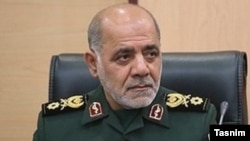
Iran has issued a fresh warning to Persian Gulf states against providing assistance to the US military.
Iranian armed forces chief of staff Ali Abdollahi said in a message published by Iranian media on August 19 that “any assistance or facilitation" provided to the US military "amounts to participation in the US military operation.”
Abdollahi also questioned Gulf states’ assertions that they have not assisted US attacks on Iran.
“It seems unlikely that such a large number of military aircraft, particularly refueling aircraft, could be present at regional bases without knowledge of host countries,” he said, adding that “nothing escapes our notice.”
He provided no evidence that these states had assisted US attacks.
Several Gulf countries host US military installations, but Arab states in the region have denied allowing their territory to be used to launch attacks on Iran.
The latest warning comes a day after the United Arab Emirates announced it was suspending all trade, commercial exchanges, and financial transactions with Iran until further notice.
Abu Dhabi said Iran had fired two ballistic missiles at maritime traffic off the UAE coast. Both fell into the sea, according to Emirati authorities, one within UAE territorial waters.
Iran has rejected the accusation.
With reporting by RFE/RL's Radio Farda and AFP
UAE Halts All Commercial Transactions With Iran
The Foreign Ministry of the United Arab Emirates announced on August 18 that it was suspending all trade and financial ties with Iran.
“In light of regional escalations that undermine regional and international peace and security, all trade, commercial exchanges, and financial transactions with Iran have been halted until further notice,” said in a statement published on the ministry’s X account.
The statement came out after the UAE said two Iranian missiles had targeted maritime navigation, although they apparently had failed to breach the territorial waters of the Emirates.
Iran rejected the UAE claim. The statement by Iranian Foreign Affairs Ministry said UAE's behavior went contrary to "the principle of good neighborliness" and disrupted efforts to prevent escalation in the region.
US Charges 17 Iranians With Conducting Massive Cyber Theft Campaign
The US Justice Department unsealed an indictment on August 18 that charges a group of individuals it claims are part of the Mabna Institute, a Tehran-based private technology company and government contractor that operates as a “state-sponsored cyber espionage and hacking group on behalf of the Iranian government.
The department said in a statement that 17 people associated with the institute were charged with 14 counts for conducting a "coordinated campaign of cyber intrusions."
The intrusions affected computer systems at 144 U.S.-based universities, 178 foreign universities, at least 42 U.S.-based private sector companies, at least 11 foreign private sector companies, at least five U.S. federal and state government agencies, and at least two non-governmental organizations (NGOs), the statement said.
"The defendants conducted many of these intrusions on behalf of the Islamic Republic of Iran’s Islamic Revolutionary Guards Corps (IRGC), one of several entities within the government of Iran responsible for gathering intelligence, as well as other Iranian government and university clients," it said.
“At the behest of entities, including the IRGC, these defendants hacked into universities and other research institutions worldwide, including the United States, stealing at least 31 terabytes of information and intellectual property of untold value,” said Assistant Attorney General for National Security John Eisenberg.
Assistant Director Brett Leatherman of the FBI’s Cyber Division noted that the defendants allegedly “built and profited from a sprawling hacking-for-hire operation that targeted the intellectual property of American and allied universities, companies, and government agencies for the benefit of the Iranian government.”
According to the US Justice Department, the Mabna Institute was founded in 2013.
It is said to have compromised approximately 8,000 professor email accounts at universities located in countries around the world, including Australia, Canada, China, Denmark, Finland, Germany, Ireland, Israel, Italy, Japan, Malaysia, Netherlands, Norway, Poland, Saudi Arabia, Singapore, South Korea, Spain, Sweden, Switzerland, Turkey and the United Kingdom.
The campaign continued through at least December 2017.
Among those charged is Amir Barati, who was arrested in June by police in Montenegro after a joint operation with the FBI.
Barati, who also holds Turkish citizenship, now faces extradition to the United States.
France To Expel 2 Iranian Diplomats After Tehran Bars French Officials
France will expel two Iranian diplomats in retaliation for Tehran's decision to bar two French diplomats from returning to Iran, French Foreign Minister Jean-Noel Barrot said on August 18.
"Two Iranian diplomats in France will be expelled in the coming days," Barrot said in an X post, describing the move as a response to Iran's "intolerable" treatment of the French diplomats.
Iran said on August 17 that the two French officials would not be allowed to return after accusing them of interfering in the country's internal affairs.
Barrot said the diplomats, one of them France's cultural attache, were detained and questioned for several hours by Iranian officials on July 19 in "flagrant violation of diplomatic immunity." He said one was physically abused and described the incident as "an extremely serious act of intimidation."
Iran has denied mistreating the diplomats, saying they were briefly questioned because they had "interfered in Iran's internal affairs under the pretext of engaging with civil society."

Two prominent Iranian graphic designers, Aria Kasaei and Elaheh Naghilou, were also detained on July 19 after a meeting with the two French Embassy officials. The Hambood Collective, an independent group of artists and activists, said the pair were arrested at the same time as the diplomats.