



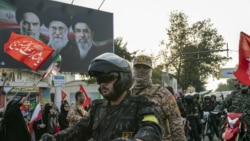

Tehran, Muscat Discuss Hormuz Navigation
Tehran and Muscat have held discussions on the revival of talks and maritime navigation in the strategic Strait of Hormuz.
Iranian Foreign Minister Abbas Araqchi spoke by phone with his Omani counterpart, Seyyed Badr Albusaidi, Iran's official news agency IRNA reported on August 22.
IRNA says the ministers exchanged views on the latest regional development, suitable conditions for resuming talks and issues related to maritime navigation in the Strait of Hormuz.
Both Iran and Oman claim territorial jurisdiction over parts of the crucial waterway. Since the beginning of the US-Israel-Iran conflict in the Middle East in late February, Iran has effectively closed the crucial waterway for maritime navigations.
Earlier this month, Iran had announced reaching an agreement with Oman on a route for shipping through the strait.
Without going into details, Iranian Foreign Ministry spokesman Esmail Baqaei had said an agreement with Oman was "in the final stages" and warned such a deal does not guarantee safe navigation.
The fresh talks between the Iranian and Omani foreign ministers followed a warning by US President Donald Trump of fresh "unprecedented" sanctions against Tehran unless the regime agrees to open the Strait of Hormuz and wrap up its nuclear program.
NATO Members Considering Freedom Of Navigation In Hormuz
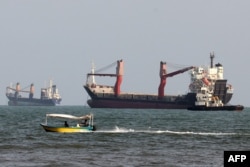
As the US-Iran conflict in the Middle East enters its sixth month and global oil supplies continue to be adversely affected, the 32-member North Atlantic Treaty Organization (NATO) is exploring options to ensure freedom of navigation in the Strait of Hormuz.
A spokesman for the alliance's Supreme Allied Commander Europe, US Air Force General Alexus Grynkewich, told Reuters news agency that members states are exploring possible cooperation on the matter, which the spokesman said will not be conducted as a formal NATO mission.
The spokesman said Grynkewich's headquarters held a videoconference with military officials from members states on August 19 to discuss options how to maintain freedom of navigation in this important waterway.
During the discussions, the spokesman said, Grynkewich emphasized that "this is not a NATO mission" but that the alliance could use its coordinating capabilities to facilitate cooperation among member states and assess what each country could contribute.
Before the war, nearly 20 percent of global oil supplies transited through the Strait of Hormuz. Its effective closure following the launch of US-Israeli strikes against Iran on February 28, has impacted global economies causing fuel prices to soar to record highs.
Damascus Says Iran Must Acknowledge Actions In Syria Before Ties Improve
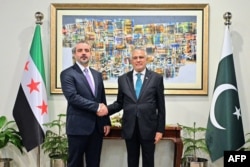
Syria says relations with Iran will improve only after the regime agrees to "recognize and admit what it has done to Syria and to the Syrian people."
The statement came from Syrian Foreign Minister Assad Hassan Al-Shaibani during his recent visit to Pakistan while replying to questions from journalists in Islamabad.
Asked if there was any mediation offer from Pakistan to bring a patch up between Damascus and Tehran, Al-Shaibani said "there was no offering of mediation" between the two countries during his current Islamabad visit.
"In the future, if the causes of such mediation or such talk with Iran are in place, and if Iran recognized and admitted what it has done to Syria and to the Syrian people, and if Pakistan is willing to have a role in such talks, so we have no problem," he said.
He added that his country was not currently seeking improved relations with Tehran. However, "if Iran changes its policy, we would have no objection," he added.
Relations between Tehran and Damascus took an about-turn following the overthrow of Bashar al-Assad regime in December 2024. Tehran remained Assad's key partner by providing military and financial support during his country's nearly 14-year civil war.
Shaibani did not rule out diplomacy with Tehran but added that an exchange of visits depended on Iran's admission of its role in Syria under the Assad regime.
"Diplomacy has no limits," he said while adding that the current Syrian government would determine that whether it would be in the interests of Syria and Syrian people.
Shaibani is the first Syrian foreign minister to visit Pakistan in nearly two decades. He arrived in Islamabad on August 19 for talks with the Pakistani authorities, meeting with Prime Minister Shehbaz Sharif and the powerful army chief, Asim Munir.
Pakistan hosted the first-ever direct talks between the United States and Iran since 1979 in April in its capital, Islamabad. The nuclear-armed country remained one of the active mediators struggling to resolve the ongoing conflict in the Middle East.
Defiant Iranian Film Spotlights Crackdown On Female Singers
An unauthorized Iranian film released for free on YouTube is stirring debate by openly challenging restrictions on women singing and Iran’s compulsory hijab rules.
Bidad, or Outcry, directed by Soheil Beiraghi, was made without government approval and features the voice of Parastoo Ahmadi, a singer who was sentenced to 74 lashes after performing publicly without a head scarf.
Parisa Sohbati from RFE/RL's Negah-e-Farda (Iran Tomorrow) program explains.



Hezbollah Rejects US Redesignation As Terrorist Group
The Lebanon-based Hezbollah has vowed to continue on what it called the "path of resistance" against Israel despite its redesignation by the United States as a terrorist group.
Operating both as a political entity and a militant group, Hezbollah controls much of the southern Lebanon. The group is believed to have connections with the Iranian regime and the Islamic Revolutionary Guards Corps.
On August 21, while announcing the redesignation, the US Treasury Department said Hezbollah acts "for service to the Iranian regime under the command of Iran"s Revolutionary Guard Corps-Quds Force."
Calling the sanctioning "unjust," the group said in a statement that it will not deter them from the "path of resistance" to defend their land, sovereignty, and resources.
According to the US Treasury, Hezbollah uses couriers traveling on commercial airline flights between Lebanon, Turkey, the United Arab Emirates, and Iran to move hundreds of millions of dollars between jurisdictions, allowing the group to obtain foreign currency and evade sanctions.
Hezbollah was also designated as a terrorist group by the six-nation Gulf Cooperation Council in 2016, which said it was involved in recruiting men for terrorist attacks and the smuggling of weapons and explosives.
Tehran Rejects 'Unprecedented' Sanctions Proposed By US
Tehran has dismissed Washington's latest plan for crushing economic sanctions that US President Donald Trump described as "unprecedented" and "economic D-day" for the regime, which is already struggling to arrest the price hike and devaluation of the currency.
In a post to X late on August 21, Iranian Foreign Minister Abbas Araqchi claimed that the fresh US sanctions campaign will fail like the previous ones.
Quoting previous US statements and descriptions of economic sanctions against Iran, such as "the most crippling sanctions in history," "maximum pressure," and "the most crushing economic operation ever," Araqchi said the latest sanctions regime would meet the same fate.
Trump announced this week Washington's intentions to levy an "unprecedented" level of economic sanctions against the regime to force it to end its nuclear program and fully re-open the Strait of Hormuz.
With nearly 20 percent of the global oil supply passing through vital waterway, the closure of the strait has adversely affected the world supply and shot up the oil prices in the international market to record high levels.
Iran's Foreign Ministry, meanwhile, said the proposed sanctions were tantamount to "economic warfare."
Foreign Ministry spokesman Esmail Baqaei wrote on social media on August 22 that the secondary sanctions against foreign banks, businesses, and airports have no basis in international law and violate the principle of sovereignty among UN member states.
"It is an assertion of extraterritorial sovereignty over every independent member state of the United Nations," he wrote.
On August 20, US Treasury Secretary Scott Bessent had told US news network CNBC that Washington's plan to intensify economic sanctions on Iran was going to "collapse" the Islamic republic.
"It is a one-two punch. We have the blockade [on Iranian ports], and we are going to have the toughest sanctions in history," he said.
Trump Calls Strait Of Hormuz 'American Territory'
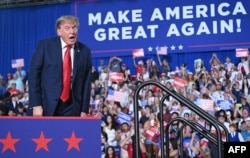
US President Donald Trump said on August 21 that he views the Strait of Hormuz as "American territory," as US forces continued a naval blockade of Iran.
"We don't even know if we won, because I view the Strait of Hormuz as an American territory right now," Trump said at a campaign rally in South Carolina. He added: "It's an American territory."
US Central Command said that American forces had redirected 68 commercial vessels as of August 21 to comply with the blockade.
The Strait of Hormuz is one of the world's most important energy waterways, with roughly one-fifth of the world's seaborne oil supply normally passing through it. The waterway is bordered by Iran and Oman. Iran's Deputy Foreign Minister Kazem Gharibabadi dismissed Trump's claims about the strait as "delusions."
Trump also reiterated that Iran must not obtain a nuclear weapon. He said that "as soon as we're finished with the Islamic Republic of Iran, as soon as we're finished, oil is gonna be down at lower than it was even just a little while ago."
Later in his speech in South Carolina, which he delivered in support of the candidacy of Darline Graham, sister of the late Senator Lindsey Graham, Trump joked about carrying out more strikes on Iran. He told the audience: "Look, it's a Friday night. We have plenty of time, right? What the hell do I have to do? Go back, bomb Iran a little bit more?"
We are now closing the live blog for the day. We'll be back at 9:30 a.m. Central European time to cover the latest events across the Middle East.
Trump Says Iran Not Ready To Make 'Right Deal'
US President Donald Trump said on August 21 that he did not think Iran was ready to make the “right deal” to end the conflict, adding that Washington was watching “what happens” next.
Trump also said that the United States had “total control” of the area around the key Strait of Hormuz, which has been effectively closed since the conflict began.
Disrupted traffic through the strait has been one of the central issues in the conflict and one of the main obstacles to a negotiated settlement, with Tehran and Washington remaining far apart in their positions on control of the waterway.
“They would love to make a deal, but they’re not ready to make the right deal, in my opinion,” Trump told reporters when asked whether US military options against Iran were limited.
His comments came as Oman said that the Iranian and Omani foreign ministers had discussed resuming negotiations on navigation through the Strait of Hormuz. The two countries have recently been in talks to establish a new route that would ensure safe passage through the waterway.
With reporting by Reuters.
Somali Pirates Seize Iran-Linked Tanker
An oil tanker under US sanctions for allegedly transporting Iranian petroleum products has been seized off Yemen and diverted toward Somalia, the latest sign of a resurgence in Somali piracy.
Six armed individuals boarded the Eritrea-flagged Sibu 1 on August 20, according to the shipping-security monitor United Kingdom Maritime Trade Operations (UKMTO).
Washington sanctioned the tanker in December, saying it belonged to a so-called shadow fleet used to circumvent restrictions on Iranian petroleum exports.
The Sibu 1 is at least the 13th vessel attacked this year off Somalia or in the Gulf of Aden, according to International Maritime Bureau data and UKMTO reports, up from five attacks in all of 2025.
Somali piracy, which caused hundreds of attacks between 2008 and 2014 before being largely suppressed by an international naval response, has revived as security resources are stretched elsewhere.
Experts say higher oil prices and the diversion of naval assets toward to counter from Iran and Yemen's Houthi rebels may have created fresh opportunities for pirates.