



Tehran Warns Countries Against Participating In US Economic Actions Against Iran
Tehran warned countries against participating in the "economic war" vowed by US leaders against the Islamic republic, saying they would be considered enemies.
"We declare to all countries...do not join the economic war waged by the United States. Any country participating in the imposition of economic restrictions against us is considered an enemy," Mohsen Rezai, head of Iran's supreme national security council, said on state TV late on August 22.
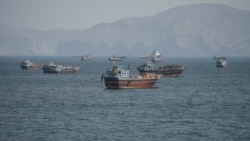
US President Donald Trump this week announced Washington's intentions to levy an "unprecedented" level of economic sanctions against the regime to force it to end its nuclear program and fully re-open the Strait of Hormuz.
With nearly 20 percent of the global oil supply passing through vital waterway, the closure of the strait has adversely affected the world supply and shot up the oil prices in the international market to record high levels.
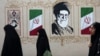
On August 20, US Treasury Secretary Scott Bessent told US news network CNBC that Washington's plan to intensify economic sanctions on Iran was going to "collapse" the Islamic republic.
"It is a one-two punch. We have the blockade [on Iranian ports], and we are going to have the toughest sanctions in history," he said.
Details were not provided, but experts who spoke to RFE/RL said truly unprecedented action could mean moving beyond another round of sanctions against Iranian companies and targeting the international financial and commercial networks that have helped Tehran keep selling oil despite decades of US pressure.
That could include Chinese banks, yuan-denominated payments for Iranian oil, alternative payment systems, and the shipping, insurance, refining, and financial intermediaries behind the trade.
The United Arab Emirates, one of Iran's major trading partners, announced it was suspending all trade and financial transactions with Tehran until further notice.
Iranian Olympic Runner Prevented From Registering For World Championship

Iranian authorities have prevented the country's Olympic runner Farzaneh Fasihi from registering for the world championship, the athlete said on social media.
“That's it. The world championship, which is the biggest dream and aspiration of every athlete, was taken from me," Fasihi wrote in an Instagram post on August 22.
She added that in recent months she had been receiving threatening messages warning her to "be careful with [her] behavior" ahead of the upcoming world championship and the Asian Games.
Fasihi said she was prevented from registering despite being the only Iranian runner to qualify for the world championship and finishing the season at the top of the Asian rankings.
In her post, she did not explicitly say why she had been prevented from competing, but wrote that she had been pursuing her rights through legal means for months and that she would “never allow” her rights as an Iranian female athlete to be violated.
Earlier this year, Fasihi wrote another Instagram post expressing sadness over the deadly government crackdown on Iranian protesters in January.
Iran Seeks Red Cross Help Returning Pilots From Qatar
Iran has requested help from the International Committee in facilitating the return of three "injured" Iranian pilots that it says are being held in Qatari waters.
Quoting a senior Iranian military official, Iran's IRNA news agency reported on August 22 that the Qatari government should transfer the three Iranian pilots -- who initially went missing when Qatar reportedly shot down two Iranian jet bombers in March -- to "an adequately equipped hospital” on land.
Mohammad Bagherzadeh, commander of Iran’s Missing-in-Action Search Committee, said the pilots are in poor health and holding them at sea is untenable.
Last week, Doha denied that it was holding the Iranian pilots. Qatari officials said they had violated their country's airspace earlier this year.
Last week, the Qatar Foreign Ministry had said that its invitation for an Iranian delegation to visit and discuss the pilots' situation remained open.
The Iranian military welcomed the move and requested the necessary cooperation.
Four more Iranians are also being held in Kuwait, and Bagherzadeh said Kuwait’s agreement to let the Iranian ambassador meet with the "four Iranian prisoners" held in that country had created "a glimmer of hope."
Iran says those four were affiliated with the Islamic Revolutionary Guards Corps and had entered Kuwait's territorial waters after their navigation was disrupted. Kuwait, however, says they are suspected of planning hostile actions against the country.
Iran Offers Women Double The Reward To 'Kill Or Capture' US Soldiers
Iran's military has offered a reward to any Iranian who kills or captures a US soldier in the event of ground attack against Iran, adding that women would be awarded twice the amount as men for the act.
According to Iran's semiofficial news agency ISNA, army spokesman and Brigadier General Mohammad Akram-Nia announced on August 22 that men would receive 5 billion tomans (roughly $30,000) for "killing or capturing" a US soldier using his "legally owned hunting firearm," while women are being offered 10 billion tomans (roughly $60,000) for doing the same.
The spokesman also offered to purchase such a firearm for twice its original price and showcase it in the national museum as a "historical honor."
In Iran, average gross monthly salaries range from 16 to 40 million tomans (roughly $150-250).
Rights groups and independent experts say slogans, exaggerated claims and propaganda have remained among the Iranian regime’s strongest tools, disseminated through state-controlled media.
Iran does not allow independent media to operate freely on its soil, while outlets that are permitted to operate face strict restrictions and conditions. The use of Internet and social media has also been under restrictions in the country.
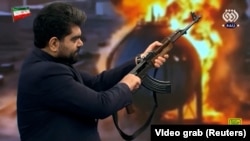
In May, a TV presenter fired a shot at the flag of the United Arab Emirates on Iranian state television while chanting "In the name of God."
The firing of an AK-47 assault rifle was featured in a state TV broadcast about military training for civilians, while Iran was observing a fragile cease-fire with the United States.
The Hana Human Rights Organization condemned the act of firing live bullets during a TV show as "dangerous" and said it was part of a campaign of public militarization in Iran that includes basic rifle training for women and children at state-organized rallies.
Iran Grants Permission For Safe Passage To Iraqi Oil Tankers
Tehran has granted permission to Iraqi oil tankers to pass through the Strait of Hormuz, Iran’s official news agency, IRNA, reported on August 22.
The report says that special permits for Iraqi oil tankers to pass through the Strait of Hormuz was a main request of Baghdad's to Iranian parliamentary speaker Mohammad Baqer Qalibaf during his recent visit to Iraq.
Qalibaf, a hard-line former commander of the Islamic Revolutionary Guards Corps (IRGC), visited Iraq last week, where he met Prime Minister Ali Faleh Al-Zaidi on August 19.
Qalibaf also addressed Iraqi business owners at a gathering where he was quoted as saying: "No matter how much military power we have, if the people are hungry and we do not have financial activity, economic growth, and domestic production, we cannot survive."
Iran is believed to support several armed groups in Iraq. The disarming of those groups has become a prominent issue in relations between Washington and Baghdad.
Under pressure from the United States, Iraqi authorities have given these groups until September 30 to hand over their weapons. This date coincides with the end of the US-led international coalition mission against the Islamic State militant group.
IRNA report says that despite high insecurity in the region, the regime, over the past six months, granted a number of Iraqi oil tankers permission to pass through the Strait.
Iraq exports most of its oil from its southern terminals through the Strait of Hormuz. The country was producing around four million barrels of oil per day and exported an average of 105 million barrel per month through the Strait of Hormuz, according to Reuters news agency.
Iraq’s oil exports have severely been affected since the start of the Middle East conflict in late February that resulted in closure of the Strait of Hormuz.
Numerous reports suggest that the country is exploring avenues to find alternative routes for its oil exports via the neighboring countries of Turkey, Syria and Jordan to the international markets.
Tehran, Muscat Discuss Hormuz Navigation
Tehran and Muscat have held discussions on the revival of talks and maritime navigation in the strategic Strait of Hormuz.
Iranian Foreign Minister Abbas Araqchi spoke by phone with his Omani counterpart, Seyyed Badr Albusaidi, Iran's official news agency IRNA reported on August 22.
IRNA says the ministers exchanged views on the latest regional development, suitable conditions for resuming talks and issues related to maritime navigation in the Strait of Hormuz.
Both Iran and Oman claim territorial jurisdiction over parts of the crucial waterway. Since the beginning of the US-Israel-Iran conflict in the Middle East in late February, Iran has effectively closed the crucial waterway for maritime navigations.
Earlier this month, Iran had announced reaching an agreement with Oman on a route for shipping through the strait.
Without going into details, Iranian Foreign Ministry spokesman Esmail Baqaei had said an agreement with Oman was "in the final stages" and warned such a deal does not guarantee safe navigation.
The fresh talks between the Iranian and Omani foreign ministers followed a warning by US President Donald Trump of fresh "unprecedented" sanctions against Tehran unless the regime agrees to open the Strait of Hormuz and wrap up its nuclear program.
NATO Members Considering Freedom Of Navigation In Hormuz
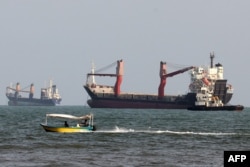
As the US-Iran conflict in the Middle East enters its sixth month and global oil supplies continue to be adversely affected, the 32-member North Atlantic Treaty Organization (NATO) is exploring options to ensure freedom of navigation in the Strait of Hormuz.
A spokesman for the alliance's Supreme Allied Commander Europe, US Air Force General Alexus Grynkewich, told Reuters news agency that members states are exploring possible cooperation on the matter, which the spokesman said will not be conducted as a formal NATO mission.
The spokesman said Grynkewich's headquarters held a videoconference with military officials from members states on August 19 to discuss options how to maintain freedom of navigation in this important waterway.
During the discussions, the spokesman said, Grynkewich emphasized that "this is not a NATO mission" but that the alliance could use its coordinating capabilities to facilitate cooperation among member states and assess what each country could contribute.
Before the war, nearly 20 percent of global oil supplies transited through the Strait of Hormuz. Its effective closure following the launch of US-Israeli strikes against Iran on February 28, has impacted global economies causing fuel prices to soar to record highs.
Damascus Says Iran Must Acknowledge Actions In Syria Before Ties Improve
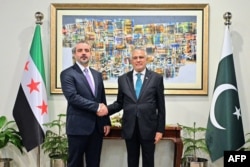
Syria says relations with Iran will improve only after the regime agrees to "recognize and admit what it has done to Syria and to the Syrian people."
The statement came from Syrian Foreign Minister Assad Hassan Al-Shaibani during his recent visit to Pakistan while replying to questions from journalists in Islamabad.
Asked if there was any mediation offer from Pakistan to bring a patch up between Damascus and Tehran, Al-Shaibani said "there was no offering of mediation" between the two countries during his current Islamabad visit.
"In the future, if the causes of such mediation or such talk with Iran are in place, and if Iran recognized and admitted what it has done to Syria and to the Syrian people, and if Pakistan is willing to have a role in such talks, so we have no problem," he said.
He added that his country was not currently seeking improved relations with Tehran. However, "if Iran changes its policy, we would have no objection," he added.
Relations between Tehran and Damascus took an about-turn following the overthrow of Bashar al-Assad regime in December 2024. Tehran remained Assad's key partner by providing military and financial support during his country's nearly 14-year civil war.
Shaibani did not rule out diplomacy with Tehran but added that an exchange of visits depended on Iran's admission of its role in Syria under the Assad regime.
"Diplomacy has no limits," he said while adding that the current Syrian government would determine that whether it would be in the interests of Syria and Syrian people.
Shaibani is the first Syrian foreign minister to visit Pakistan in nearly two decades. He arrived in Islamabad on August 19 for talks with the Pakistani authorities, meeting with Prime Minister Shehbaz Sharif and the powerful army chief, Asim Munir.
Pakistan hosted the first-ever direct talks between the United States and Iran since 1979 in April in its capital, Islamabad. The nuclear-armed country remained one of the active mediators struggling to resolve the ongoing conflict in the Middle East.
Defiant Iranian Film Spotlights Crackdown On Female Singers
An unauthorized Iranian film released for free on YouTube is stirring debate by openly challenging restrictions on women singing and Iran’s compulsory hijab rules.
Bidad, or Outcry, directed by Soheil Beiraghi, was made without government approval and features the voice of Parastoo Ahmadi, a singer who was sentenced to 74 lashes after performing publicly without a head scarf.
Parisa Sohbati from RFE/RL's Negah-e-Farda (Iran Tomorrow) program explains.



Hezbollah Rejects US Redesignation As Terrorist Group
The Lebanon-based Hezbollah has vowed to continue on what it called the "path of resistance" against Israel despite its redesignation by the United States as a terrorist group.
Operating both as a political entity and a militant group, Hezbollah controls much of the southern Lebanon. The group is believed to have connections with the Iranian regime and the Islamic Revolutionary Guards Corps.
On August 21, while announcing the redesignation, the US Treasury Department said Hezbollah acts "for service to the Iranian regime under the command of Iran"s Revolutionary Guard Corps-Quds Force."
Calling the sanctioning "unjust," the group said in a statement that it will not deter them from the "path of resistance" to defend their land, sovereignty, and resources.
According to the US Treasury, Hezbollah uses couriers traveling on commercial airline flights between Lebanon, Turkey, the United Arab Emirates, and Iran to move hundreds of millions of dollars between jurisdictions, allowing the group to obtain foreign currency and evade sanctions.
Hezbollah was also designated as a terrorist group by the six-nation Gulf Cooperation Council in 2016, which said it was involved in recruiting men for terrorist attacks and the smuggling of weapons and explosives.