




Iranian President Arrives In New Delhi For BRICS Summit Amid Gulf Crisis
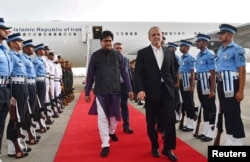
Iranian President Masud Pezeshkian arrived in the Indian capital, New Delhi, on September 11 to join the leaders of BRICS countries for a summit, with the escalating Middle East conflict expected to feature prominently on the agenda.
BRICS, a grouping of major emerging markets and developing countries, takes its name from Brazil, Russia, India, China, and South Africa. It expanded from five to 11 members in 2024 and 2025, adding Egypt, Ethiopia, Indonesia, Iran, Saudi Arabia, and the United Arab Emirates (UAE).
Making his first visit to India since taking office in 2024, Pezeshkian is scheduled to hold talks with Indian Prime Minister Narendra Modi, Iran's IRNA state news agency reported.
The two-day BRICS Leaders' Summit begins on September 12 and is expected to bring together Russian President Vladimir Putin and Chinese President Xi Jinping, among other leaders.
Iran, which joined BRICS in 2024, is directly involved in the conflict, while fellow member the UAE has faced Iranian missile attacks and taken measures against Tehran.
The UAE suspended all trade and financial transactions with Iran in August following the attacks, underscoring growing tensions within BRICS as the summit convenes amid the deepening regional crisis.
The UAE is expected to be represented by Abu Dhabi Crown Prince Sheikh Khaled bin Mohamed bin Zayed Al Nahyan.
With reporting by AFP and Reuters
Oil Hits 4-Month High As Hormuz, Red Sea Risks Mount
Oil prices surged to a four-month high on September 11 as escalating threats to two of the world's key energy shipping routes fueled fears of prolonged supply disruptions and renewed inflation.
Brent crude touched $109.97 a barrel after jumping more than 6 percent a day earlier, before falling back. The benchmark was still on track for a weekly price gain of about 11 percent.
Oil flows through the Strait of Hormuz remain restricted as the United States and Iran trade attacks, while the reported seizure of Yemen's Red Sea port of Mocha by Iran-aligned Houthi rebels has raised concerns over shipping through the Bab el-Mandeb Strait.
The oil rally intensified inflation concerns across global markets, pushing government bond yields sharply higher as investors increased bets on further interest-rate hikes.
JPMorgan analysts now expect eight of nine developed-market central banks to raise interest rates by the end of the year as policymakers contend with persistent inflation and rising commodity prices.
With reporting by Reuters
Gulf States, Iran Plan Talks On Hormuz Shipping Deal, FT Reports
Foreign ministers from Persian Gulf Arab states are expected to meet Iranian Foreign Minister Abbas Araqchi in Oman next week as regional powers seek support for a temporary arrangement to restore commercial shipping through the Strait of Hormuz, the Financial Times reported.
The meeting, an Omani initiative, is scheduled for September 14 in the coastal city of Salalah, according to two people briefed on the matter cited by the FT. One of the people said details were still being finalized, but that a number of states had confirmed their participation and the meeting was expected to go ahead.
Oman and Iran have been negotiating a temporary arrangement under which ships would enter the strait through Iranian waters and mostly exit through Omani territory. Diplomats cautioned, however, that a US-Iran agreement would ultimately be needed for the waterway to fully reopen.
One person briefed on the talks told the FT that Iran and Oman hoped to get GCC backing and use it to press Washington to lift its blockade of Iranian ports. Gulf states, meanwhile, want to ensure that any arrangement is temporary and allows vessels to enter and leave.
The diplomatic push comes after a short-lived US-Iran memorandum of understanding signed in June unraveled amid disputes over shipping through Hormuz.
Washington has told mediators it wants any new agreement to also address Iran's nuclear program, while Tehran is demanding concessions including an end to the blockade and permission to resume oil exports, the FT reported.
There are currently no direct US-Iran talks, though regional mediators are maintaining diplomatic back channels.
Trump Says He Has No Regrets Over Iran War

US President Donald Trump said he had no regrets about going to war with Iran despite the conflict's potential impact on November's midterm elections, and said he would make the same decision again.
“I don't believe in the word 'regret.' You can always question yourself a little bit,” Trump told Fox News in an interview broadcast on September 10. “If I had it do again, I would do exactly as I did.”
Trump also dismissed suggestions that some of his supporters had been demoralized by the war, saying they were “very proud of the fact that I'm not letting Iran have a nuclear weapon.”
He repeated his prediction that the conflict would end after the midterm elections. “It ends right after the election,” he said, a day after accusing Tehran of seeking to influence the vote.
Rising oil and gasoline prices linked to the conflict have become an issue for Republicans ahead of the elections.
US Sanctions Target Iran-Linked Networks, Draw Attention To Iraq-China Defense Ties
WASHINGTON -- The United States has expanded its campaign against Iran's regional networks, imposing sanctions on individuals and companies in Iraq, Lebanon, the United Arab Emirates, and Turkey that Washington says help finance or support Iran-backed militant groups.
The Treasury Department said on September 10 that the measures target networks linked to Kata'ib Hezbollah in Iraq and Hezbollah in Lebanon. It also announced tougher restrictions on Iran-related licensing, saying most outstanding applications for specific licenses would now face a presumption of denial.
Hezbollah is both a militant group and political party that controls much of southern Lebanon. It is considered a terrorist organization by the United States, although the European Union has only blacklisted its armed wing.
The sanctions focus in part on Iraq's Popular Mobilization Commission and companies involved in procuring foreign military equipment. Treasury said Iraqi government dealings involving the company Ain Al-Iraq included transactions with Russia, China, and Iran to obtain defense components, which it said were connected to broader corruption and sanctions-evasion schemes.
Max Meizlish, a research fellow at the Foundation for Defense of Democracies and a former Treasury sanctions official, said the significance of the move goes beyond targeting Iran-backed militias.
"Buried in today's sanctions action targeting Iran's proxy network, Treasury more directly links the Iraqi government -- not just Iranian-backed militias -- to defense-related dealings involving China, Russia, and Iran," Meizlish told RFE/RL.
The action also targets a Dubai-based exchange that Treasury says moved millions of dollars from Iraq to Iran, as well as Lebanese exchange businesses that US officials accuse of helping transfer Iranian funds to Hezbollah.
The latest measures are part of the Trump administration's broader Operation Economic Outcast, aimed at cutting off the financial channels supporting Iran and regional allies. The department has warned that foreign companies and financial institutions facilitating sanctions evasion could face greater exposure to US penalties.
The State Department said in a statement that the United States "remains committed to supporting a sovereign, stable Iraq free from malign external influence, and to protecting Lebanon's institutions from [Hezbollah's] corrosive financial and political interference."
"These networks not only threaten regional stability but also undermine the economic interests of the very populations Iran claims to serve," spokesman Tommy Pigott said.
Reports: US Military Aircraft Damaged In Iranian Strikes On Base In Jordan
Several US military aircraft were damaged in Iranian missile strikes on a base in Jordan housing American soldiers, according to reports.
Iran fired 20 ballistic missiles at the Muwaffaq Salti Air Base on September 9, Jordan said, adding that it shot down 18 of them. Tehran said it was in response to the US military destroying five Iranian tankers hours earlier.
US television broadcaster CBS News, citing sources with direct knowledge of the matter, reported that an A-10 Thunderbolt aircraft was struck and lost a wing.
In addition, around eight F-15 fighter jets sustained light damage and were put back into service, CBS News reported.
Reuters, citing a US official speaking on the condition of anonymity, reported the same damage.
No deaths or injuries were reported in the strikes on Jordan.
A report issued in May by the Congressional Research Service said that 42 US military aircraft had been destroyed or damaged since the war with Iran began in February.
With reporting by Reuters and CBS News
'Infiltration' Bill Exposes Iran's Internal Divisions Over Wartime Security Crackdown
- By Kian Sharifi
Iran's parliament is trying to turn fears of foreign infiltration into law. But as lawmakers work through the legislation, the debate is exposing an increasingly awkward question for the Islamic republic: How far should the state go in policing Iranians' contact with the outside world?
At the center of that debate is Parliament Speaker Mohammad Baqer Qalibaf, who, at least publicly, is doing a balancing act. He has defended the need for tougher measures against foreign infiltration while warning that the current draft of the legislation goes too far.
"No patriot opposes countering foreign infiltration," Qalibaf said during a recent parliamentary session. But, he added, lawmakers needed to ensure that people's "rights, their lives, and their trade" were not affected.
He said security agencies may need to be able to vet Iranians' contacts with foreigners but that they cannot demand permission at every stage.
To read the full report, click here.
Hormuz Shipping Traffic Falls To 7 Vessel Transits
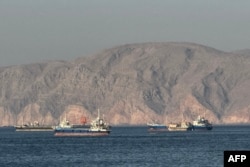
Shipping through the Strait of Hormuz fell to seven vessel transits on September 9, down from 12 a day earlier and half the 10-day average of 14, preliminary ship-tracking data showed, according to Reuters.
Four vessels exited the strait and three entered. Among those leaving was the very large crude carrier Finland Prosperity, carrying nearly 2 million barrels of crude. No liquefied natural gas (LNG) tankers were recorded exiting.
The figures may understate actual traffic because some vessels could be crossing with their tracking transponders switched off.
Traffic through the Bab el-Mandeb Strait remained considerably higher, with 28 commodity vessels transiting on September 9, broadly in line with its 10-day average of 27.
Before the Iran war began in February, the Strait of Hormuz typically handled about 125 large commercial vessels a day, with traffic through the waterway accounting for roughly 20 percent of the world's daily crude oil and LNG supplies.
With reporting by Reuters
Houthis Seize Strategic Yemeni Port Of Mocha, Military Sources Say
Iran-backed Houthi rebels in Yemen have seized the historic Red Sea port city of Mocha, four Yemeni government military sources told Reuters on September 10, extending their control along a strategically important stretch of coast near the Bab el-Mandeb Strait.
The Houthis were also attacking the Hanish Islands in the Red Sea, the sources said, while government forces and their allies were relocating south to Dhubab, directly on the strait. Control of Dhubab and nearby Perim Island is considered key to controlling the narrow waterway.
The advance marks a significant escalation in renewed fighting between the Houthis and forces aligned with Yemen's internationally recognized government, threatening to reopen a major front in the wider conflict involving Iran and the United States.
Bab el-Mandeb, which connects the Red Sea with the Gulf of Aden, is a crucial route for oil, fuel, and other goods moving between Asia and Europe via the Suez Canal.
More than 20,000 people have been displaced by fighting in Taiz and Hodeidah provinces over the past two weeks, according to Yemeni government data.
The fighting has also spilled across Yemen's borders. Saudi Arabia says Houthi attacks on civilian and economic targets in the kingdom have injured 73 people in recent days.

Yemen descended into civil war in 2014 when the Houthis seized the capital, Sanaa, driving the internationally recognized government south. Saudi Arabia intervened militarily the following year at the head of a coalition seeking to restore the government and counter what Riyadh viewed as growing Iranian influence in Yemen. A UN-brokered truce in 2022 largely halted major fighting but failed to produce a lasting settlement.
The Houthi advance toward the Bab el-Mandeb comes after the group declared a naval blockade against Saudi Arabia on July 20 and threatened vessels using Saudi ports. The threats have disrupted shipping through the Red Sea at a time when Saudi Arabia has become increasingly reliant on the route for oil exports because of disruptions in the Strait of Hormuz.
With reporting by Reuters
Rights Groups Say Iran Escalating Executions To Deter Dissent
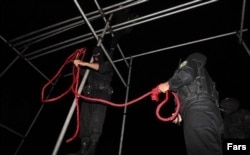
Iranian authorities have sharply escalated the use of executions against protesters and political dissidents, often after rushed trials marred by torture allegations and other serious due-process violations, two human rights groups said on September 10.
Human Rights Watch and the Abdorrahman Boroumand Center for Human Rights in Iran said authorities were using the death penalty “to instill fear and deter further public dissent” following nationwide protests earlier this year.
Between March 18 and the end of August, authorities executed at least 59 men on politically motivated and vaguely worded national security charges, including 29 people arrested in connection with the December 2025-January 2026 protests, the groups said. Several were aged 18 or 19, and five were executed in public.
In 16 of the 29 protest-related cases, authorities made no allegation that the defendants had killed anyone. Some were accused of acts including damaging public property, throwing stones, or breaking into government buildings.
“Day after day, Iran’s authorities are sending protesters, including teenagers, to the gallows based on torture-tainted ‘confessions’,” said Bahar Saba, senior Iran researcher at Human Rights Watch.
The groups said defendants had been denied access to independent lawyers and convicted on vaguely worded capital charges including “waging war against God” and “corruption on earth.” In some cases, little more than five weeks elapsed between arrest and execution.
Scores of protesters and dissidents, including women and children, remain at imminent risk of execution, the groups said.
“The authorities’ message is clearly that protests will be met with brutality,” Saba said.
The groups urged UN member states to press Tehran to halt executions and establish a moratorium on the death penalty.
The increase in political executions comes amid a broader surge in the use of the death penalty in Iran. The Boroumand Center recorded at least 2,113 executions in 2025, the highest annual figure known since the late 1980s. Meanwhile, the Iran Human Rights group says it has recorded 549 executions so far this year.