




As Trump Courts Xi, Pressure Mounts To Confront China Over Support For Iran
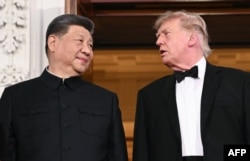
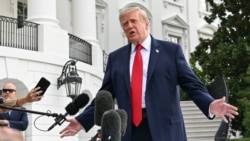
WASHINGTON -- US lawmakers and national-security experts are pressing President Donald Trump to take tougher action against Chinese entities accused of helping Iran with satellite intelligence, weapons components, and oil revenue.
The calls intensified as Chinese President Xi Jinping visited the White House on September 24 for a high-stakes meeting with Trump, followed by a lavish state dinner that underscored the delicate balancing act between the world's two largest economies.
Trump made no explicit mention of Iran during his public remarks with Xi despite growing pressure from lawmakers who warned that Washington risks encouraging deeper cooperation between Beijing and Tehran if it fails to impose costs.
To read the full report, click here.
Iranian Foreign Minister Says Plan Presented To US To Open Strait Of Hormuz
Iranian Foreign Minister Abbas Araqchi said Tehran has presented the United States with a plan to reopen the Strait of Hormuz that mirrors conditions the two countries agreed to in a June memorandum of understanding.
“We have introduced a plan to the United States through the intermediators that if certain conditions are met, the Strait of Hormuz would be open on the end of the seventh day and talks would restart,” Araghchi told reporters on September 24 while attending the United Nations General Assembly in New York.
He gave no further details. CNN quoted a White House official as saying the two sides were having "positive and constructive discussions through the mediators."
The two sides have appeared to remain far apart on ending their nearly seven-month war despite a round of renewed diplomacy.
They held their first indirect talks in months on September 23, which produced no publicly announced concessions.
During speeches on the UN floor this week, sharp words were hurled by both US President Donald Trump and his Iranian counterpart Masud Pezeshkian.
Trump threatened in his UN address to “annihilate” Iran if no agreement was reached. Pezeshkian told the UN that Iran would not “bend at the knee” under pressure.
Both leaders, however, said they were still open to negotiations.
Washington and Tehran signed a 60-day memorandum of understanding (MOU) on June 17 aimed at ending hostilities and reopening the strait. However, disputes over the meaning of the terms in the agreement have led to fresh attacks by both sides.
Macron Says Paris Will Send Troops, Defense Systems To Saudi Arabia
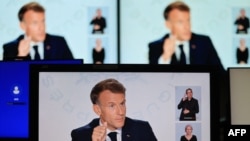
French President Emmanuel Macron announced on September 24 that Paris would send military personnel and defense systems to Saudi Arabia to help protect the country's key Red Sea oil port of Yanbu.
"We are going to send military resources, that is to say, soldiers, radar systems and defense systems, to protect this site," Macron said in an interview with French broadcasters TF1 and France 2.
The aim would be "not to get us involved in any conflicts, but to protect this site," the French president added.
Macron's comments came as Yemen's Iran-aligned Houthi rebels said they had targeted "sensitive sites" in Riyadh and an oil facility in Yanbu for the second time in a week.
Yemen descended into civil war in 2014 when the Houthis seized the capital, Sanaa, ousting the internationally recognized, Saudi-backed government. A 2022 truce had mostly held until recently.
In July, a spate of attacks began after the Houthis welcomed an Iranian plane in Sanaa.
Earlier this month, Houthi rebels seized nearly all of Yemen’s Red Sea coastline, giving the militant group control of the Bab al-Mandab Strait, a key chokepoint for global trade.
The Houthis have also intensified attacks on energy facilities in Saudi Arabia, the group’s foe and the world’s biggest oil exporter.
Riyadh has been forced to temporarily shut down a crucial oil pipeline after a drone attack that it blamed on a pro-Iranian militia in Iraq.
With reporting by AFP.
Iran, US Remain Far Apart Despite Renewed Talks
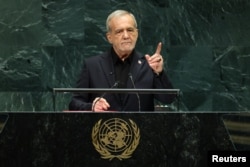
Iran and the United States remain far apart on ending their nearly seven-month war despite renewed diplomacy, an Iranian official said on September 23, as President Masud Pezeshkian rejected US pressure in an address to the UN General Assembly.
Iran and the United States remain far apart on ending their nearly seven-month war despite renewed diplomacy, an Iranian official said on September 23, as President Masoud Pezeshkian rejected US pressure in an address to the UN General Assembly.
The official told Reuters that Tehran was reviewing Washington’s response to Iranian proposals focused on lifting a US naval blockade and reopening the Strait of Hormuz, but said “there are still many differences” between the sides.
The comments followed the first indirect US-Iran talks in months, which produced no publicly announced concessions.
Pezeshkian told the UN that Iran would not “bend at the knee” under pressure, a day after US President Donald Trump threatened in his UN address to “annihilate” Iran if no agreement was reached. Pezeshkian nevertheless said Tehran remained open to negotiations.
The two leaders also clashed over Iran’s nuclear program. Pezeshkian said Tehran did not seek nuclear weapons but would not relinquish peaceful nuclear technology, while Trump accused Iran of pursuing a bomb and vowed: “I will never allow Iran to have a nuclear weapon.”
He also defended Iran’s restrictions on the Strait of Hormuz, which carried about a fifth of global oil and liquefied natural gas before the war and has become a central point of contention in negotiations with Washington
Also on September 23, European Council President Antonio Costa said he had spoken with Pezeshkian and urged Iran to restore freedom of navigation, halt strikes on its neighbors and resume cooperation with the UN nuclear watchdog.
With reporting by Reuters, AFP, and dpa
IRGC Commander Reported Killed In Clashes In Iran’s Southeastern City Of Saravan
Iranian security forces and unidentified gunmen have reportedly engaged in heavy fighting in the southeastern city of Saravan, according to Iranian media and reports from the region.
A senior commander in Iran’s Revolutionary Guard Corps (IRGC) was killed during an operation in the country’s restive southeastern province of Sistan-Baluchistan, the IRGC-affiliated Tasnim news agency reported.
The agency identified the victim as Brigadier General Hossein Zarifi, who headed the Shahid Sajjad operational base in Saravan, near Iran’s border with Pakistan.
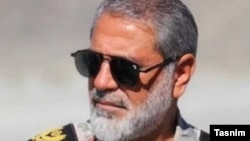
The statement did not provide details about the circumstances of Zarifi’s death or identify who IRGC forces were fighting during the operation.
Fighting reportedly began around 1300 local time, in the Jihadabad area of Saravan, located in the Sistan-Baluchestan Province.
Videos published by Haalvsh, a rights group and media organization, captured the sound of sustained gunfire as security forces blocked roads leading to the site of the clashes. Other footage showed a drone flying over the area, heavy smoke rising above the neighborhood, and a building on fire.
These videos have not been independently verified.
Iranian state media and the Islamic Revolutionary Guards Corps (IRGC) said security forces had targeted what they described as a “terrorist” group, which it said had intended on carrying out an assassination operation but was identified and targeted based on information received from the public.
Five members of the group were reportedly killed and others arrested, while weapons and ammunition were seized. The IRGC said that one of its guards was killed.
The reports could not be independently confirmed by RFE/RL.
Sistan-Baluchestan, which borders both Pakistan and Afghanistan, is predominantly populated by people of Baloch ethnicity. Unlike in the rest of Iran, most of the population is Sunni Muslim.
The province has seen a long-running insurgency involving Baloch armed groups, with militants frequently targeting figures associated with the Iranian state. On September 14, unidentified attackers assassinated the pro-government Sunni Baloch cleric Yousef Gorgij outside his home in Zahedan, the capital of the province.
Iranian MP Says Pezeshkian-Trump Meeting 'Likely'
- By RFE/RL
Ahmad Bakhshayesh Ardestani, an Iranian lawmaker and member of parliament's National Security Commission, said he thinks it is "likely" that Iranian President Masud Pezeshkian and US President Donald Trump will meet in New York during this week's United Nations General Assembly.
"It would not be bad if the Iranian president had a meeting with him [Trump], but the nature of the relationship between the two countries is much more complicated than solving problems with a meeting," he said in an interview with the Iranian news outlet Didban.
Ardestani added that while a meeting between the two failed to materialize last year during the UNGA even though Pezeshkian was prepared to hold talks, "I think it is likely that their meeting will take place this time."
White House officials have given no indication that Trump will meet with his Iranian counterpart in New York, though the president himself said last week he would "probably" meet with Pezeshkian.
Trump's special envoy Steve Witkoff and his son-in-law Jared Kushner held talks with Iranian Foreign Minister Abbas Araqchi and his delegation on September 22 at the General Assembly -- the first direct contact between the two sides since June -- that the US leader called "very productive."
Prior to that, Trump said during a speech to the UNGA that he would either strike a deal with Iran or “annihilate” it.
The possibility of a Trump-Pezeshkian meeting has already drawn criticism from hard-line figures in Iran.
Iran Cancels Some International Flights As US Sanctions Bite
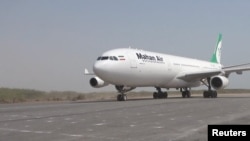
Iranian airlines canceled some international flights on September 23 after the United States tightened sanctions on Iran’s aviation industry as part of efforts to increase economic pressure on Tehran.
Flights from Iran to Baghdad, Muscat, Qatar, Georgia, and Azerbaijan were suspended, a Tehran travel agent told AFP, while services to destinations such as China and Turkey continued despite some cancelations.
US Treasury Secretary Scott Bessent announced the measures on September 21, vowing to “shut down” Iranian carriers and threatening penalties against countries and companies that provide them with services.
The full impact remained unclear. Mahan Air, one of Iran’s largest carriers, operated a flight to Guangzhou after the sanctions took effect, while China said it opposed the measures.
Iraq has not publicly announced whether it will enforce the restrictions, although officials told AFP that Baghdad would comply. Iranian authorities were in talks to reroute Baghdad services to Najaf, a major destination for Shi'a pilgrims.
Meanwhile, Iranian President Masud Pezeshkian flew to New York on September 22 for the UN General Assembly aboard Ashianeh, a little-known Iranian airline that does not appear to be under US or EU sanctions.
With reporting by AFP
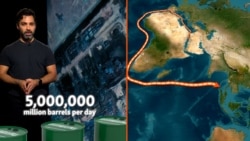
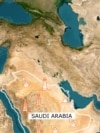
Why Saudi Arabia’s Oil Is Getting Harder To Ship
The crises in the Middle East are creating a growing challenge for Saudi Arabia: how it gets its oil to global markets. Shipping costs are rising, oil recently topped $105 a barrel, and global inventories are being rapidly drained. (Video by Kian Sharifi and Kenan Cerimagic)

Iranian Hard-Liners Up In Arms After Araqchi-Witkoff Meeting In New York
- By Kian Sharifi
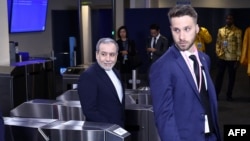
For days, both Iranian and US officials were signaling that some level of interaction between the two sides would take place in New York on the sidelines of the UN General Assembly.
So, it came as little surprise when news broke that White House Special Representative Steve Witkoff and Iranian Foreign Minister Abbas Araqchi had met on September 22.
But that did not stop hard-liners inside Iran from railing against the government of Masud Pezeshkian, with some going as far as demanding impeachment proceedings.
Read more here
Oil Falls Below $100 Per Barrel After US-Iran Talks
Oil prices fell on September 23 after US President Donald Trump said American and Iranian representatives had held “very good” and “very productive” talks at the United Nations, raising hopes of progress towards easing the seven-month Middle East conflict.
Brent crude fell to $98.41 a barrel in afternoon Asian trading, while US West Texas Intermediate dropped to $89.23, putting both benchmarks below $100.
Trump said the three-hour meeting with Iranian mediators on September 22 would be followed by another “in the very near future,” hours after telling the UN he faced a “big decision” on whether to reach a deal with Tehran or “annihilate the Islamic republic and do it quickly.”
The conflict has disrupted regional energy flows, with Iran keeping the Strait of Hormuz closed and fighting in Yemen squeezing Red Sea exports.
Prices also eased as Saudi Arabia reportedly restarted its East-West Pipeline, with exports expected to resume later this week.