




The United States and Iran exchanged missile and drone attacks early on June 3 as their fragile cease-fire hangs in the balance amid uncertainty over peace talks.
The US Central Command (CENTCOM) said its forces successfully intercepted multiple Iranian ballistic missiles and drones during incidents across the Middle East on June 3.
CENTCOM reported that three missiles fired at Bahrain were intercepted by US and Bahraini air defense systems, while two missiles aimed at Kuwait fell short or broke apart in flight.
However, authorities in Kuwait said the "brutal" Iranian attacks left at least one person dead and at least 63 others injured, in addition to forcing the closure of Kuwait International Airport and damaging "vital installations," including diplomatic missions.
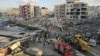
"Iran's blatant acts of aggression...escalate tensions, undermine security and stability of the region, and constitute a flagrant violation of international law," Kuwait's Foreign Ministry said in a statement.
Iran's Islamic Revolutionary Guards Corps (IRGC) confirmed the attack, saying it was made in retaliation for previous US strikes in recent days.
The incident came ahead of a visit by Kuwaiti Foreign Minister Sheikh Jarrah Jaber Al-Ahmad Al-Sabah to Washington, where he was expected to meet with US Secretary of State Marco Rubio on June 4, RFE/RL learned from a diplomatic source.
CENTCOM also said US forces shot down three Iranian one-way attack drones that were said to be targeting civilian shipping in regional waters.
In response, US forces conducted what CENTCOM described as "self-defense strikes" against an Iranian military ground control station on Qeshm Island, which is located in the Strait of Hormuz.
Ongoing Peace Negotiations
The developments come as peace negotiations between the United States and Iran are about to enter their third month without yielding any concrete results.
Speaking to the New York Post's Pod Force One podcast, US President Donald Trump said Tehran has agreed to a major concession by saying it will not seek to obtain a nuclear weapon, adding that the situation was rapidly evolving.
In the interview, Trump said Iran's Supreme Leader Ayatollah Mojtaba Khamenei was involved in negotiations and approving Tehran's stance over the issues. Khamenei has not been seen in public since before US and Israeli air strikes killed his father, Ayatollah Ali Khamenei, and several other family members on February 28.
Mojtaba Khamenei, who was named the new supreme leader on March 8, was reportedly severely wounded in the strikes, raising questions as to who was actually leading Iran.
"I would like to meet him, and we probably will meet at some point, depending on how it all works out," Trump said.
While there was no immediate confirmation from Iranian authorities on Trump's comments about nuclear weapons, Tehran has been vague about where the negotiations stand.
Earlier in the week, Iranian Foreign Minister Abbas Araqchi said that the talks were indeed ongoing but warned against "speculation," saying Tehran could not judge the negotiating process until there was a clear result.

The latest draft of potential agreement between the countries, reported by US media, was said to extend the cease-fire by 60 days, call for the reopening of the Strait of Hormuz, and establish a framework for renewed nuclear negotiations.
The deal would also potentially allow Iran to access billions of dollars in frozen assets through sanctions relief if diplomatic progress continues.
However, later the US media reported that Trump has requested changes to the proposed agreement. The revisions reportedly concerned the status of the Strait of Hormuz and the disposal of Iran's highly enriched uranium stockpile.
On June 2, Rubio said that no sanctions on Iran will be lifted in exchange for Iran agreeing to open the Strait of Hormuz. "That's not been discussed. That's not been offered," he told a Senate committee hearing.

