


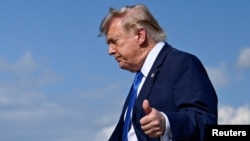
US President Donald Trump said he has decided to "hold off" on any new attacks on Iran, saying "the perimeters" of a deal have been agreed to with Tehran and adding that Israel was joining him in the commitment.
"The U.S.A. is locked and loaded and ready to go against the Islamic Republic of Iran, at levels of Military Terror, Strength, and Power not seen since World War II. Despite this, we have just been asked by Iran, and other Middle Eastern Countries, to hold off any attack in that the perimeters of a deal has been agreed to," Trump posted on Truth Social late on August 1.
"This would include the Immediate, Complete, and Total OPENING OF THE HORMUZ STRAIT, and an end to Iran's nuclear threat."
"Based on this request, I have agreed, for the future benefit of the WORLD and, likewise, the survival of a successful and prosperous Iran, to cancel the attack, subject to being able to rapidly make a DEAL," he wrote, adding that Israel joins him in this "commitment."
However, according to Iranian media, military sources in Iran denied Trump's claim that Tehran had asked Washington to refrain from launching new attacks.
Iran’s Mehr News Agency on August 2 quoted the unnamed sources as saying Trump's statement was "simply a new lie" and an attempt to "blackmail the rulers of the Persian Gulf and pressure them with threats."
The sources claimed that Iranian forces were at the highest level of readiness and prepared for any eventuality.
Trump has often threatened major attacks on Iran only to call them off, claiming an agreement between Washington and Tehran was imminent. Until now, a lasting peace agreement has been elusive, with tit-for-tat strikes by both sides resuming.
Although Trump initially said the elimination of Tehran's nuclear threat was the major aim of the US-Israeli war with Iran, which began on February 28, in recent weeks he has focused on the free flow of traffic through the important Strait of Hormuz.
More than 20 percent of the world's oil and gas supplies moved through the strait prewar, but Iran has at times effectively shut down the waterway, including with attacks on ships it said had not received proper approval from Tehran. Iran has also threatened to impose fees or tolls on ships in the strait.
The United States and other countries have insisted the strait is an international waterway and is not under the control of any nation.
Washington and Tehran signed a 60-day memorandum of understanding (MOU) on June 17 aimed at ending hostilities and reopening the strait. However, disputes over the meaning of the terms in the agreement have led to fresh attacks by both sides.


Trump told Axios on July 23 that he was seriously considering "a massive attack" on Iran. But he later backed down from the threat, saying on July 27 that a new round of diplomacy with Iran could produce a breakthrough, although he has always kept open the possibility of further strikes.
Israel, which is conducting a separate war with Hezbollah militants in Lebanon, has often resisted peace deals suggested by the US administration, saying it would continue its attacks as long as necessary.
Iran-backed Hezbollah, a militant group and political party that controls much of southern Lebanon, is considered a terrorist organization by the US, while the European Union has blacklisted its armed wing but not its political branch.

