



Iranian Ambassador Insists 'Service Fees' Will Be Charged For Hormuz Passage
The Iranian ambassador to China insisted that fees would be charged to ships transiting the important Strait of Hormuz, but he indicated "friendly" nations would receive special treatment.
The comments on July 4 are likely to raise the ire of most of the nations that use the crucial waterway to transport oil and gas products.
Washington has insisted that no tolls or fees will be charged to ships transiting the strait despite suggestions by Tehran that it would charge fees for services to ensure safe passage by vessels in the international waterway.

An interim deal reached between the US and Iran to end their war set out that commercial ships would transit the strait free of charge for 60 days, although it remains unclear what would happen after that period.
Speaking at the World Peace Forum in Beijing, Iranian Ambassador Abdolreza Rahmani Fazli said Tehran was working in "collaboration and cooperation" with Oman on "new arrangements" for the waterway.
"As a country where the Hormuz is part of its territorial waters, we will definitely charge service fees," Azli said in translated remarks -- insisting that such fees would not be a "toll."
"These new arrangements will be concerning guaranteeing the security of passage through the Straits of Hormuz, supervision of the passage of the vessels...and also guaranteeing and dealing with the environmental consequences of the massive number of ships," he said.
"We will definitely consider special treatment for the countries that were friendly to us and specially stood by us during the hard times," he added.
Prewar, some 20 percent of the world's crude oil and liquefied natural gas supplies flowed throughl the strait, but the waterway was all but shut down by Iran during the Middle East war, sending energy prices soaring.
With reporting by AFP
Iranian Ambassador Insists 'Service Fees' Will Be Charged For Hormuz Passage
The Iranian ambassador to China insisted that fees would be charged to ships transiting the important Strait of Hormuz, but he indicated "friendly" nations would receive special treatment.
The comments on July 4 are likely to raise the ire of most of the nations that use the crucial waterway to transport oil and gas products.
Washington has insisted that no tolls or fees will be charged to ships transiting the strait despite suggestions by Tehran that it would charge fees for services to ensure safe passage by vessels in the international waterway.
An interim deal reached between the US and Iran to end their war set out that commercial ships would transit the strait free of charge for 60 days, although it remains unclear what would happen after that period.
Speaking at the World Peace Forum in Beijing, Iranian Ambassador Abdolreza Rahmani Fazli said Tehran was working in "collaboration and cooperation" with Oman on "new arrangements" for the waterway.
"As a country where the Hormuz is part of its territorial waters, we will definitely charge service fees," Azli said in translated remarks -- insisting that such fees would not be a "toll."
"These new arrangements will be concerning guaranteeing the security of passage through the Straits of Hormuz, supervision of the passage of the vessels...and also guaranteeing and dealing with the environmental consequences of the massive number of ships," he said.
"We will definitely consider special treatment for the countries that were friendly to us and specially stood by us during the hard times," he added.
Prewar, some 20 percent of the world's crude oil and liquefied natural gas supplies flowed throughl the strait, but the waterway was all but shut down by Iran during the Middle East war, sending energy prices soaring.
With reporting by AFP
Iran Names New Commander Of Revolutionary Guards Navy
Iranian media have published a statement by the Islamic Revolutionary Guards Corps (IRGC) Navy marking the funeral of the Islamic republic's late supreme leader, in which Ali Azmaei has been identified as the force's new commander.
The previous commander of the IRGC Navy was Alireza Tangsiri, whom Israel said was killed in an air strike on March 26 during the recent conflict in the Middle East. Iran's armed forces confirmed his death several days later.
Israeli Defense Minister Israel Katz had described Tangsiri as being directly responsible for mine-laying operations and efforts to block the Strait of Hormuz.
The IRGC had not previously announced Azmaei's appointment as commander. He had served as deputy commander of the IRGC Navy under Tangsiri.
In the course of the 40-day US-Israeli war with Iran, dozens of senior political leaders and military commanders of the Islamic republic were killed, including former Supreme Leader Ayatollah Ali Khamenei.
With reporting by RFE/RL's Radio Farda
Still No Sign Of Supreme Leader As Iran Kicks Off Funeral Rites For Khamenei
- By Kian Sharifi
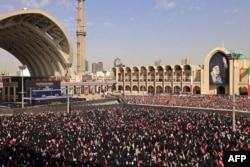
Iran has begun six days of funeral ceremonies for the late Supreme Leader Ayatollah Ali Khamenei under heavy security, but the absence of his son and successor, Mojtaba Khamenei, has become one of biggest unanswered questions surrounding the event.
The new supreme leader has not been seen in public since he was reportedly injured in the US-Israeli strikes that killed his father in February.
With state media are portraying the funeral as a demonstration of national unity and resilience after the recent conflict in the Middle East, analysts told RFE/RL's Radio Farda that Mojtaba Khamenei's appearance would carry symbolic weight because, by tradition, the new supreme leader leads prayers for his predecessor, reinforcing the legitimacy of the succession.
Read more here
Trump Says Iran Was Given 'A Week Off' Because Of Khamenei Funeral
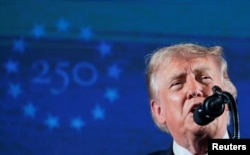
US President Donald Trump said he had effectively given Iran "a week off" from negotiations because of the funeral ceremonies for Ali Khamenei, the slain leader of the Islamic republic.
Speaking during an event late on July 3 marking the 250th July 4 anniversary of US independence, Trump said: "We knocked the hell out of Iran. They're dying to settle. They want to settle so badly. We gave them a week off for a funeral, because we're nice."
The latest round of indirect talks between Iran and the United States was held in Doha, Qatar, on July 1. Quoting an unnamed Iranian official with knowledge of the the discussions, Reuters reported that the talks were technical in nature.
Also on July 1, Trump expressed satisfaction with the process, saying "the denuclearization of Iran is moving along well" and that "they've had very good meetings." He did not give any further details.
Iranian authorities have organized six days of funeral ceremonies for Khamenei in several cities. It remains unclear, however, whether whether his son and successor, Mojtaba Khamenei, who has not appeared in public since being injured in the strike that killed his father, will attend any of the events.
Iran Begins Dayslong Funeral For Khamenei Amid Tight Security
- By Kian Sharifi
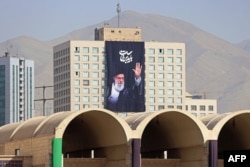
The six-day funeral ceremonies for Iran’s late Supreme Leader Ayatollah Ali Khamenei has begun in Tehran.
Doors to the Mosalla prayer grounds opened in the early morning, with hundreds of supporters of the Islamic republic waiting to enter.
Security is exceptionally tight around the vast prayer complex. Riot police and other security forces have been deployed throughout the area, roads surrounding the Mosalla were closed hours before the ceremonies began, and reports said authorities had established a no-vehicle zone extending more than one kilometer from the venue.
Coffins containing the bodies of Khamenei and four of his family members killed in the first day of the US-Israeli war against Iran are on display and will remain there until July 6.
Khamenei’s remains will then be taken to the holy city of Qom before being put on display in Baghdad, Karbala, and Najaf in neighboring Iraq. Khamenei will be buried in his home city of Mashhad in northeastern Iran on July 9.
Senior Iranian officials and foreign dignitaries paid their respects on July 3, but Mojtaba Khamenei, the late supreme leader’s second-born son and his successor, did not make an appearance.
The younger Khamenei, the Islamic republic’s third supreme leader, has not been seen in public since he suffered injuries in the same attack that killed his father as well as his wife.
It remains unclear who will pray over Khamenei’s remains in Tehran on July5, but reports in Iran suggest it will not be the new supreme leader but a high-ranking cleric.
In the lead-up to the funeral, Iranian authorities variously described the ceremony as “the most important event of the century” and “the most unique event in human history.”
But Taghi Rahmi, a rights activist and husband of Nobel Peace Prize Winner Narges Mohammadi, told RFE/RL's Radio Farda that the drawn-out affair is designed as a show of the state "still standing" and reasserting itself after the war.
It will also seek to gloss over the thousands of deaths at the hands of the Khamenei regime, which had a long record of executions, mass arrests, torture, prison abuse, and deadly crackdowns on dissent -- including the persecution of women, activists, journalists, and political prisoners.
Oman Agrees With Britain, France To Safeguard Hormuz Shipping
The British and French leaders said the Gulf state of Oman has agreed to work with the two European countries to ensure that the crucial Strait of Hormuz remains open to world shipping.
"The Strait of Hormuz is a vital artery for the global economy. Restoring safe transit for ships of all nations through the strait is a matter of global concern," British Prime Minister Keir Starmer and French President Emmanuel Macron said in a joint statement on July 3.
"The Sultanate of Oman has agreed to work with the United Kingdom and France to ensure that its sovereign territorial waters are safe for navigation," the statement added.
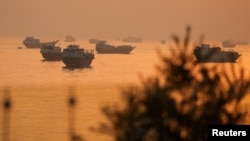
The important waterway -- through which 20 percent of the world’s oil and gas transits – was effectively blocked by Iran in response to the US and Israeli air strikes beginning on February 28.
The move, and a subsequent blockade of Iranian ports by US forces, sent global fuel prices soaring.
As part of a now-fragile cease-fire between Iran and the US, the shipping lane has been reopened, although incidents in and around the strait have kept tensions high in the region.
Britain and France have been preparing to launch a coordinated mission to keep the strait free from future blockades, although no specific plans have been announced.
"The United Kingdom and France reaffirm their shared commitment to regional stability, respect for the sovereignty of all states, and their willingness to maintain close cooperation with their partners in order to uphold global security, freedom of navigation and international law," the statement by Starmer and Macron said.
Iranian Deputy Foreign Minister Kazem Gharibabadi responded to the move by saying the Strait of Hormuz was "not a stage for displays of military power by extra-regional powers." Claiming that Tehran was "the guarantor of security" in the strait, he said the waterway was "the responsibility of the littoral states."
With reporting by dpa and RFE/RL's Radio Farda
News Analysis: Curtains On Khamenei As Iran Stages Five-Day Farewell
More than four months after he was killed in the opening strikes of the war with the United States and Israel, Ali Khamenei, who ruled the country for more than three decades with an iron first, is finally being buried.
Starting on July 4, Iran is staging what officials are calling one of the largest, most complex funerals in its history: five days of ceremonies stretching across Tehran, Qom, and Mashhad -- with stops in Baghdad, Karbala, and Najaf in neighboring Iraq -- before his body reaches its final resting place at the Imam Reza shrine on July 9.
The event is expected to have the scale of pageantry usually reserved for founding figures, but having ruled Iran for nearly 37 years, Khamenei leaves as the Islamic republic's longest-serving supreme leader and a defining force in Iran's modern history.
The drawn-out affair, according to Taghi Rahmani, a rights activist and husband of Nobel Peace Prize Winner Narges Mohammadi, is designed as a show of the state "still standing" and reasserting itself after the war. It will also attempt to gloss over the deaths of tens of thousands of Iranians at the hands of Khamenei's regime.
To read the full news analysis, click here.
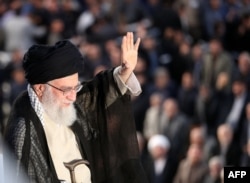
Netanyahu's Office Denies NYT Report On Israel Plotting To Kill Iranian Negotiators
The office of Israeli Prime Minister Benjamin Netanyahu has denied a story by The New York Times that reported US officials believed Israel might have been plotting to kill two top Iranian officials.
Citing unnamed US officials, The New York Times reported on July 2 that American officials feared Israel would target Foreign Minister Abbas Araqchi and Mohammad Baqer Qalibaf, Iran's chief negotiators, during talks over an interim US-Iran deal that was signed in June.
Concerned that an Israeli assassination attempt could scupper negotiations, the administration of US President Donald Trump indirectly alerted Iran in April, The New York Times reported.
"As usual, The New York Times' latest story about Israel and the Iranian negotiators is fake news. A complete fabrication of reality," Netanyahu's office said in a July 3 post on X.
Israel assassinated dozens of Iranian military and political leaders, including the late Supreme Leader Ayatollah Ali Khamenei, in the first few weeks of the war that started on February 28.
In March, The Wall Street Journal reported that Araqchi and Qalibaf were on Israel's target list.
Houthis Threaten Saudi Arabia Over Iran Flight
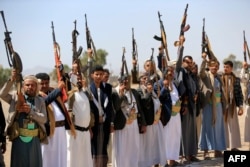
Yemen's Houthi rebels said they confronted Saudi Arabian "warplanes" that allegedly attempted to prevent an Iranian civilian aircraft from landing in the capital, Sanaa.
According to a July 3 statement by the Houthi military spokesman Yahya Sarea, the Iran-backed group warned it would target "Saudi airports and vital interests on land and sea" if Riyadh continued to violate Yemeni airspace, he added.
Earlier, local media said the aircraft successfully landed and headed back to Tehran carrying the Houthi delegation to attend the funeral of Iran's late Supreme Leader Ayatollah Ali Khamenei, who was killed in an Israeli air strike on the first day of the war on February 28.
The Houthi rebels are a key ally of Tehran and entered the war in March when they fired missiles at Israel.
War broke out between Saudi Arabia and the Houthis in 2015. A UN-brokered truce in 2022 largely stopped the fighting.
NATO To Reiterate At Summit Iran Must Never Have Nuclear Weapons
NATO leaders will reiterate that Iran "must never have a nuclear weapon and call on Iran to fully respect freedom of navigation in the Strait of Hormuz."
That's according to a text approved by NATO ambassadors on July 3 and reviewed by Reuters.
NATO leaders will meet at a summit in Ankara next week.
Under a memorandum of understanding (MOU) signed by Tehran and Washington on June 17, Iran agreed to allow 60 days of toll-free navigation in the Strait of Hormuz, a key artery for global energy supplies.
Under the interim agreement, Iran also reaffirmed that it will not "procure or develop nuclear weapons."
The sides have 60 days to reach a lasting peace deal, but several thorny issues, including the fate of Iran’s nuclear program, remain unresolved.