




After Trump Criticism, Pope Leo Condemns Killing Of Iranian Protesters
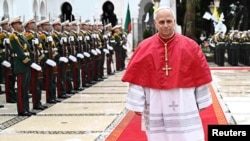
Pope Leo XIV condemned the killing of protesters in Iran after US President Donald Trump criticized the Roman Catholic pontiff for not doing so and for not speaking out against the war involving the United States, Israel, and Iran.
"When a regime, when a country takes decisions, which takes away the lives of other people unjustly, then obviously that is something that should be condemned," Leo told journalists on April 23 aboard a flight from Equatorial Guinea to Rome.
"I condemn all actions that are unjust. I condemn the taking of people's lives," he added.
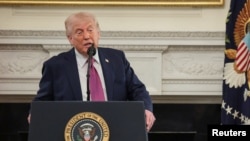
Leo’s latest comments came amid criticism from Trump, who had previously said he was "not a big fan" of the Catholic leader, calling him on the Truth Social platform "WEAK on crime, and terrible for Foreign Policy."
In a separate post, Trump also wrote: "Will someone please tell Pope Leo" about the deaths of Iranian protesters.
Iranian authorities killed thousands of people during the brutal January crackdown on anti-government protests.
UPDATE: Pope Leo later called on the United States and Iran to return to the negotiating table.
"One day Iran says yes, the United States says no and vice versa. We don't know where it will go," he said.
"I would like to encourage everyone to find responses that come from a culture of peace and not hatred and division.”
White House To Host Israel-Lebanon Talks
Talks between Israel and Lebanon will be held at the White House, a US official has said.
“The ambassador-level talks between Israel and Lebanon will now take place at the White House. President Trump will greet both representatives upon their arrival,” the official said.
The talks were originally going to be held at the State Department. A first round was held on April 14.
Fighting between Israel and Hezbollah started again in early March. A US-brokered cease-fire took effect on April 16, but there have been violations from both sides.
Report: Container Ships Seized By Tehran Taken To Iranian Port
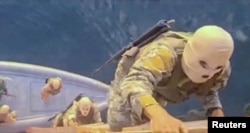
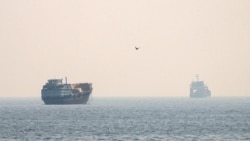
Two container ships seized by Iran near the Strait of Hormuz with about 40 crew aboard have been taken toward the Iranian port of Bandar Abbas, sources told Reuters on April 23 after Tehran vowed retaliation for the US seizure of an Iranian vessel three days earlier.
Iran’s Islamic Revolutionary Guards Corps (IRGC) seized the ships on April 22, one operated by MSC, the world’s largest container shipping group, and another chartered by the firm, sources said.
Iran accused the vessels of lacking permits and tampering with navigation systems.
Montenegro's Maritime Affairs minister, Filip Radulovic, said four Montenegrin sailors, including the captain, were aboard the MSC Francesca and were safe, adding that “negotiations between the shipping company and the Iranian side are ongoing.”
The Liberia-flagged Epaminondas reported being fired on and damaged before being boarded by Iranian forces while the Panama-flagged MSC Francesca was hit by gunfire but not damaged.
A third ship, Euphoria, was fired upon but managed to resume sailing.
The seizures have deepened disruption to the vital Strait of Hormuz waterway, which normally carries about one-fifth of global oil and gas flows.
Iranian Lawmaker Says Khamenei Opposes Continuing US Negotiations
A member of the National Security Committee of the Iranian parliament said that Supreme Leader Mojtaba Khamenei opposes extending negotiations with the United States.
In an interview with Iranian state television on April 23, Ali Khazrian praised Khamenei -- who succeeded his father, Ali Khamenei, as Iran's supreme leader after the ayatollah died in an air strike on February 28 -- for “commanding the armed forces and running the country,”
“Our information is that he is strongly opposed to any extension of negotiations under such circumstances,” he added. “Iran has concluded that participation in negotiations without a clear agenda is merely a tool for the United States to manage energy markets.”
The lawmaker also claimed that all US objectives in the war with Iran had failed.
In recent days, reports in several US media outlets have suggested growing disagreements among different factions within Iran’s ruling establishment over whether to participate in talks with the United States.
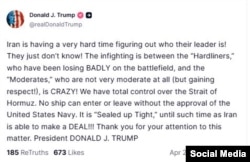
US President Donald Trump claimed on April 23 that infighting between Iran’s “hardline” and “moderate” factions had become “completely crazy.”
Mojtaba Khamenei has not been seen in public since his appointment as supreme leader.
Pahlavi Splashed With Red Liquid After Berlin Press Conference
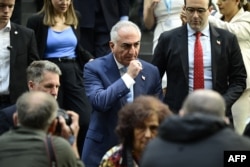
Reza Pahlavi, the exiled son of Iran's last shah, was splashed with a red liquid in Berlin on April 23 after a press appearance.
Pahlavi appeared unfazed by what happened and later waved to supporters. One man was subsequently detained in connection with the incident.
During his visit to the German capital, Pahlavi urged Western governments to back change in Iran and criticized the German government for not meeting him.
“Change is on the way,” he said, asking how many Iranians "will lose their lives while the community of Western democracies continue to merely watch."
He also said Europe was pursuing “an attempt of appeasement” that had failed “over all these years.”
Around 1,000 Pahlavi supporters rallied outside the Reichstag Building, while counterdemonstrations were also expected.
With reporting by Reuters and dpa
Trump Says Navy Targeting Mine Boats, Claims US Controls Hormuz
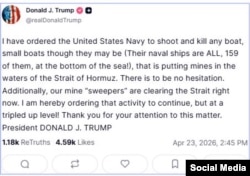
In an April 23 Truth Social post, US President Donald Trump said he had ordered the US Navy to “shoot and kill” any boat laying mines in the Strait of Hormuz, adding mine “sweepers” were operating at a “tripled up level.” He did not elaborate.
In a subsequent post, Trump also said Iran was struggling to choose a leader and claimed the Strait of Hormuz was under US control, with no ship moving without US Navy approval and the waterway “Sealed up Tight.”
US Says Forces Boarded Sanctioned Vessel Transporting Iranian Oil
The US Department of Defense says that US forces overnight carried out a maritime interdiction in the Indian Ocean and boarded a sanctioned, stateless vessel, the M/T Majestic X, which it claims was transporting oil from Iran.
"International waters cannot be used as a shield by sanctioned actors," the department wrote on X on April 23, saying that US forces would "continue to deny illicit actors and their vessels freedom of maneuver in the maritime domain."
Since the United States began its naval blockade of Iranian ports on April 13, it has intercepted dozens of vessels.
More Than 10 Million Barrels Of Iranian Crude Left Persian Gulf Since Blockade Began
An oil market data analysis firm reported on April 23 that "more than 10 million barrels of Iranian crude left the Persian Gulf" since the US military began its naval blockade of Iranian ports.
Citing an assessment by Vortexa, Reuters wrote that from April 13 to 21, approximately 10.7 million barrels of Iranian crude oil were shipped and exited the Strait of Hormuz.
According to this report, this amount of crude oil was transported by six tankers.
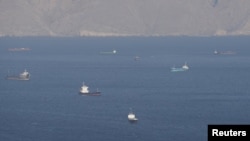
The US government announced that it would blockade Iranian ports and prevent the passage of ships to Iran in response to the closure of the Strait of Hormuz by the Islamic Revolutionary Guards Corps.
However, Vortexa wrote that the US blockade "is not necessarily implemented close to Iranian ports…but flexibly around an area about 300 miles to the west between the Pakistan/Iran border and the westernmost corner of Oman."
Since the blockade began, Iran-related traffic through the Strait of Hormuz has decreased, reaching "one to two tankers per day," down from "around two to three per day" in the month before that period, according to Vortexa.
In this regard, the US military announced on April 23 that it had "directed 31 vessels to turn around or return to port" since the beginning of the blockade.
Pentagon Disputes Report Saying Hormuz Mine Clearance Could Take Six Months
The Pentagon has disputed an article by The Washington Post which said that clearing Iranian mines from the Strait of Hormuz could take six months.
Citing unnamed officials, the newspaper reported on April 22 that US lawmakers were told Iran may have laid 20 or more advanced mines, some remotely floated using GPS technology to make detection harder.
Pentagon spokesman Sean Parnell rejected the report, saying that the media had been "cherry picking leaked information, much of which is false."
He added that a prolonged closure of the strait was "an impossibility and completely unacceptable" to US Defense Secretary Pete Hegseth.
The ongoing disruption of the crucial waterway, which usually accounts for one-fifth of global oil trade, has raised energy prices and hurt shipping confidence.
Britain and France are leading talks with more than 30 countries on a defensive coalition to reopen the strait and conduct mine-clearing operations.
With reporting by AFP
Germany Urges Tehran To 'Seize' Opportunity Of Cease-Fire To Hold Talks With US
The German government has urged Iran to "seize the opportunity" of the current cease-fire with the United States to continue diplomatic negotiations in Islamabad to prevent renewed fighting in their war.
In an April 23 statement, the government also called on Tehran to halt its military nuclear program, cease threatening Israel and other neighboring states, and ensure the Strait of Hormuz is opened "permanently, reliably, and without restrictions or fees."
"If a comprehensive agreement is reached, the German government is prepared to gradually ease existing restrictive measures with its partners," it said. "If, on the other hand, Iran continues to block the Strait of Hormuz, the German government is prepared to discuss additional sanctions."
The statement also said that once a "lasting" peace has been achieved, Germany and its allies are ready "to contribute to freedom of navigation in the Strait of Hormuz in accordance with international law and national procedures."