



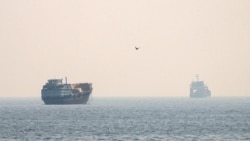

Doctors Fear Jailed Nobel Laureate Has Serious Heart Condition

The Narges Mohammadi Foundation says that doctors treating the imprisoned human rights activist and Nobel Prize winner believe she may be suffering from Prinzmetal angina, which it described as "a dangerous condition caused by coronary artery spasms."
The foundation said a statement on May 7 that Mohammadi remains in "unstable condition" on the seventh day of her hospitalization in the cardiac intensive care unit of a hospital in Zanjan, and concerns about her heart condition have intensified.
It added that Prinzmetal angina can lead to complications such as severe heart attacks, dangerous arrhythmias, sharp fluctuations in blood pressure, and reduced oxygen supply to the heart muscle.
According to the foundation, Mohammadi has been waking up almost daily since April 25 with "severe chest pain, heart palpitations, and intense pressure." Doctors have reportedly deemed an urgent specialized angiography necessary.
The foundation also said that Mohammadi’s family and doctors are demanding her immediate transfer to Tehran for treatment, but the Tehran prosecutor’s office continues to oppose the request.
In a post on X on May 7, US Assistant Secretary of State Rilery Barnes called on Iran to immediately release Mohammadi and "give her the care she needs."
Mohammadi, one of Iran’s most prominent human rights activists, won the 2023 Nobel Peace Prize for her campaign against the oppression of women in Iran and her advocacy for human rights and freedom. She has spent years in and out of prison on charges related to her activism, which supporters say are politically motivated.
Iran's Internet Shutdown Driving Job Losses, Says Monitor
The NetBlocks connectivity monitor says Iran's digital blackout "continues to drive job losses" as the country's Internet shutdown enters its 69th day.
Iranian President Says He Recently Met Supreme Leader
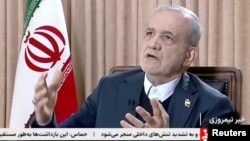
Iranian President Masud Pezeshkian has said that he recently met and had a detailed conversation with Supreme Leader Mojtaba Khamenei.
Speaking at Iran's Health Ministry on May 7, Pezeshkian said he met Khamenei for 2 1/2 hours but gave no further details about the meeting, only that the supreme leader was a "model for the country's management and administrative system" due to his "sincerity and humility."
After the assassination of former Supreme Leader Ali Khamenei on the first day of the war with the US and Israel on February 28, Iran's Assembly of Experts named his son Mojtaba as the new leader.
However, there have been no public appearances, images, or audio from the supreme leader since then. Some written statements, purportedly from Khamenei, have been published in the Iranian media.
The New York Times reported last week that Khamenei was wounded the day his father was killed and was still receiving treatment for injuries to his leg, lips, and face.
The New York Times also reported, citing Iranian officials, that the reason Khamenei had not yet recorded and released any video or audio messages was that he does not want to appear vulnerable or weak in his first public speech.
'It's Not Entirely Clear Who Is In Charge'
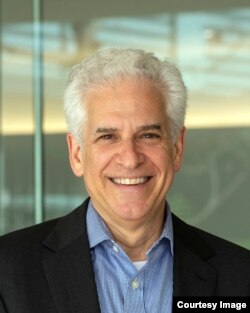
Our senior correspondent in Washington, Alex Raufoglu, spoke with Barry Pavel, a former senior director for defense policy and strategy at the National Security Council, who served as a special assistant to the president under George W. Bush, about the strategic meaning behind recent developments in the war with Iran and the chances of a peace deal.
Read more.
Iran Denies Involvement In South Korea Ship Incident
In a statement, Tehran's embassy in Seoul has said that Iran wasn't involved in an incident that damaged a South Korean ship in the Strait of Hormuz.
The embassy's statement also said that safe passage through the Strait of Hormuz requires "coordination with the competent authorities of the Islamic Republic of Iran" and that ignoring the conditions "may lead to unwanted incidents."
On May 4, there was an explosion and fire on a South Korean-operated cargo ship called the HMM Namu in the Strait of Hormuz.
Earlier, a South Korean presidential national-security adviser said it was not yet clear whether the explosion and fire were caused by an attack or a technical malfunction. The adviser said the fire started in the engine room and none of the ship's 24 crew members were injured.
The US has blamed Iran for the incident, with President Donald Trump saying that Iran fired shots at the vessel.
We are now closing the live blog for the day. We'll be back at 7:30 a.m. Central European time to cover the latest events across the Middle East.
ASEAN States Meet As Iran War Takes Growing Economic Toll
Leaders of the ASEAN states are arriving in the central Philippines on May 7 for a summit focused on economic issues tied to the war in the Middle East.
Supply chain issued caused by the US-Israeli war with Iran are likely to dominate the discussions of the Association of Southeast Asian Nations, a grouping of 11 countries, the latest being Timor-Leste.
Fuel shortages, rising food prices, and the safety of migrant workers in the Middle East region will be the key issues at the summit, President Ferdinand Marcos said ahead of the summit after he declared a state of national energy emergency in his country of about 118 million people.
"What we really need at this time is for leaders to talk about...how can we help each other," he said.
With reporting by AFP
Rubio Set To Meet With Pope In Vatican Amid Tensions Over Iran War
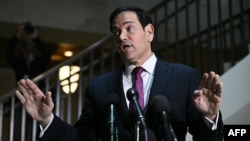
US Secretary of State Macro Rubio is set to meet with Pope Leo XIV at the Vatican on May 7 amid an extraordinary war of words between the pontiff and President Donald Trump over the actual war in the Middle East.
US officials have said Rubio will meet with the pontiff and other Vatican leaders to discuss the situation in the Middle East, as well as other key issues affecting the Western Hemisphere.
Trump has heavily criticized the first American pope in the Catholic Church’s 2,000-year history after the pontiff called for peace and expressed dismay over the US military operation in Iran.
The US president accused Leo of being “soft on crime” and being in favor of allowing Tehran to develop a nuclear arsenal.
"I don't want a Pope who thinks it's OK for Iran to have a Nuclear Weapon," Trump wrote on Truth Social on April 12.
The 70-year-old pontiff rejected the 79-year-old Trump’s assertion that he was in favor of allowing Tehran to attain weapons of mass destruction.
“The Church has spoken for years against all nuclear weapons, so there is no doubt there,” Leo told reporters on May 5. And, so, I simply hope to be listened to for the value of God’s words.”
Leo has also spoken out for the rights of immigrants and refugees -- comments seen by some Trump supporters as targeted toward the president.
With reporting by CNN
Read more here.
Israel Targets Hezbollah Unit Commander In Beirut Suburb Amid Cease-Fire
Israeli forces struck a Beirut suburb on May 6 for the first time since a cease-fire took effect three weeks ago, targeting and reportedly killing a commander of Hezbollah’s Radwan special forces unit.
Israeli Prime Minister Benjamin Netanyahu and defense chief Israel Katz said in a joint statement that the operation was aimed at “eliminating” Malek Balut, commander of Radwan unit.
Hezbollah, a militant group and political party that controls much of southern Lebanon, is considered a terrorist organization by the US, while the EU has blacklisted its armed wing but not its political branch.
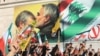
Israeli Channel 13, citing Israeli sources, reported that Balut, his deputy, and several other fighters were killed in the strike. Hezbollah sources confirmed to AFP that the commander was killed.
"The Radwan terrorists led by him are responsible for fire directed at Israeli communities and attacks against Israel Defense Forces soldiers," Netanyahu and Katz said in the statement.
Lebanon's state-run National News Agency reported that "Israeli warplanes launched an attack, targeting Ghobeiri" in the southern Beirut suburbs, a Hezbollah stronghold.
US Warplane Fires On Iranian-Flagged Ship
- By RFE/RL
US military officials said a naval warplane fired on and disabled the rudder of an Iranian-flagged oil tanker that tried to break the US blockade of Iranian ports.
In a statement on May 6, US Central Command, which oversees Washington's forces in the region, said the ship's crew "failed to comply" with demands and a F/A-18 Super Hornet fighter jet fired on the ship, identified as the M/T Hasna, as it was en route to an Iranian port on the Gulf of Oman.
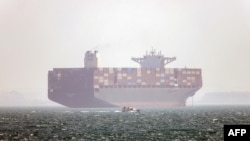
"American forces issued multiple warnings and informed the Iranian-flagged vessel it was in violation of the US blockade," officials said.
The tanker was not carrying oil, the statement said.
US forces have imposed a naval blockade on Iranian ports, following Iran's moves to effectively close down all maritime traffic through the Strait of Hormuz.
US naval forces had been escorting some ships through the chokepoint waterway, but US President Donald Trump announced a suspension of that effort.