



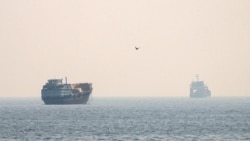

Britain Sanctions Several Individuals, Entities Over Iran Ties
The British government sanctioned 12 individuals and entities linked to Iran, it announced on May 11, accusing them of involvement in "hostile activity including plotting attacks and providing financial services to groups seeking to destabilize the UK and other countries."
Reuters reported that those sanctioned were accused of participating in hostile acts against Britain and several other countries.
The new sanctions include asset freezes and travel bans.
Those targeted include alleged members and associates of what the British government described as the "Zindashti criminal network."
In recent months, there has been speculation about possible Iranian support for anti-Semitic attacks in Britain.
At the same time, an Islamist group suspected of ties to Iran, Harakat Ashab al-Yamin al-Islamia, has claimed responsibility for some attacks in Britain as well as similar incidents in several European countries.
Could Iran Start Charging Global Tech Firms For Undersea Cables In The Strait Of Hormuz?
Iran has insisted for weeks that it has the right to charge international ships to transit the Strait of Hormuz, a key global shipping route off the coast of the Islamic republic.
Now, two news agencies affiliated with the Islamic Revolutionary Guards Corps (IRGC) have issued proposals urging Tehran to go further by imposing fees on the global tech firms that operate undersea fiberoptic cables running through the narrow waterway connecting the Persian Gulf to the open sea.
The reopening of the Strait of Hormuz, which Tehran has effectively closed since the United States and Israel launched a bombing campaign on February 28, remains a key sticking point in ending the war. Tehran has claimed sovereignty over the strategic waterway, which is rejected by the international community.
Experts say the proposals calling for Iran to demand payment for undersea cables under the strait is more of a threat than a viable plan.
"The risk of adversarial subsea cable cuts has always been there, but an open threat from a nation-state like Iran adds urgency," Isik Mater, director of research at the London-based Internet monitoring group NetBlocks, told RFE/RL.
To read the full report, click here.
Iran Says Water Shortages Affecting 35 Million People
A spokesman for Iran's water industry says that 35 million people in the country are facing water shortages.
Discussing the current water supply situation in Iran, Issa Bozorgzadeh told a press conference on May 11 that "currently, about 35 million people in the country are facing the problem of water shortage, and for this reason, we still need to save water consumption to overcome these conditions."
Referring to regional differences in rainfall, he said: "The distribution of rainfall in the country is very unbalanced, and although very good rainfall has b recorded in provinces such as Bushehr, Hormozgan, Ilam, and Kerman, we have encountered very little rainfall in provinces such as Tehran, Qom, Yazd, Markazi, and Isfahan."
Bozorgzadeh added that currently 11 provinces in the country are still experiencing below-normal rainfall conditions and "it cannot be said in any way that the country has entered a wet period."
In recent decades, Iran has faced persistent drought, excessive groundwater extraction, and mismanagement, which has caused many of the country's major cities to face a water shortage crisis.
The spokesman made no mention of the environmental impact of the US-Israeli war with Iran or attacks on Iranian infrastructure.
Beijing Pushes Back On US Sanctions Tied To Iran War Ahead Of Trump-Xi Summit
- By Colin Hood
Beijing says it opposes the inclusion of Chinese and Hong Kong entities in the latest round of US sanctions aimed at companies with ties to the Iranian regime, as US President Donald Trump prepares to head to China and meet with Chinese leader Xi Jinping for the first time since 2017.
Foreign Ministry spokesman Guo Jiakun told reporters on May 11 that Beijing has "always required Chinese enterprises to conduct business in accordance with laws and regulations," adding that China "will firmly safeguard the legitimate rights and interests of Chinese enterprises."
The US State Department announced sanctions against 10 individuals and companies on May 8 for "enabling efforts by Iran's military to secure weapons," as well as raw materials with military applications. One Chinese individual and seven Chinese companies were targeted.
Washington and Tehran have traded cease-fire proposals but have yet to reach any breakthrough in talks, with Trump calling Iran's response to the US proposal "totally unacceptable."
The round of sanctions comes as Trump travels to visit for a high-profile visit that will involve broad strategic talks ranging from trade issues to the war in Iran. The US president is set to arrive on May 13 and hold two days of talks from May 14-15.
A senior US official told Reuters on May 11 that Trump and Xi will likely discuss Beijing's support for both Iran and Russia during the summit.
Iran Official Says Tehran Called For End Of War, Release Of Frozen Assets
A spokesman for the Iranian Foreign Ministry says that in response to the latest US proposal, Tehran has called for an end to the war in the region and the release of frozen assets abroad.
"We did not demand any concessions from the Americans. The only thing we demanded was Iran's legitimate rights," Esmail Baqaei said in his weekly press conference on May 11.
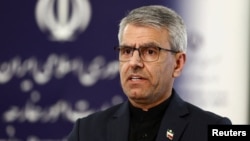
He added that Iran's demands include "stopping the war, lifting the blockade and piracy, and freeing Iran's assets," which, according to Baqaei, "have been unjustly blocked in banks due to American pressure."
"Safe passage through the Strait of Hormuz and establishing security in the region and Lebanon were other demands of Iran, which are considered a generous and legitimate offer for regional security," he added.
On May 10, US President Donald Trump described Iran's response to Washington's proposed plan to end the war as "totally unacceptable."
South Korea Condemns Attack On Cargo Ship In Strait Of Hormuz, Vows Response
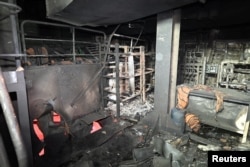
Seoul has strongly condemned the attack on a cargo ship belonging to a Korean shipping company in the Strait of Hormuz earlier this month, saying it would respond after identifying the perpetrator of the attack.
According to an official from the South Korean president's office, the May 4 attack caused a fire in the ship's engine room.
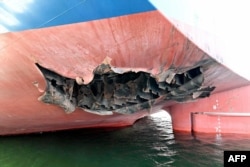
Wi Sung-lac, the South Korean presidential national-security adviser, added that the ship, the Namo operated by HMM, had not violated any regulations in the waters near the United Arab Emirates at the time of the incident, which Seoul considers an unjustified attack on a commercial vessel.
"We condemn this in the strongest terms," Wi said, adding that the damage was identified during expert assessments by Korean officials and experts in Dubai.
Wi also said it was not yet clear whether Iran played a role in the attack.
Tehran had previously denied any involvement in the incident.
US President Donald Trump said shortly after the incident that Iran had fired on the Korean ship and called on Seoul to join US-led efforts to ensure the safety of shipping in the strait.
Iran Says It Allowed Iraqi Tanker To Pass Through Strait Of Hormuz
A VLCC tanker named Agus Fanorius passed through the route designated by Iran in the Strait of Hormuz, according the semiofficial Tasnim news agency, which is linked to Islamic Revolutionary Guards Corps.
According to the report on May 11, the tanker, which is carrying Iraqi crude oil and heading toward Vietnam, is currently in the Sea of Oman.
On May 9 -- the same day that US Secretary of State Marco Rubio met with Qatar's prime minister in Miami, a Qatari tanker carrying liquefied gas passed through the Strait of Hormuz on its way to Pakistan.
Reuters, citing sources, wrote that the tanker is making the passage "with the approval" of the Islamic republic and is a confidence-building measure with Qatar and Pakistan, both of which have played a mediating role in the US-Israeli war with Iran.
Former Senior US Diplomat Gordon Gray: Iran Talks Likely To Continue Despite Trump's Latest Rejection
WASHINGTON -- Former senior US diplomat Gordon Gray, who served as deputy assistant secretary of state for Near Eastern affairs under President George W. Bush, says indirect negotiations between Washington and Tehran are likely to continue despite what he described as significant pain and pressure on both sides.

The latest exchange comes after Tehran reportedly sent a proposal via Pakistan seeking an end to military operations across the region, sanctions relief, and guarantees for maritime security, including the reopening of the Strait of Hormuz.
President Donald Trump responded on May 10 by rejecting the Iranian position, while signaling continued frustration with the slow pace of diplomacy.
RFE/RL spoke with Gray, who also served as US ambassador to Tunisia and deputy chief of mission in Egypt and now is a professor of Gulf and Arabian Peninsula affairs at the Elliott School of International Affairs at George Washington University, about the latest state of Iran peace talks.
To read the full interview, click here.
Iran Executes Man Accused Of Spying For US and Israel
An Iranian man has been executed on allegations of spying for the United States and Israel, reported Mizan, the judiciary's official news outlet.
Mizan identified the man as Erfan Shakourzadeh, 29, who worked at a scientific organization involved in satellite activities, saying he was allegedly transferring classified satellite-related scientific data after being recruited through a research project.

The outlet claimed Shakourzadeh had contacts with both US and Israeli intelligence services at different stages and shared sensitive data.
Iran's satellite program has long been viewed by Western governments as potentially linked to the development of ballistic missile technology. The report provided no specific details about the circumstances of his arrest or when the execution took place.
Human rights organizations said Shakourzadeh was a master's student in aerospace engineering at the Iran University of Science and Technology in Tehran.
They also reported that he was arrested in 2024, held in solitary confinement, and subjected to forced confessions, with his death sentence recently upheld by Iran's Supreme Court.
The case is part of a broader pattern of executions and security-related prosecutions in Iran, often involving espionage or anti-state accusations.
Rights groups say Iran ranks among the world's top executors, second only to China, and estimate that at least 1,639 people were executed in the country in 2025.
With reporting by RFE/RL's Radio Farda, Reuters, and AFP
We are now closing the live blog for the day. We'll be back at 7:30 a.m. Central European time to cover the latest events across the Middle East.