





Iran's Internet Blackout Enters 88 Days Despite Reports Of Restoration Order
Internet connectivity remains cut in Iran as it enters its 88th day, despite earlier media reports suggesting that Iranian President Masud Pezeshkian had issued an order to restore access to the global Internet.
According to the independent web monitor NetBlocks, the digital blackout in Iran has surpassed 2,088 hours of isolation from the outside world.
"Metrics confirm the shutdown currently remains in effect, despite the president’s order yesterday to restore access," NetBlocks said in a post on X on May 26.
The Islamic republic imposed the latest Internet shutdown on February 28 amid US and Israeli attacks on the country.
Experts say Iran's connectivity outage is the largest government-directed communications blackout in recorded history.
Iran's Supreme Leader Uses Hajj Message To Escalate Rhetoric Against US, Israel
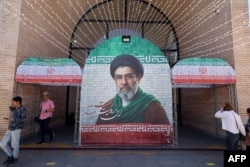
Iran's Supreme Leader Mojtaba Khamenei on May 26 issued a Hajj season message calling on Muslims worldwide to sustain chants of "Death to America" and "Death to Israel" beyond the pilgrimage period, while invoking his late father's prediction that Israel would not survive to 2040.
In a statement attributed to Khamenei carried by Iranian state media, the supreme leader declared that regional nations "will no longer be a shield for American bases" and that Washington "will no longer have a secure point for establishing military bases in the region."
The message invoked a 2015 statement by his father -- the late Supreme Leader Ayatollah Ali Khamenei, who was killed in an air strike at the start of the war on February 28 -- that Israel would not exist 25 years hence.
Mojtaba Khamenei framed the current conflict as the fulfillment of that prediction, claiming that Israel had "approached the final stages” of its existence.
The statement closed with an appeal for "friendship and cooperation" among Islamic states, a diplomatic register his father had maintained in prior public messages.
Mojtaba, who was reportedly injured in the same strike that killed his father, has not made any public appearance since being announced as the new supreme leader on March 8.
Qatar Denies Reports Of $12 Billion Offer To Iran For 'Agreement'
Qatar says reports claiming the Doha government had “offered” Iran $12 billion to ensure the finalization of a peace agreement are “simply not true.”
Foreign Ministry spokesman Majed Al Ansari wrote on X on May 26 that the reports were being "circulated by parties attempting to sabotage the deal & undermine ongoing diplomatic efforts toward regional de-escalation & stability."
He added that Qatar’s diplomatic efforts, carried out "in coordination with regional partners," were "well established & publicly documented & such narratives are nothing more than desperate attempts to tarnish Qatar’s reputation as a trusted international peace facilitator."
The statement came shortly after an unexpected visit to Qatar on May 25 by an Iranian delegation led by parliament speaker Mohammad Baqer Qalibaf and accompanied by Foreign Minister Abbas Araqchi.
During the Iran war, Qatar has repeatedly been targeted by missile and drone attacks launched by the Islamic republic.
Reuters, citing informed sources, had also reported that the governor of Iran’s central bank was present in Qatar to discuss the possible release of frozen Iranian assets as part of a final agreement.
Markets Turn Cautious As US-Iran Talks Face Fresh Uncertainty
The dollar has steadied as investor optimism over a possible agreement to reopen the Strait of Hormuz and ease tensions between the United States and Iran faded following fresh US strikes in southern Iran late on May 25 and warnings that negotiations could take time.
Markets had rallied earlier in the week amid hopes of a breakthrough in talks aimed at ending the Iran conflict, helping keep oil prices below $100 a barrel and easing pressure on emerging-market currencies.
However, US Secretary of State Marco Rubio said on May 26 that reaching a deal could “take a few days,” tempering expectations of a rapid de-escalation.
Brent crude rose 1.5 percent to $97.76 a barrel on May 26 after falling 7 percent the previous day, Reuters reported, while the euro slipped slightly against the dollar and the Australian dollar weakened after recent gains.
Analysts said investor confidence remained fragile, warning that shipping and energy supply chains through Hormuz could take time to normalize even if an agreement is reached in the near term.
With reporting by Reuters and AFP
Netanyahu Vows Tougher Offensive As Israel Strikes Southern Lebanon
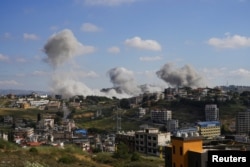
Israel intensified strikes in southern Lebanon on May 25 after Prime Minister Benjamin Netanyahu said he had ordered the military to escalate operations against Hezbollah.
Netanyahu said Israel would “intensify our blows, increase our firepower, and we will crush them”, despite a cease-fire that took effect on April 17.
The latest escalation comes as the United States and Iran work to finalize a broader agreement aimed at ending conflict across the Middle East, potentially including the Lebanon front.
Israel and Hezbollah have continued near-daily exchanges of fire since the truce began.
Israeli strikes late on May 25 targeted towns and villages in southern Lebanon and the Bekaa valley, with Lebanon’s National News Agency reporting three people killed in attacks on two cars and a motorcycle.
Residents were also seen fleeing Beirut’s southern suburbs, a Hezbollah stronghold, following Israel’s evacuation orders for 10 villages.
Israel accused Hezbollah of violating the cease-fire, with Israel Defense Forces spokesman Avichay Adraee saying the army was “compelled to operate against it with force.”
Hezbollah later said it had attacked Israeli military positions “in response to the violation of the cease-fire” by Israel.
Two far-right Israeli ministers also called for an expanded offensive.
“For every explosive drone strike, 10 buildings must fall in Beirut,” Finance Minister Bezalel Smotrich said.
Meanwhile, Lebanon and Israel are due to hold talks in Washington next week, although Hezbollah leader Naim Qassem has reiterated his opposition to direct negotiations and dismissed calls for his organization for disarm.
With reporting by AFP
US Says It Carried Out 'Self-Defense' Strikes in Southern Iran Amid Fragile Cease-Fire
WASHINGTON -- The United States military said it carried out “self-defense” strikes in southern Iran on May 25, targeting missile launch sites and Iranian boats allegedly attempting to lay mines near key shipping routes.
In a statement, the US Central Command (CENTCOM) said the strikes were aimed at protecting American troops from what it described as threats posed by Iranian forces during a tense ceasefire period.
“US Central Command continues to defend our forces while using restraint during the ongoing ceasefire,” CENTCOM spokesperson Navy Captain Tim Hawkins said.
According to the statement, US forces struck “missile launch sites and Iranian boats attempting to emplace mines” in southern Iran.
The strikes appeared to focus on areas near the Strait of Hormuz, one of the world’s most strategically important waterways for global oil shipments prior to the war that began with US and Israeli strikes on Iran on February 28.
Explosions were earlier reported by Iranian news agencies in and around the southern Iranian port city of Bandar Abbas. Iran’s semi-official Mehr news agency later said the situation was “completely under control” and urged residents not to worry.
Following the strikes, US Secretary of State Marco Rubio, speaking to reporters during a trip to India, defended the US position, insisting the vital shipping route “has to be open one way or the other.”
“What’s happening there is unlawful, it’s illegal, it’s unsustainable for the world, it’s unacceptable,” Rubio said of Iran's actions.
“There’s no country in the world that’s in favor of a tolling system, except the regime in Iran. So that’s not acceptable,” he added, referring to Tehran's announced plans to charge fees for ships to pass through the strait.
Washington Signals Restraint As Talks Continue
The military action comes despite ongoing diplomatic contacts between Washington and Tehran aimed at ending months of confrontation.
Rubio told reporters that a deal with Tehran was still possible and could be reached soon.
“I think it’s a lot of talking back and forth going on about specific language in the initial document, so it’ll take a few days,” he said.
US President Donald Trump said over the weekend that negotiators were discussing the “final details” of a possible agreement, while Iranian officials said the two sides had reached a preliminary framework on several issues but that no deal was imminent.
Both sides signaled major differences remain.
Trump reiterated on May 25 that Iran’s enriched uranium stockpile should either be handed over to the United States or “destroyed in place.”
In a post on Truth Social, Trump said the US Atomic Energy Commission should oversee any destruction or transfer of uranium material.
Iran, however, pushed back against reports suggesting it had agreed to suspend uranium enrichment.
A senior Iranian diplomat reportedly dismissed such claims as “pure fabrication”, while the Iranian foreign ministry said that although some conclusions had been reached in negotiations, “that does not mean we’re close” to a final deal.
The US and Iran have maintained a fragile cease-fire since April 8, though sporadic incidents have continued in the Gulf region.
We are now closing the live blog for the day. We'll be back at 7:30 a.m. Central European time to cover the latest events across the Middle East.
Trump: Iran's Enriched Uranium Will be Destroyed
The enriched uranium possessed by Iran will "either be immediately turned over" to be shipped to and destroyed in the United States or will be destroyed in Iran itself or "any other acceptable location."
This statement was posted on US President Donald Trump's social network Truth Social on May 25 and provided no further details.
Iran's possession of tons of home-made highly enriched uranium that can be upgraded for the use in a nuclear weapon remains among the most contentious items in the ongoing peace talks between the US and Iran.
Iran Says FIFA Promised Soccer Players Will Receive Visas: State Media
World soccer governing body, FIFA, has promised that members of Iran’s national team will receive visas to play in the United States at the 2026 World Cup despite the current war in the Middle East, state media quoted Iran’s sports minister as saying.
"The FIFA president promised us that all our players would receive visas. There is no reason why our players should not receive visas," Ahmad Donyamali was quoted as saying by the semi-official ISNA news agency.
"I hope that all the conditions will be met so that the national team can participate in the tournament in a calm and orderly manner."
Iranian soccer fans have for months faced uncertainty over whether they will see their national team compete in the sport’s most important event, amid the conflict between the United States and Iran.
On May 23, Iran's soccer federation said the national soccer team will be based in the Mexican border city of Tijuana during the World Cup, which will be co-hosted by the United States, Canada, and Mexico.
Mexican President Claudia Sheinbaum said on May 25 that the country will allow the Iranian soccer team to be based there to avoid US visa restrictions.
Iran’s President Issues Order To Restore Internet: State Media
Iran’s President Masoud Pezeshkian has issued an order to restore access to the global Internet, according to state media.
Authorities have imposed a nationwide Internet blackout since the United States and Israel launched a bombing campaign of the Islamic republic on February 28.
The Tasnim and Fars news agencies -- both affiliated with the Islamic Revolutionary Guards Corps (IRGC) -- reported on May 25 that the order was “communicated to the Ministry of Communications by the president."
It was not immediately clear if access to the global Internet would be fully restored and when.