





Iran Accuses US Of 'Flagrant Violation' Of Cease-Fire
Iran's Foreign Ministry has accused the United States of a "flagrant violation" of the April 8 cease-fire over the past 48 hours.
The ministry referred to “aggressive actions” in Hormozgan Province, though it made no explicit reference to US strikes in southern Iran.
It also cited what it described as "illegal actions" since the cease-fire was announced, including "maritime piracy against Iranian commercial vessels."
It "strongly condemned" US conduct, accused Washington of "ill-will and bad faith," and said the United States bore responsibility for "all consequences" of its actions.
Iran's Islamic Revolutionary Guards Corps (IRGC) separately warned that it would "respond decisively to any violation of the cease-fire."
US Central Command earlier said it carried out strikes in southern Iran on May 25 against "missile launch sites and Iranian boats attempting to emplace mines," describing the action as "self-defense" and saying the cease-fire remained in effect.
With reporting by RFE/RL's Radio Farda
Iran's Internet Reopening Push Hit By Court Order
Iran’s Administrative Justice Court has suspended implementation of a decree establishing a new state body intended to oversee cyberspace policy, complicating government plans to restore full Internet access after months of nationwide restrictions.
The court announced on May 26 that, following legal complaints, it had ordered a halt to the creation of the “Special Headquarters for the Organization and Management of the Country’s Cyberspace.”
It said that “until the final review of the complaints,” the body’s decisions and resolutions “shall not be enforceable.”
The ruling came shortly after officials in President Masud Pezeshkian’s government said reconnection to the global Internet would begin within hours and that full public access could be restored within 24 hours.
Government spokeswoman Fatemeh Mohajerani said the new cyberspace headquarters had concluded that “the reopening of the Internet should take place.”

Iran has experienced a near-total internet blackout since February 28, when authorities shut down access following the outbreak of the US-Israeli war against Iran.
Some officials have criticized the restrictions, citing their severe economic and social impact.
With reporting by RFE/RL's Radio Farda
Judiciary Announces Execution Of Another Man Accused Of Spying For Israel
Iran’s judiciary has announced that another citizen has been executed on charges of spying for Israel.
The judiciary’s news agency identified the executed individual as Gholamreza Khani Shekarab and claimed he had been “the head of an Israeli espionage network.”
The judiciary report on May 26 did not mention the date of the defendant’s arrest or trial.
At the same time, it described him as “a thug and hooligan from one of the country’s provinces with a history of violence and criminal activity,” and alleged that he had been “seeking to recruit individuals and use them inside the country to carry out anti-security operations.”
No details have been published regarding the legal proceedings in the case, and the report did not provide evidence or documentation supporting the accusations.
In recent months, Iran’s judiciary has carried out executions on an almost daily basis against protesters or individuals accused of cooperating with the United States and Israel.
Human rights organizations say the Islamic republic uses executions to create an atmosphere of fear and as a tool of repression.
With reporting by RFE/RL's Radio Farda
Drinking Water Shortages Possible In Several Iranian Provinces, Authorities Warn
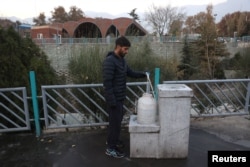
An official from Iran’s Meteorological Organization says water stress in some areas has become so severe that problems could arise in supplying drinking water unless water conservation measures are observed.
Ahad Vazifeh, head of the National Center for Climate and Crisis Management at the Meteorological Organization, pointed to prolonged water stress in major cities such as Tehran, Karaj, Mashhad, and Isfahan, emphasizing the need to reduce water consumption in those areas.
He said residents of Mashhad, Tehran, Saveh, Arak, and Karaj must exercise maximum water conservation, “otherwise it is predicted that these cities will face shortages of drinking water.”
The warning comes even though Vazifeh said rainfall during March and April this year was relatively high, with precipitation during the two-month period “about four percent above normal.”
However, Vazifeh said drought conditions continue in several provinces.
He said Tehran, Qom, Qazvin, Semnan, Markazi, and Gilan provinces are facing significant rainfall deficits, adding that conditions in Tehran are particularly severe.
Although Tehran has received 155 millimeters of rainfall during the current water year, precipitation remains 38 percent below normal, he said.
Tehran also ended the previous water year with nearly 50 percent below-normal rainfall and remains the country’s driest province this year.
Vazifeh added that, despite good rainfall during the first two months of the current year, precipitation levels remain below normal in many provinces.
With reporting by RFE/RL's Radio Farda
Iran Claims It Downed A US Drone
Iran’s Islamic Revolutionary Guards Corps (IRGC) says it has “shot down” a US drone and “opened fire” on several other American drones that had entered Iranian airspace.
In a statement published on May 26, the IRGC said that after US military aircraft "entered Iranian airspace in the Persian Gulf region," its air defense units “identified and shot down an MQ-9 drone.”
The IRGC added that its forces “also fired upon an RQ-4 drone and an intruding F-35 fighter jet.”
The statement did not specify when the incidents took place.
The Iranian claim came after US Central Command announced that the American military had carried out "self-defense" strikes in southern Iran on May 25 against targets that included "missile launch sites and Iranian boats attempting to emplace mines."
Iranian media reported early on May 26 that “American fighter jets targeted several Iranian vessels south of Larak Island,” adding that at least three people were killed in the attack.
With reporting by RFE/RL's Radio Farda and AFP
Iran's Internet Blackout Enters 88 Days Despite Reports Of Restoration Order
Internet connectivity remains cut in Iran as it enters its 88th day, despite earlier media reports suggesting that Iranian President Masud Pezeshkian had issued an order to restore access to the global Internet.
According to the independent web monitor NetBlocks, the digital blackout in Iran has surpassed 2,088 hours of isolation from the outside world.
"Metrics confirm the shutdown currently remains in effect, despite the president’s order yesterday to restore access," NetBlocks said in a post on X on May 26.
The Islamic republic imposed the latest Internet shutdown on February 28 amid US and Israeli attacks on the country.
Experts say Iran's connectivity outage is the largest government-directed communications blackout in recorded history.
Iran's Supreme Leader Uses Hajj Message To Escalate Rhetoric Against US, Israel
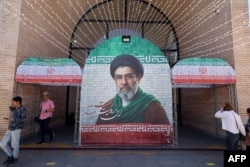
Iran's Supreme Leader Mojtaba Khamenei on May 26 issued a Hajj season message calling on Muslims worldwide to sustain chants of "Death to America" and "Death to Israel" beyond the pilgrimage period, while invoking his late father's prediction that Israel would not survive to 2040.
In a statement attributed to Khamenei carried by Iranian state media, the supreme leader declared that regional nations "will no longer be a shield for American bases" and that Washington "will no longer have a secure point for establishing military bases in the region."
The message invoked a 2015 statement by his father -- the late Supreme Leader Ayatollah Ali Khamenei, who was killed in an air strike at the start of the war on February 28 -- that Israel would not exist 25 years hence.
Mojtaba Khamenei framed the current conflict as the fulfillment of that prediction, claiming that Israel had "approached the final stages” of its existence.
The statement closed with an appeal for "friendship and cooperation" among Islamic states, a diplomatic register his father had maintained in prior public messages.
Mojtaba, who was reportedly injured in the same strike that killed his father, has not made any public appearance since being announced as the new supreme leader on March 8.
Qatar Denies Reports Of $12 Billion Offer To Iran For 'Agreement'
Qatar says reports claiming the Doha government had “offered” Iran $12 billion to ensure the finalization of a peace agreement are “simply not true.”
Foreign Ministry spokesman Majed Al Ansari wrote on X on May 26 that the reports were being "circulated by parties attempting to sabotage the deal & undermine ongoing diplomatic efforts toward regional de-escalation & stability."
He added that Qatar’s diplomatic efforts, carried out "in coordination with regional partners," were "well established & publicly documented & such narratives are nothing more than desperate attempts to tarnish Qatar’s reputation as a trusted international peace facilitator."
The statement came shortly after an unexpected visit to Qatar on May 25 by an Iranian delegation led by parliament speaker Mohammad Baqer Qalibaf and accompanied by Foreign Minister Abbas Araqchi.
During the Iran war, Qatar has repeatedly been targeted by missile and drone attacks launched by the Islamic republic.
Reuters, citing informed sources, had also reported that the governor of Iran’s central bank was present in Qatar to discuss the possible release of frozen Iranian assets as part of a final agreement.
Markets Turn Cautious As US-Iran Talks Face Fresh Uncertainty
The dollar has steadied as investor optimism over a possible agreement to reopen the Strait of Hormuz and ease tensions between the United States and Iran faded following fresh US strikes in southern Iran late on May 25 and warnings that negotiations could take time.
Markets had rallied earlier in the week amid hopes of a breakthrough in talks aimed at ending the Iran conflict, helping keep oil prices below $100 a barrel and easing pressure on emerging-market currencies.
However, US Secretary of State Marco Rubio said on May 26 that reaching a deal could “take a few days,” tempering expectations of a rapid de-escalation.
Brent crude rose 1.5 percent to $97.76 a barrel on May 26 after falling 7 percent the previous day, Reuters reported, while the euro slipped slightly against the dollar and the Australian dollar weakened after recent gains.
Analysts said investor confidence remained fragile, warning that shipping and energy supply chains through Hormuz could take time to normalize even if an agreement is reached in the near term.
With reporting by Reuters and AFP
Netanyahu Vows Tougher Offensive As Israel Strikes Southern Lebanon
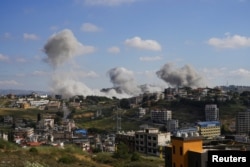
Israel intensified strikes in southern Lebanon on May 25 after Prime Minister Benjamin Netanyahu said he had ordered the military to escalate operations against Hezbollah.
Netanyahu said Israel would “intensify our blows, increase our firepower, and we will crush them”, despite a cease-fire that took effect on April 17.
The latest escalation comes as the United States and Iran work to finalize a broader agreement aimed at ending conflict across the Middle East, potentially including the Lebanon front.
Israel and Hezbollah have continued near-daily exchanges of fire since the truce began.
Israeli strikes late on May 25 targeted towns and villages in southern Lebanon and the Bekaa valley, with Lebanon’s National News Agency reporting three people killed in attacks on two cars and a motorcycle.
Residents were also seen fleeing Beirut’s southern suburbs, a Hezbollah stronghold, following Israel’s evacuation orders for 10 villages.
Israel accused Hezbollah of violating the cease-fire, with Israel Defense Forces spokesman Avichay Adraee saying the army was “compelled to operate against it with force.”
Hezbollah later said it had attacked Israeli military positions “in response to the violation of the cease-fire” by Israel.
Two far-right Israeli ministers also called for an expanded offensive.
“For every explosive drone strike, 10 buildings must fall in Beirut,” Finance Minister Bezalel Smotrich said.
Meanwhile, Lebanon and Israel are due to hold talks in Washington next week, although Hezbollah leader Naim Qassem has reiterated his opposition to direct negotiations and dismissed calls for his organization for disarm.