





US Treasury Chief Warns Oman On Sanctions Day After Trump Threatens To 'Blow Them Up'
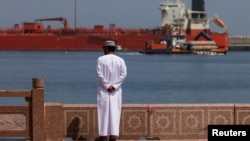
US Treasury Secretary Scott Bessent on May 28 threatened to target longtime Gulf ally Oman with sanctions if it helps Iran impose a tolling system in the strategic Strait of Hormuz.
In a posting on X. on X, Bessent wrote: "The United States Government will not tolerate any effort to impose a tolling system in the Strait of Hormuz."
"Oman, in particular, should know that the US Treasury will aggressively target any actors involved -- directly or indirectly -- in facilitating tolls for the Strait and any willing partners will be penalized."
He added that "all nations should reject outright any efforts by Iran to disrupt the free flow of commerce. Tehran’s days of terrorizing the region and the world are over."
Bessent later told a White House briefing that he had spoken with the Omani ambassador and received assurances that "there were no plans for tolling" the waterway.
"I told him that this was a non-starter and he did not want to risk either the Oman individuals or Omani financial institutions getting sanctioned," Bessent said.
Iran has effectively blocked the crucial strait, through which some 20 percent of the world's oil and gas supplies transited prior to the war. It has threatened to charge ships passing through the international waterway and has sought Oman's partnership in the project.
Oman has helped mediated talks between Washington and Tehran but has itself come under attack from Iran's retaliatory drone and missile strikes.
A day earlier, US President Donald Trump appeared to threaten Oman when asked about a possible arrangement allowing it and Iran to control the strait, saying he would "blow them up" if Oman did so.
US Slaps Sanctions On Iran Military Oil Trade
The US said on May 28 said it has slapped fresh new sanctions on Iran's military oil trade, sanctioning eight vessels involved in transporting Iranian crude oil and petroleum products to global markets.
The ships included the Marshall Islands-flagged oil tanker Flora, the Comoros-flagged crude oil tanker Hauncayo, and the Panama-flagged tanker Ill Gap.
"We will not allow the Iranian government to increase its oil revenue for the purpose of reconstituting its armed forces and military capabilities," Treasury Secretary Scott Bessent said in a statement.
The Treasury said some of the sanctioned Iranian entities also use the oil sales infrastructure of the Iranian armed forces to secure oil products from outside Iran.
The news of the sanctions comes amid reports that Washington and Tehran negotiators have reached a tentative agreement on a 60-day extension of the cease-fire that is currently in place. Various media reports state that the deal is awaiting US President Donald Trump's approval.
US, Iran Negotiators Reach Tentative Deal To Extend Cease-Fire, Await Trump's Approval: Reports
Multiple US and international news outlets are reporting that the United States and Iran have reached a tentative agreement on extending the current cease-fire and that it is awaiting President Donald Trump’s final approval.
Reuters on May 28 cited four sources familiar with the matter as saying the deal would extend the truce for a further 60 days and allow for traffic to freely flow through the strategic Strait of Hormuz while negotiators continue to address more difficult issues -- such as Tehran’s nuclear program.
The news comes amid reports by Iranian news agencies that the country's forces had on May 28 launched missile strikes, initially believed to be warning shots fired toward ships in the Strait of Hormuz.
Meanwhile, the US announced it had imposed new sanctions on Iran's military oil trade, targeting eight ships involved in transporting Iranian petroleum products to global markets.
Although it would not be the more-inclusive cease-fire deal that Trump has said the US was seeking, the new agreement, if confirmed, would appear to be the largest step toward peace since the US-Israeli air strikes on Iran on February 28 led to the widespread Middle East conflict.
Reuters said Trump has not yet approved the agreement, while the White House declined to comment.
However, Vice President JD Vance told reporters that Washington was "not there yet" in talks with Tehran but that the sides were close.
"It's hard to say exactly when or if the president is going to sign the MOU (memorandum of understanding). We're going back and forth on a couple of language points," Vance said.
"I can't guarantee that we're going to get there, but right now I feel pretty good about it," he said.
Tehran has not commented on the report, which was first published by Axios. Iran's Tasnim news agency, citing a source, said the text of the agreement had not been finalized or confirmed.
Among others, AFP, dpa, CNN, The New York Times, Fox News, and CBS News cited sources to say a tentative deal had been reached to extend the cease-fire.
US Treasury Secretary Scott Bessent, during a briefing at the White House, declined to confirm an agreement but told reporters that "we perhaps have the makings of a deal here."
The Axios report said terms of the agreement had largely been finalized by May 27, but it added that both sides must still get the approval of their political leaders.
A 30-day US-Iran cease-fire was first announced in early April before Trump set an open-ended extension prior to its expiration.
Back Online After Internet Blackout Ends, Iranians Still Face Limited Communications
Internet access in Iran has been partially restored after the government shut down communications at the start of the US-Israeli bombing campaign in late February. Iranians told RFE/RL's Radio Farda that they had been unable to check on their loved ones' safety during months of deadly air strikes. Even as the total blackout ended on May 27, Iranians inside and outside the country described slow connections and difficulty reaching friends and family.
Video by Kian Sharifi, RFE/RL's Radio Farda, and Margot Buff



Rights Activist Nasrin Sotoudeh Says She Was Beaten In Intelligence Ministry Detention Center

Lawyer and human rights activist Nasrin Sotoudeh says that she was arrested by Iranian Intelligence Ministry agents on April 1 and beaten while being held in one of the ministry’s detention centers.
She wrote in a Facebook post on May 28 that when she arrived at the detention facility, agents tied her hands and feet and beat her “over the compulsory hijab,” or mandatory Islamic head scarf. She said the beating left bruises on her legs and wounds on her face.
Sotoudeh also described conditions in the detention center as “inhumane,” saying "forced confessions were rampant" and that the release of some detainees was conditioned on recording video confessions.
She added that she was temporarily released on May 13 after a new case was opened against her.
At the end of her message, referring to domestic and international support for political prisoners in Iran, Sotoudeh wrote: “No to war, no to dictatorship.”
Sotoudeh is one of Iran’s best-known human rights lawyers and has been repeatedly jailed over her defense of political prisoners, women’s rights activists, and opponents of compulsory hijab laws.
Number Of Iranians Living Below Poverty Line This Year May Reach 40 Million, Say Economists
Several Iranian economists and university professors warned during a specialist conference that the country’s economy could shrink by as much as 10 percent following the recent war, predicting that around 4.5 million more people could fall into poverty this year.
The Donya-e Eqtesad economic daily reported on May 28 that four economists and researchers in economics and social policy painted a “worrying” picture for Iran’s economic outlook.
Hojat Mirzai, a faculty member at Allameh Tabatabai University’s economics department, said that because of the US naval blockade and the collapse of Iran’s oil exports to almost zero, economic growth in the country of some 90 million people is "forecast to be between minus 8.8 and minus 10 percent" in the coming year.
He added that “between 3.5 and 4.5 million more people” could fall below the poverty line this year, bringing the total number of people living below it in Iran to more than 40 million.
The warnings come amid soaring inflation, rising consumer prices, and sharp declines in Iranian government revenues following weeks of a US naval blockade and collapsing oil exports.
With reporting by RFE/RL's Radio Farda
Bessent Signals Pressure On Iranian Airlines

US Treasury Secretary Scott Bessent says that Washington would tighten pressure on Iran by targeting the country’s airlines as part of efforts to force Tehran to reopen the Strait of Hormuz.
In a post on X on May 28, Bessent said the United States would “be shutting down both Iranian airlines' access to landing spots, refueling, and ticket sales,” though he did not specify which carriers would be affected.
The country's flag carrier Iran Air has previously been designated by the US State Department while Iran's Mahan Air has also been sanctioned
Bessent warned that “only a satisfactory outcome in negotiations will end the downward spiral.”
The announcement came a day after Washington sanctioned Iran’s Persian Gulf Strait Authority, which regulates transit through the strategic waterway.
Iran tightened control over the strait after US-Israeli strikes on February 28 triggered a regional war.
Despite a cease-fire in place since April 8, US and Iranian forces exchanged strikes again on May 28.
An X post from CENTCOM, which oversees US military operations in the Middle East.
Iranian Supreme Leader Warns Of 'Divisions And Disintegration'

Iran’s Supreme Leader Mojtaba Khamenei has claimed that the United States and Israel were seeking to destabilize the Islamic republic through war, economic pressure, and social divisions.
In a written message published by Iranian media and read on state television on May 28, Khamenei said the "enemy’s blind plan” was to create “divisions and disintegration” in Iran following months of conflict and sanctions pressure.
He called on Iranians to preserve “unity” and avoid turning disagreements into “conflict and division.”
The statement came a day after Iran’s Intelligence Ministry warned that economic hardship, shortages, and rising prices caused by US pressure could trigger fresh unrest.
The Wall Street Journal also reported on May 28 that analysts feared the continuing US naval blockade and falling foreign currency reserves could increase the likelihood of renewed protests in Iran.
Mojtaba Khamenei, 56, succeeded his father, Supreme Leader Ayatollah Ali Khamenei, who was killed on February 28 in the opening US-Israeli strikes on Iran. He has not appeared in public since.
With reporting by RFE/RL’s Radio Farda and Agence France-Presse.
Iran-US Talks 'A Dangerous Game,' Says Ex-Pentagon Official Michael Patrick Mulroy
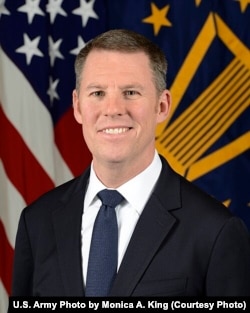
WASHINGTON -- As Washington and Tehran weigh diplomacy against the risk of renewed conflict, former US Deputy Assistant Secretary of Defense for the Middle East Michael Patrick Mulroy, says both sides now have strong incentives to prevent the crisis from escalating again if they are prepared to compromise.
In an interview with RFE/RL, Mulroy, who served under the first administration of President Donald Trump, said there is “hope” for an agreement because both Washington and Tehran “have an interest in seeing this come to an end,” while cautioning that negotiations could still collapse if either side overplays their hand.
RFE/RL: President Trump said during the cabinet meeting that Iran “very much wants to make a deal,” but also warned that “maybe we’ll just have to finish the job.” He ruled out sanctions relief in exchange for uranium concessions. From your perspective, how close are we to either a diplomatic breakthrough or direct military escalation?
Michael Patrick Mulroy: I think we are closer than we have been. I know a lot of people have seen the comments that keep coming out that we're on the verge, and we never get there, so they're very skeptical -- and I think that's fair.
But it's clear to me that President Trump does not want this to go into a stalemate that just continues
and continues. Although I think he is willing to use military escalation, he understands that would come with significant consequences.
Iran, of course, is not just going to absorb another round of air strikes. They're going to launch a counterattack. Obviously, it would be against US forces, but also against Gulf countries, as they have already proven both their willingness and capability to do.
That would further exacerbate the very issue Iran believes gives it leverage -- dramatically increasing the cost of energy around the world, including in the US, at a time when the US is heading into midterm elections.
At the same time, the [US] blockade and naval pressure have put serious strain on the regime’s ability to fund itself. So both sides have an interest in seeing this come to an end. I think there is hope. But the question is whether both sides are willing to compromise, because that’s how negotiations work.
Read more here