



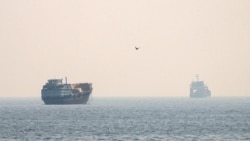

Israeli Forces Strike Arms-Laden Tunnel In Southern Lebanon, Netanyahu Says
Despite a newly signed cease-fire deal, the Israeli military destroyed an extensive tunnel built by Hezbollah militants in southern Lebanon, Prime Minister Benjamin Netanyahu said.
"The tunnel, stretching more than 200 meters and reaching a depth of over 25 meters, contained hundreds of weapons as well as several launch shafts intended to target the State of Israel and its civilians," a joint statement by Netanyahu and Defense Secretary Israel Katz said on June 28.
Iran-backed Hezbollah, a militant group and political party that controls much of southern Lebanon, is considered a terrorist organization by the US, while the European Union has blacklisted its armed wing but not its political branch.
Hezbollah, which was not a party to the talks, has said it will reject the framework agreement as long as Israeli forces remain in Lebanon.
The Israeli statement said the tunnel destroyed in the operation contained hundreds of weapons and launchers.
The operation came two days after Israel and Lebanon signed a US-mediated framework agreement that aims to bring about a lasting peace agreement between the two countries.
The Israeli military said it also struck Hezbollah militants carrying rocket-propelled grenades and that it struck a rocket launcher in the Nabatieh region of south Lebanon.
With reporting by Reuters
Israel Renews Strikes In Lebanon
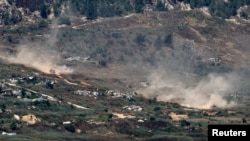
Israel renewed strikes in southern Lebanon on June 28, Lebanese state media reported, two days after Israel and Lebanon signed a framework agreement aimed at ending decades of conflict, as Hezbollah warned the deal could trigger "internal conflict."
Lebanon's state-run National News Agency reported several strikes, while the Israeli military said one of its soldiers "fell in combat" in southern Lebanon. Israeli military chief Eyal Zamir later approved plans for "continued operations...in accordance with the cease-fire agreement" in a self-declared Israeli security zone extending up to 10 kilometers into southern Lebanon that is intended to prevent attacks by Hezbollah.
The renewed violence came a day after Lebanese President Joseph Aoun told US President Donald Trump that Lebanon "would assume its responsibilities" in implementing the agreement, which makes an Israeli withdrawal from occupied Lebanese territory conditional on Beirut disarming Hezbollah.
Iran-backed Hezbollah is both a militant group and political party that controls much of southern Lebanon. It is considered a terrorist organization by the United States, while the European Union has blacklisted its armed wing.
Under the agreement, Lebanon's military is to restore state authority across the country following the verified disarmament of non-state armed groups.
Hezbollah has rejected the Israel-Lebanon framework agreement, calling it a surrender of Lebanese sovereignty and refusing to disarm while Israeli troops remain on Lebanese territory.
Russia Won't Return Specialists To Bushehr Nuclear Plant Without Security Guarantee
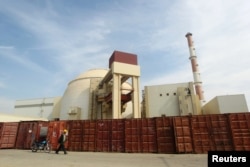
The head of Russia's state nuclear corporation, Rosatom, has said that Russia will not return its specialists to Iran's Bushehr nuclear power plant until it receives a "100 percent guarantee" of their safety.
Rosatom chief executive Aleksei Likhachev told the Russian news agency Interfax on June 28 that "until we understand that our people's safety is 100 percent guaranteed we, of course, will not be returning them."
Rosatom evacuated around 400 of its specialists from the Bushehr plant after the outbreak of the US-Israel war with Iran.
Likhachev said that 20 Russian specialists remain at the Bushehr facility and are continuing their work, including cooperation with Iranian staff.
However, he said any large-scale return of personnel "will only become possible when we understand that our people are not risking their lives. And not only at the plant, but also during, so to speak, logistical operations, because all transportation is taking place by motor transport, at least while planes are not flying."
The area around the Bushehr plant was struck several times during the recent war, prompting criticism from the UN's International Atomic Energy Agency, which warned that military activity around operating nuclear facilities posed a serious safety risk.
Iran Warns Against 'New Or Separate Arrangements' For Hormuz Strait
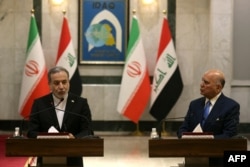
Iranian Foreign Minister Abbas Araqchi has warned that "any attempt to adopt new or separate arrangements" for the Strait of Hormuz would "increase the tensions" and delay reopening the strategic waterway.
Speaking while on a visit to Baghdad on June 28, Araqchi said alternative arrangements would "lead to more complicated situations and delays in the reopening of the Strait of Hormuz."
He also urged all parties to "adhere to the memorandum of understanding and not to allow this MoU to deviate from its course."
Speaking after meeting with Araqchi, Iraqi Foreign Minister Fuad Hussein said Iraq supported reopening the Strait of Hormuz but opposed any widening of the conflict in the Gulf.
Iran says the memorandum gives it responsibility for implementing the reopening of the strait. However, the memorandum also calls for consultations with Oman and other Gulf littoral states on the strait's future administration and maritime services, while the United States has backed an alternative shipping route near Oman's coast.
The framework agreement was intended to end months of fighting and reopen the strait, which usually accounts for around one fifth of global oil and gas supplies, but both Tehran and Washington have since accused each other of violating the truce amid renewed military exchanges.
With reporting by AFP
As Cease-Fire Brings Uneasy Calm, Iranians Wonder What Comes Next
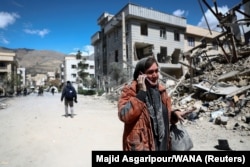
Life in Tehran appears to be edging back toward peacetime normalcy as a cease-fire holds and negotiations between the United States and Iran continue. Cafes that shuttered during air strikes have reopened. Streets that were once empty are again busy with traffic and pedestrians. Shops are open late, and families have returned to evening walks.
Most Iranians say they are relieved that the bombing has stopped and that daily life is no longer punctuated by the fear of explosions. But beneath the calm surface, a deeper sense of anger and disappointment lingers among some.
According to several Iranians who spoke to RFE/RL’s Radio Farda, the end of the fighting has brought peace, but not the change many had hoped for.
Read more here
Bahrain, Kuwait Slam Iranian Attacks As Gulf Tensions Rise
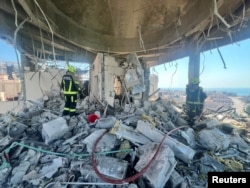
Bahrain said its air defenses intercepted Iranian missiles and drones on June 28 after Tehran launched attacks on targets in Bahrain and Kuwait in retaliation for US strikes on Iran. Kuwait condemned the attack on its territory.
Bahrain's military said it had "intercepted and destroyed a number of projectiles used in these treacherous Iranian attacks" and was on "maximum alert." The Foreign Ministry described the attack as a "dangerous escalation" and said Iran was "solely responsible" for undermining efforts to de-escalate the conflict.
Kuwait's Foreign Ministry condemned "in the strongest terms, the recurrence of Iran's heinous aggression," calling the strikes "a flagrant violation of its sovereignty."
Iran's Islamic Revolutionary Guards Corps (IRGC) said it had attacked US military facilities in Bahrain and Kuwait, claiming infrastructure at both bases had been destroyed.
The attacks came days after a framework agreement between Tehran and Washington took effect, easing tensions following months of conflict triggered by US and Israeli strikes on Iran.
However, the US carried out fresh strikes overnight into June 28 on "Iranian missile and drone storage locations, and coastal radar sites," saying they were in retaliation for an Iranian drone attack on a commercial vessel in the Strait of Hormuz.
Bahrain later reported damage to a residential building, but no fatalities.
US Hits Iran For Second Night As Trump Threatens To 'Complete The Job'; IRGC Retaliates
(This item has been updated to include IRGC statement.)
For the second straight night, US forces have struck "multiple targets" in Iran in response to Tehran's "aggression" against commercial shipping, as the fragile cease-fire in the Middle East continued to fray and US President Donald Trump threatened to wipe out the Islamic republic.
"United States aircraft just struck Iranian missile and drone storage locations, and coastal radar sites, for violating the Cease Fire Agreement, AGAIN! It is very possible that they will never learn!" he wrote on social media.
"There may come a point when we are no longer able to be reasonable, and will be forced to militarily complete the job that we very successfully started. If that happens, the Islamic Republic of Iran will no longer exist!"
Hours later, Iran's hard-line Islamic Revolutionary Guards Corps (IRGC) said it had fired missiles and drones at US-linked sites at 2-3 a.m. on June 28 in retaliation, with Kuwait and Bahrain reporting incoming projectiles. Details were not immediately available.
The IRGC also threatened that any "cease-fire violations" will "bring all ongoing diplomatic processes to a complete halt."
US Central Command (CENTCOM) on June 27 said its forces launched the strikes in "direct response to continued Iranian aggression against commercial shipping."
Iran did not immediately comment. The US statement did not disclose which specific targets were hit, but US defense officials said the latest strikes have been concluded.
"After yesterday’s US strikes in response to the Iranian attack on M/V Ever Lovely, Iran was given a chance to honor the cease-fire agreement but elected not to when its forces launched a one-way attack drone that hit M/T Kiku this morning at 4:30 a.m. ET," CENTCOM said in a social media post.
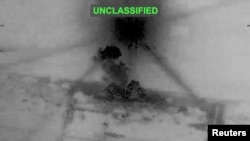
It said the Panamanian-flagged tanker was transiting near the important Strait of Hormuz with more than 2 million barrels of crude oil.
"US military aircraft targeted Iranian military surveillance infrastructure, communication systems, air defense sites, drone storage facilities, and minelayer capabilities.
Iranian media reported that explosions were heard in southern coastal region of Sirik, which has been hit multiple times by US forces in recent weeks.
Earlier on June 27, Iran accused the US of violating the peace agreement that ended their recent conflict, after US forces carried out strikes on Iranian military targets on June 26.

The Iranian Foreign Ministry claimed that those attacks on coastal surveillance facilities were a "blatant violation" of the recent memorandum of understanding between the two countries as well as of the UN Charter.
A senior US official told RFE/RL that in the June 26 mission, six US aircraft carried out strikes on four targets inside Iran, including radar installations and missile and drone storage facilities in the coastal area of Sirik.
In its statement, the IRGC said its forces "destroyed eight important US military facilities at the Ali al-Salem base in Kuwait and at the Fifth Fleet naval base in Port Salman in Bahrain." Those reports could not be verified.
"Any enemy aggression, whatever the pretext, even against insignificant targets... will have a crushing response," the IRGC added.
Iran and the US are set to resume technical negotiations in Switzerland following the signing of a memorandum of understanding (MOU) designed to end the war in Iran and throughout the Middle East, including Lebanon.
The cease-fire has remained fragile, with all sides accusing the other of violations.
Lebanon President Asks Trump To Help Prevent Framework Violations
Lebanon's leader has told US President Donald Trump in a call that he hopes Washington can help prevent violations of a framework deal with Israel and ensure commitments agreed to are fulfilled.
President Joseph Aoun particularly urged Trump to press Israel to withdraw from occupied areas in southern Lebanon, the Lebanese presidency said on June 27.
Aoun told Trump that Lebanon would assume its responsibilities in implementing the agreement, the presidency added in a statement.
The Lebanese presidency said on X that Trump had initiated the call, congratulating Aoun on the signing of the US-brokered deal between Israel and Lebanon.

The statement said Trump indicated he would meet soon with Aoun in Washington, although no details of a possible meeting were published.
Even with the deal, Aoun faces challenges with the implementation of the agreement.
Hezbollah leader Naim Qassem has rejected the US-brokered security agreement between Lebanon and Israel a day after it was signed, declaring the accord "null and void" and accusing the Lebanese government of surrendering the country's sovereignty.
Iran-backed Hezbollah, a militant group and political party that controls much of southern Lebanon, is considered a terrorist organization by the United States, while the European Union has blacklisted its armed wing but not its political branch.
Lebanese state television reported an Israeli drone strike on June 27 in the Nabatiyeh area in the south. The Israeli military said it targeted a person who posed a threat to its forces.
With reporting by Reuters
Hezbollah Rejects Israel-Lebanon Deal
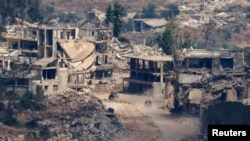
Hezbollah leader Naim Qassem has rejected a US-brokered security agreement between Lebanon and Israel a day after it was signed, declaring the accord "null and void" and accusing the Lebanese government of surrendering the country's sovereignty.
The agreement, signed in Washington on June 26 after five rounds of talks, calls for a phased Israeli withdrawal from parts of southern Lebanon alongside the deployment of the Lebanese Army.
It also sets out a process for the verified disarmament of Hezbollah while allowing Israeli forces to remain temporarily in an expanded buffer zone.
The latest conflict erupted in March after Hezbollah launched rocket attacks on Israel following the killing of Iran's supreme leader in US-Israeli strikes. Israel responded with air strikes and a ground offensive in southern Lebanon, where its forces continue to hold territory.
In a statement on June 27, Qassem described the deal as "humiliating, shameful, and a surrender of sovereignty." He accused the government of "legitimizing the continuation of the (Israeli) occupation," saying it had crossed "all red lines."
Iran-backed Hezbollah, a militant group and political party that controls much of southern Lebanon, is considered a terrorist organization by the United States, while the European Union has blacklisted its armed wing but not its political branch.
Also on June 27, Lebanon's state news agency reported an Israeli drone strike near Nabatieh al-Fawqa in southern Lebanon. The Israeli military said it had targeted an individual posing a threat to its forces.
With reporting by Reuters and AFP
Oil Tanker Struck In Strait Of Hormuz
An tanker in the Strait of Hormuz was struck by an "unidentified projectile," British shipping-security monitor United Kingdom Maritime Trade Operations (UKMTO) said on June 27, after the first exchange of fire between the United States and Iran since they signed a framework agreement to end the recent Middle East war.
UKMTO said the tanker sustained damage to its bridge, but that "all crew are reported safe." It also said that there was "No environmental damage reported at present."
Maritime security firm Vanguard Tech has identified the vessel as the Panama-flagged oil tanker KIKU.