





Houthis Threaten Saudi Arabia Over Iran Flight
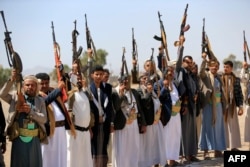
Yemen's Houthi rebels said they confronted Saudi Arabian "warplanes" that allegedly attempted to prevent an Iranian civilian aircraft from landing in the capital, Sanaa.
According to a July 3 statement by the Houthi military spokesman Yahya Sarea, the Iran-backed group warned it would target "Saudi airports and vital interests on land and sea" if Riyadh continued to violate Yemeni airspace, he added.
Earlier, local media said the aircraft successfully landed and headed back to Tehran carrying the Houthi delegation to attend the funeral of Iran's late Supreme Leader Ayatollah Ali Khamenei, who was killed in an Israeli air strike on the first day of the war on February 28.
The Houthi rebels are a key ally of Tehran and entered the war in March when they fired missiles at Israel.
War broke out between Saudi Arabia and the Houthis in 2015. A UN-brokered truce in 2022 largely stopped the fighting.
NATO To Reiterate At Summit Iran Must Never Have Nuclear Weapons
NATO leaders will reiterate that Iran "must never have a nuclear weapon and call on Iran to fully respect freedom of navigation in the Strait of Hormuz."
That's according to a text approved by NATO ambassadors on July 3 and reviewed by Reuters.
NATO leaders will meet at a summit in Ankara next week.
Under a memorandum of understanding (MOU) signed by Tehran and Washington on June 17, Iran agreed to allow 60 days of toll-free navigation in the Strait of Hormuz, a key artery for global energy supplies.
Under the interim agreement, Iran also reaffirmed that it will not "procure or develop nuclear weapons."
The sides have 60 days to reach a lasting peace deal, but several thorny issues, including the fate of Iran’s nuclear program, remain unresolved.
Mixed Feelings Among Iranians As Khamenei's Body Lies In State
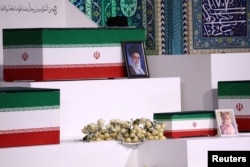
The body of Iran's late supreme leader, Ayatollah Ali Khamenei, was laid in state in Tehran on July 3 as authorities began a week of funeral processions for the slain cleric amid mixed reactions among Iranians over a man whose more than three decades in power was marked by oppression and the death of tens of thousands of Iranians through crackdowns and executions.
Foreign dignitaries began arriving in the capital early in the day ahead of official mourning ceremonies set for July 4 for Khamenei, who was killed at the age of 86 in US and Israeli air strikes on February 28.
It is unclear whether Mojtaba Khamenei -- who was appointed to replace his father but has not appeared in public since his parent's death -- will attend the ceremonies.
"This goes beyond an ordinary funeral procession," Babak Dorbeiki, a UK-based political analyst, told RFE/RL's Radio Farda.
"It serves a full political function, a legitimizing function, and it's meant to reinforce their own propaganda."
Read more here
As Iran Prepares Elaborate Funeral For Khamenei, Many Recall A Brutal Leader
Iran's government is preparing a multiday funeral ceremony for late Supreme Leader Ali Khamenei, who was killed in US and Israeli strikes in February. But many Iranians are not mourning his loss, and are instead sharing complex reactions to the death of a man who led an oppressive theocratic regime.

Foreign Dignitaries Arrive In Tehran For Khamenei Funeral Ceremonies
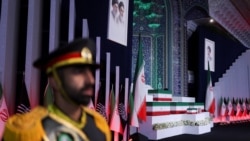
Foreign dignitaries arrived in Tehran on July 3 ahead of official mourning ceremonies for former Iranian Supreme Leader Ali Khamenei, Iranian state television reported.
Delegations from China, Belarus, Iraq, and Turkmenistan were shown arriving as Khamenei's coffin lay in state at Tehran's Grand Mosalla prayer complex.
The weeklong ceremonies will begin in Tehran before continuing to Qom and Iraq, culminating in Khamenei's burial at the Imam Reza Shrine in his hometown of Mashhad on July 9.
With reporting by dpa
Iranian State Media Shows Revolutionary Guards Chief Making First Public Appearance Since War Began
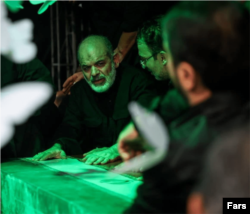
Ahmad Vahidi, the commander-in-chief of Iran's Islamic Revolutionary Guards Corps (IRGC), appeared publicly for the first time since the outbreak of the US-Israeli war with Iran, paying his respects at the coffin of late Supreme Leader Ali Khamenei in Tehran on July 3, according to footage broadcast by Iranian state media.
Vahidi, who has kept a low profile since the conflict began amid concerns that senior Iranian commanders could be targeted for assassination, placed his hand on Khamenei's coffin and prayed, images published by the semiofficial Fars news agency showed.
A day earlier, the IRNA state news agency reported that Vahidi had appeared at an official government meeting that was also attended by President Masud Pezeshkian, Parliament Speaker Mohammad Baqer Qalibaf, and Tehran Mayor Alireza Zakani among others. The agency also published photographs from the meeting.
A veteran IRGC commander and former defense minister, Vahidi took over as head of the Revolutionary Guards in March after his predecessor, Mohammad Pakpur, was killed during the war.
He had previously served as deputy commander following the death of the previous IRGC chief, Hossein Salami, in Israeli strikes in 2025, making him the third commander to lead the force in less than a year.
The IRGC is Iran's powerful ideological military force, operating alongside the country's regular armed forces and wielding significant influence over national security, foreign policy, and large parts of the economy.
With reporting by AFP and RFE/RL's Radio Farda
Khamenei's Body Moved To Tehran Prayer Complex For Funeral Ceremonies
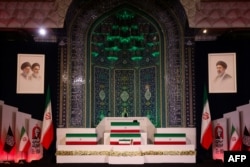
Iranian authorities have begun special funeral and burial ceremonies for former Supreme Leader Ali Khamenei, more than four months after he was killed alongside several associates and family members during the first day of the US-Israeli war with Iran.
According to Iranian domestic news agencies, Khamenei's body was transferred to Tehran's Grand Mosalla, the capital's main prayer complex, on the morning of July 3.
The reports said that foreign delegations are expected to "pay their respects to the former leader of the Islamic republic" later in the day.
Iranian authorities have planned a weeklong program comprising a "farewell, funeral procession, and burial" for Khamenei and say they hope "millions of people" will take part in the ceremonies.
Khamenei ruled Iran for more than three decades, a period marked for many Iranians by repression, intimidation, arrests, and severe political and social restrictions.
After his death in US-Israeli air strikes on February 28 was announced, some Iranians publicly expressed satisfaction at the news, prompting arrests, heavy sentences, and, in some cases, the threat of execution.
With reporting by RFE/RL's Radio Farda
Waltz Warns Iran Against Holding The World's Economy 'Hostage'
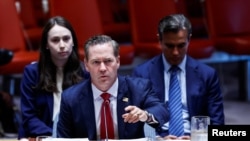
The United States and Iran exchanged sharp accusations at the United Nations Security Council on July 2 over Tehran's recent attacks on Bahrain, Kuwait, and commercial shipping in the Persian Gulf, amid growing strain on a US-Iran cease-fire agreement.
US Ambassador to the UN Mike Waltz accused Iran of violating its June 17 memorandum of understanding with Washington by attacking its Gulf neighbors and disrupting traffic through the Strait of Hormuz.
"Iran cannot and we cannot allow it to hold the world's economy hostage," Waltz said, urging Tehran to halt attacks on neighboring states and keep the strategic waterway open.
Warning that diplomacy could falter, he added: "I cannot stress enough the possibility of real transformative positive opportunity for the nation and people of Iran is on the table, but President [Donald] Trump's patience is not unlimited."
Bahrain's Foreign Minister Abdullatif Al-Zayani accused Iran of "deliberately" targeting civilian facilities, critical infrastructure and residential areas, saying the attacks killed three civilians and wounded 465 others.
Iran's UN ambassador, Amir-Saeed Iravani, rejected the accusations and argued that countries hosting US military bases had become targets because they had facilitated US and Israeli military operations.
The "presence of American bases in their countries not only does not bring security to their countries but also make their countries vulnerable," he said.
Waltz dismissed Iran's justification for the attacks, calling them "a cynical, sad, and sick attempt at global blackmail. Plain and simple."
UN Assistant Secretary-General Elizabeth Spehar said the US-Iran memorandum offered "a measure of hope that dialogue and diplomacy can regain momentum."
Mojtaba Khamenei Did Not Attend Funeral For His Late Wife
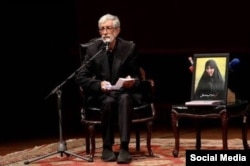
Iranian media have reported that the funeral and memorial service for Zahra Haddad Adel, the daughter-in-law of the late Supreme Leader Ali Khamenei and the wife of his son and successor, Mojtaba Khamenei, was held in Tehran on July 1.
According to the Iranian daily Hamshahri, "a number of colleagues and friends" of Zahra Haddad Adel attended the ceremony.
A written tribute described by Iranian state media as a "heartfelt message" from Mohammad Baqer Hosseini Khamenei, the son of Mojtaba Khamenei and Zahra Haddad, was also read during the service.
News reports described Zahra Haddad Adel as a teacher.
Along with other members of her family, the ceremony was attended by Gholamali Haddad Adel, Zahra's father and a member of Iran's Expediency Discernment Council -- an unelected body that advises the supreme leader.
Mojtaba Khamenei did not attend. He has not been seen in public since being reportedly injured in the air strike that killed his father in February at the start of the US-Israel war with Iran.
The funeral for the supreme leader's daughter-in-law was held more than four months after her death in the same air strike on Ali Khamenei's residence.
Other members of Ali Khamenei's family were also killed in the attack, including his daughter, granddaughter, and son-in-law.
Prisoner Health Worsening At Iran's Evin Prison
According to Radio Farda sources, the health and medical situation in Evin Prison has worsened in recent months.
In the most recent case, political prisoner Mohammad Mehdipour was transferred to the hospital after months of bleeding, severe weight loss, frequent coughing, and digestive problems. He was diagnosed by doctors with gastrointestinal and pulmonary tuberculosis.
The delay in diagnosing Mehdipour has put a number of his fellow prisoners at risk of contracting tuberculosis.
The sources told Radio Farda that restrictions on prisoner visits to medical facilities, a shortage of medicine, and a lack of adequate facilities in the prison have led to an increase in kidney, heart, digestive, skin, and infectious diseases in Evin Prison.
The prison is a notorious high-security facility in northwestern Tehran, which is known for holding political prisoners, journalists, activists, and for its widespread reports of torture and human rights abuses.