


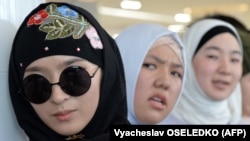
As a practicing Muslim, Gulbarg wears the hijab, or Islamic head scarf, and prays five times a day.
But in Tajikistan, a Muslim-majority country where a staunchly secular government has been in power for decades, she is seen as "some kind of threat," said Gulbarg, whose name has been changed for security reasons.
"On the first day of university, a professor politely reminded me that the hijab is banned at schools," Gulbarg, a student at Khujand State University in northern Tajikistan, told RFE/RL. "She said, 'Personally, I don't have anything against your hijab, but the law is the law.'"
The hijab has long been a hot topic in Muslim-majority Central Asia, where governments have sought to restrict independent Islamic activity and regulate religious expression.
That includes the hijab. Rules over Islamic head coverings vary across the region, but they are banned in public schools and government offices in Tajikistan, Kazakhstan, and Uzbekistan.
That debate has flared up again as millions of students flocked back to school and university for the start of the new academic year this month.
Matter Of National Security
In Kazakhstan, Education Minister Zhuldyz Suleimenova warned that private schools allowing girls to wear the hijab "could be deprived of their licenses."
The warning has created a dilemma for some schools in Kazakhstan.
A teacher working at a public school in the southern Kazakh city of Shymkent said several girls in her class have refused to remove their head scarves.
"The principal and deputy principal don't know on what grounds they can remove the girls from school," the teacher, speaking on condition of anonymity because she was not authorized to speak to the media, told RFE/RL's Kazakh Service.
"The school even conducted an unscheduled writing test, apparently hoping that poor grades could provide a reason to expel them."
But all four girls passed the test, the teacher said.
In 2016, Kazakhstan's Education Ministry issued a decree on student uniforms that prohibited the wearing of religious symbols at school, including the hijab.
Since then, the issue has pitted supporters of secular education against those who say Muslim girls should be allowed to wear the head scarf.
Kazakh officials have portrayed the hijab issue as a matter of national security and the protection of the country's secular political system.
Central Asia has grappled with Islamic extremism in recent years. But critics say the authorities have severely restricted any signs of Islam without addressing the causes of radicalization.

'Deep-Seated Fear Of Islam'
Experts say the hijab debate reflects a broader struggle over how much space secular governments are willing to give religious expression.
Davide Cancarini, a Milan-based researcher focusing on Central Asia, said the hijab is "the most visible element" of the debate.
He said governments have promoted an official, moderate form of Islam while wary of the religion as an independent social and cultural force.
"The deep-seated fear of Islam has led governments to suppress any form of religious practices that fall outside state control," Cancarini told RFE/RL.
Ahmet Furkan Ozyakar, an expert on regional politics at Atatürk University in Turkey, said Islam is an important part of Kazakhstan's history and national identity, but religious activity remains closely regulated.
"The hijab is particularly sensitive because it makes religious identity visible in an institution that the state explicitly defines as secular," Ozyakar said.
He said governments in Central Asia do not necessarily see greater religiosity itself as a threat.
"Their concern is often with religious expression or organizations outside state-regulated structures, particularly when they could become a source of independent social or political mobilization," Ozyakar told RFE/RL.

That fear is particularly visible in Tajikistan and Uzbekistan, where police have carried out raids targeting women wearing the hijab and men with long beards.
Both governments have justified their restrictions on Islamic clothing by claiming they are protecting secularism and national security.
Tajikistan and Turkmenistan have also promoted traditional national clothing as an alternative to what the authorities regard as foreign forms of dress.
Kyrgyzstan is the only Central Asian country that has not officially banned the hijab, although the issue has also generated debate there.