


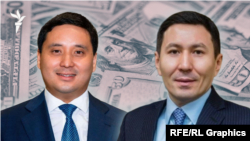
Bundles of greenbacks tumbled from a balcony in an upscale residential complex in the Kazakh capital as two titans of the country's economy were shaken by the arrests of their bosses on corruption charges. The following day, Kazakh President Qasym-Zhomart Toqaev called an extraordinary meeting of his Security Council and declared corruption to be the "Achilles heel" of state-owned companies.
The events of November 12-13 have made for a busy news cycle in Kazakhstan, even if the details remain murky. There's no clear link between the dollar downpour and the arrests, but more on that later.
No One Above The Law
The people arrested on November 12 are major figures leading two of Kazakhstan's most powerful state-owned institutions.
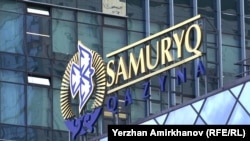
Nurlan Zhakupov is chairman of Samruk-Kazyna, the country's sovereign wealth fund.
In its 2021 annual report, the state-owned fund said it controlled "almost all strategic assets" of Kazakhstan's corporate sector, representing nearly 40 percent of GDP. Its total assets reached approximately $87.5 billion at the end of 2025.
Yelzhas Otynshiyev is head of Kazakhstan Temir Zholy (KTZ), the state-run rail operator, which has been preparing for an IPO of up to 20 percent of its shares on the London, Hong Kong, and Kazakh stock exchanges, with a potential valuation of up to $5 billion, according to a Samruk-Kazyna press release.
Both men were appointed to senior roles during Toqaev's presidency after successful careers in major Western companies.
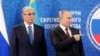
Toqaev described the arrests as "an extremely serious signal of widespread corruption in state-owned companies" and said they should be seen as part of a broader effort to ensure equality before the law following constitutional changes he rammed through earlier this year.
Critics have said the changes are more about cementing his grip on power than anything else. They were followed by an election in August, roundly criticized by international observers, in which a new political party dedicated to pushing Toqaev's political agenda won 70 percent of the vote.
Speaking on November 13, Toqaev focused on hard-hitting anti-corruption rhetoric. He cited more than 3,100 corruption offenses identified between 2023 and 2025, involving some $560 million, and insisted that no official, regardless of position or connections, should be above the law.
"There will, of course, be no distinction between 'our own', 'not quite our own' and, even more so, 'outsiders'. Our constitution enshrines the principle that all citizens are equal before the law. We must uphold this requirement," he said.
Founded in 2008 under then-President Nursultan Nazarbayev, Samruk-Kazyna is also central to major state-backed deals with foreign companies and international lenders. Several of its subsidiaries, including uranium producer Kazatomprom, oil giant KazMunayGas, and airline Air Astana, have already been listed on stock exchanges.
KTZ's IPO was expected to fund Kazakhstan's railway modernization and expand capacity across the vast country, including along the Trans-Caspian corridor linking China and Europe. It remains unclear whether the listing will go ahead as planned.
Financial analyst Rasul Rysmambetov told RFE/RL that some potential investors were taking news of the arrests calmly, provided the company's accounts remained reliable.
"KTZ's IPO can and should be postponed, though more for financial reasons than reputational ones," Rysmambetov said. "If it turns out this was a bribe rather than money stolen directly from projects, investors will take it fairly neutrally. Those who have already invested in Kazakhstan say: 'The main thing is that the financial reports aren't fabricated.'"
Toqaev said some agreements and contracts had recently been reviewed because, in his view, they had been signed erroneously. He gave no details and did not link them to the current investigation.
A 'Black Box' Under Scrutiny
Political analyst Dosym Satpayev says Samruk-Kazyna and much of Kazakhstan's wider quasi-public sector have long operated like a "black box." He argues that replacing executives will not fix the underlying problems.
"To paraphrase the plumber from an old joke: It's not just the tap that needs fixing here -- the entire system at the fund needs to be changed!" he wrote, questioning why Samruk-Kazyna had failed to become the kind of state investment institution originally envisioned, modeled on Singapore's Temasek Holdings state-owned global investment firm.
Economist Olzhas Khudaibergenov, a former economic adviser to Toqaev, sees the KTZ arrests as an opportunity to confront entrenched corruption. He described the alleged networks inside the railway operator in stark terms:
"There are legends that an entire mafia operates there, capable of sabotaging orders and even derailing a passenger train so that an honest manager is dismissed in the scandal that follows."
He questioned whether detaining three or four executives would be enough to dismantle such networks and whether anyone would be willing to take on the backlash involved in cleaning up the company.
The arrests have also reignited debate over whether Samruk-Kazyna should be reformed or broken up. Toqaev has offered no specific plan but has ordered the government and oversight agencies to submit proposals by November 24 to reduce corruption and improve the performance of quasi-public-sector companies.
Making It Rain
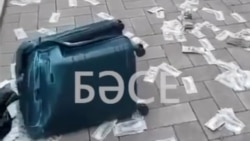
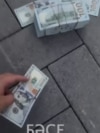
The same day that Kazakhstan's National Security Committee (KNB) announced the arrests, footage began circulating online that appeared to show suitcases and bundles of cash scattered outside the upscale Atlant residential complex in central Astana.
The video shows uniformed police officers in high-visibility vests cordoning off the area alongside plainclothes officials. The building is close to the headquarters of both KTZ and Samruk-Kazyna. Authorities have not confirmed whether the incident is connected to the arrests or whether the bank notes are authentic.
Some bloggers claimed one of the detained officials lived in the building and that eight suitcases and duffel bags filled with $100 bills had been thrown from a balcony as KNB officers arrived. Local media and online commentators have speculated that the cash amounted to between $15 million and $40 million, though no official figure has been released.
The KNB did not respond to an inquiry from RFE/RL about whether the incident was linked to the arrests, how much cash was involved, or what has happened to the money.