


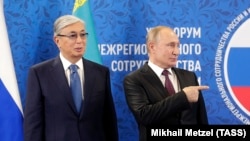
Kazakh President Qasym-Zhomart Toqaev’s proposal to grant Russia observer status in the Organization of Turkic States (OTS) took many by surprise, except, perhaps, for Moscow.
The proposal raises a fundamental question: Can a state that does not meet the technical requirements for such status, and which moreover restricts the rights and autonomy of its own Turkic peoples, claim a place in an organization that brings together independent Turkic states?
Kremlin spokesman Dmitry Peskov quickly welcomed the proposal, saying Russia's participation "would be entirely understandable and appropriate.”
However, that participation should be the Russian Federation "as a whole," rather than individual Russian regions, a thinly veiled reference to the country's Turkic-speaking republics, such as Tatarstan and Bashkortostan.
Toqaev’s proposal and Peskov’s response have sparked a debate across the OTS over Russia’s eligibility for observer status.
Halil Akinci, the founding secretary-general of the OTS and a retired Turkish diplomat, told RFE/RL that Toqaev's initiative departed from the organization's established diplomatic practice.
“Usually, such matters are never brought up at a high-level meeting without prior discussions. There are committees, there are committees of foreign ministries, then they are discussed, then they are brought to the attention of the heads of state. So, it was a surprise for everyone,” Akinci said.

Akinci said he believes that Toqaev's proposal might be linked to Kazakhstan's special relationship with Russia and its need to maintain peaceful relations with its powerful neighbor. This balancing act is particularly delicate in Kazakhstan's northern regions, which are home to substantial ethnic Russian populations and have occasionally been the subject of territorial claims by Russian nationalist figures.
“So, it is better to be on good terms with Russia," Akinci said. "Again, Russia is a great power, still a great power. And then, you wish great powers as your friends, not as your enemies.”
'Rules Cannot Change'
Following the proposal, Kursad Zorlu, deputy chairman of Turkey’s ruling Justice and Development Party (AK) and head of its relations with Turkic states, outlined Ankara’s position.
Speaking to Turkey's state-run Anadolu news agency, Zorlu described the issue as “sensitive” and stressed the importance of maintaining cultural dialogue with Russia, given the millions of people of Turkic origin living there. However, he noted that Russia does not meet the OTS criteria for observer status, citing the rules adopted at the organization’s 2021 Istanbul summit.
“Only states that have adopted one of the Turkic languages or related languages as a state or official language -- that is, as a language of official correspondence throughout the entire country, not merely in any particular region -- may apply for observer status in the Organization of Turkic States,” he said.

Akinci also stressed that a shared language at the state level is a founding principle of the OTS.
"This is a family club. You only accept your relatives," he said. "And the only objective criterion for relatives is the language."
"Another point. The Organization of Turkic States was founded on the principle of membership of independent and sovereign countries," Akinci added. "We are not bringing people together -- we are bringing states together. Independent states together. These rules cannot change."
Under both requirements, Russia would not qualify for observer status because Turkic languages such as Tatar and Bashkir have official status in individual republics, rather than throughout the Russian Federation.
However, Zorlu suggested an alternative: high-level meetings with third countries, involving foreign ministers or heads of state, under the OTS+ framework, a format established in 2025 to facilitate cooperation with countries outside the organization without granting them membership or observer status. Such meetings require the unanimous approval of OTS member states.
Zorlu also added that, if the Kremlin wishes to deepen its relations with the OTS, it should consider restoring cooperation with the International Organization of Turkic Culture (TURKSOY).
Moscow's Efforts 'To Keep A Firm Grip'
TURKSOY, founded in Ankara in 1993, was among Turkey’s earliest initiatives to institutionalize cultural cooperation with the newly independent Turkic states of the former Soviet Union. Often described as the “UNESCO of the Turkic World,” it promotes shared languages, heritage, and traditions.
Following the establishment of the OTS in 2009, TURKSOY became one of its affiliated institutions.
Six republics within the Russian Federation -- Tatarstan, Bashkortostan, Altai, Sakha (Yakutia), Tuva, and Khakassia -- subsequently joined TURKSOY as observers.
However, following the Russian-Turkish diplomatic crisis in November 2015, triggered by Turkey's downing of a Russian Su-24 aircraft near the Syrian-Turkish border, Moscow instructed all six republics to suspend their contacts with the organization.

Experts interviewed by RFE/RL’s Tatar-Bashkir Service questioned why Moscow was now seeking closer ties with the OTS while continuing to restrict the international cultural contacts of its own Turkic communities.
One Tatar analyst, who spoke anonymously citing concerns about possible repercussions from Russian authorities, described what he viewed as Moscow’s deliberate efforts to prevent direct ties between Turkey and Russia’s Turkic republics.
"The Russian authorities have never welcomed Turkey working together with Tatarstan or Bashkortostan," he said. "They are afraid of these ties growing stronger. The Turks can work with Moscow, St Petersburg, and Yekaterinburg, but they should not travel to [Tatarstan's capital] Kazan and [Baskortostan's capital] Ufa. That is what the authorities really want."
He added that Moscow also viewed cultural and educational cooperation as a threat, fearing that closer ties with Turkey could strengthen Tatars and Bashkirs.
“It was convenient for them to use a fabricated pretext to suspend the activities of the TURKSOY organization," the analyst said. "Its work could have been resumed at any time since 2015, but Moscow needs to keep a firm grip on the reins. Today, Russia is isolated, and there are not many countries eager to engage or cooperate with it.”
'A Special Operation Of The Kremlin'
In a statement issued in response to Toqaev’s proposal, representatives of Bashkir, Tatar, and Sakha organizations belonging to the League of Free Nations -- a coalition of movements advocating independence for ethnic republics and other regions within Russia -- called on OTS member states to reject Russia’s participation, either as an observer or through the OTS+ format. The statement was also supported by representatives of Chuvash, Tuvan, and Khakas movements.
“The right of the Turkic peoples of Russia to an independent voice cannot be replaced by Moscow's right to speak on their behalf,” the statement said.
Its signatories pointed to what they described as Moscow’s restrictions on native-language education, the persecution of national activists, and the erosion of political and cultural autonomy in Russia’s Turkic republics.

Refat Chubarov, chairman of the Mejlis of the Crimean Tatar People -- the representative body of Crimea's indigenous Tatar community, which Russia banned as an "extremist" organization in 2016 following its illegal annexation of the Ukrainian peninsula -- also strongly criticized Toqaev’s initiative. He described it as "a special operation of the Kremlin."
Pointing to Peskov’s endorsement of the proposal, Chubarov argued that Toqaev had voiced precisely what Moscow wanted. He condemned the initiative against the backdrop of Russia’s war on Ukraine and its occupation of Crimea, where, he said, Moscow is killing Ukrainian citizens and destroying the Crimean Tatar people in their historical homeland.
“I am convinced that the members of the Organization of Turkic States should not support this proposal,” he said.