



Accessibility links

Breaking News

News

Sixteen Arrested During Kazakh January Unrest In Kazakhstan Go On Hunger Strike

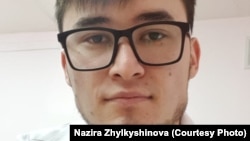
Nursultan Sultanov, a 24-year-old dentist, is one of those on hunger strike.

OSKEMEN, Kazakhstan -- Sixteen men arrested in the northeastern Kazakh city of Oskemen during deadly anti-government demonstrations that shook the country in January have launched a hunger strike to protest the conditions they are held in and a court's decision to extend their pretrial detention.

Anar Qusaiynova, a lawyer representing them, told RFE/RL late on April 7 that the 16 detained men had started their hunger strike the day before.

According to Qusaiynova, the men are demanding to be transferred to house arrest and their cases brought to court quickly.

Nazira Zhylqyshynova, the mother of 24-year-old dentist Nursultan Sultanov, one of those detained and on hunger strike, told RFE/RL that the conditions in the city's central detention center, which is situated in an 18th-century fortress, were "horrible."

"I visited the place to see my son. It's very damp and humid inside. It's probably dangerous for anyone's health. We demand that our sons be released. They have families, mortgages. They will not go anywhere before the trial," Zhylqyshynova said.

Relatives of another man on hunger strike, Semei Ismaghambetov, told RFE/RL that all 16 men were being kept in one cell.

State Penitentiary Service officials told RFE/RL that they were "unaware of any hunger strike" in Oskemen.

Protests in the remote town of Zhanaozen in Kazakhstan's southwest over a sudden fuel-price hike in early January quickly spread across the country and led to violent clashes.

President Qasym-Zhomart Toqaev called on the Russian-led Collective Security Treaty Organization to send troops to Kazakhstan in the wake of the protests, which were also directed at former President Nursultan Nazarbaev, who resigned in 2019 but retained large political influence in the tightly controlled nation with almost limitless powers.

Kazakh authorities say at least 230 people, including 19 law enforcement officers, were killed during the violence, but human rights groups say the number of those killed was much higher, pointing to evidence that there were peaceful demonstrators and people who had nothing to do with the protests among those killed by law enforcement and military personnel.

The authorities say some 800 people have been arrested over the unrest and dozens have been sentenced to various prison terms. There are reports that those in custody have been tortured by the police.

All Of The Latest News

Polish Government Says It's Prepared For Gazprom Gas Cut

Russia has said it will cut off the flow of gas to Poland via the Yamal pipeline. (file photo)

The Polish government says it is ready to face any interruption of gas supply after Russia's Gazprom informed Warsaw that it will halt gas shipments through the Yamal pipeline from April 27.

Poland's PGNiG gas firm said in a statement that Gazprom informed Poland of its intention earlier on April 26.

PGNiG also said it would take steps to reinstate the flow of gas according to the Yamal pipeline contract and that any halt of supplies is a breach of that contract. It added that it has the right to pursue damages over breach of contract.

Polish Climate Minister Anna Moskwa said on Twitter that there would be no shortage of gas in Polish homes as a result of the Gazprom move.

"Since the first day of the war we have declared that we are ready for full independence from Russian raw materials," she said.

"Poland has the necessary gas reserves and sources of supply to protect our security," she added.

Gas storage facilities are 76 percent full, Prime Minister Mateusz Morawiecki said, adding that Poland is ready to obtain gas from other sources.

After Western countries imposed sanctions against Russia over its invasion of Ukraine, the Kremlin warned EU member states that their gas supplies will be cut unless they pay in rubles.

Poland has refused to do so, agreeing with other EU countries that have refused, saying that under the terms of the purchase agreement they can continue to pay in euros or dollars.

Gazprom did not confirm the cut-off but a senior executive at the company was quoted by Russian news agencies as saying that "Poland must pay for gas supplies according to the new payment procedure."

Based on reporting by Reuters and AFP

Putin Defends Russian Figure Skater At Center Of Winter Olympic Doping Scandal

Russian figure skater Kamila Valieva (file photo)

Russian President Vladimir Putin has defended teenage figure skater Kamila Valieva, who was at the center of a doping scandal at the Beijing Winter Olympics.

The Russian skater's performances could not have been achieved with the help of any banned substances, Putin claimed in comments on April 26.

Valieva failed a doping test at the Russian national championships in December but the result was only revealed on February 8, a day after she had helped the Russian Olympic Committee (ROC) win gold in the team event.

"The whole country, figure skating fans all over the world, were especially worried about Kamila," Putin said during a televised ceremony with Russian Olympic and Paralympic medalists at the Kremlin.

Valieva has "absorbed all the most complex elements of figure skating -- its flexibility, beauty, power, and tenderness...and with her work brought the sport to the height of real art," Putin said.

"Such perfection cannot be achieved dishonestly with the help of additional substances, manipulations,” he added.

Putin gave Valieva a state award and congratulated her on her 16th birthday, which was April 26.

During the Beijing Olympics, Valieva was cleared to compete in the women's single event by the Court of Arbitration for Sport, but she finished in fourth place after falling several times in the individual free skate.

Russia competed at the Beijing Olympics as the ROC without its flag or anthem following years of doping sanctions and legal battles across numerous sports. Russia has denied any doping was state-sponsored.

Putin also claimed that the removal of Russian and Belarusian Paralympians from the Beijing Paralympic Games after Russia invaded Ukraine on February 24 was a case of discrimination based on nationality, and he criticized the International Swimming Federation (FINA) for handing Russian Olympic gold medalist Yevgeny Rylov a nine-month suspension for attending a rally backing Moscow's military intervention in Ukraine.

Since Moscow invaded Ukraine, athletes and teams from Russia and its ally Belarus have been excluded from many international sports events, and Russia has been stripped of the rights to host various competitions. Putin said Russia should set up new events in their place.

“The canceled competitions need to be compensated with our own new formats. And we can get it done fast,” Putin said, adding that Russia should invite “international athletes, clubs, teams.”

With reporting by Reuters, AFP, AP, and dpa

Almaty Resident Who Fought Against Ukrainian Troops In Donbas Gets Life For Murdering Five People

Five people died in the Almaty shooting incident in September last year. (file photo)

ALMATY, Kazakhstan -- A resident of Kazakhstan's largest city, who fought alongside Russia-backed separatists against Ukrainian armed forces in Ukraine’s Donbas region, has been sentenced to life in prison for murdering five people in September.

A court in Almaty sentenced Igor Duzhnov on April 26 after finding him guilty of illegally taking part in a military conflict abroad, assaulting law enforcement officers, and murdering five people in Almaty.

The 54-year-old Duzhnov shot to death two police officers, a bailiff, a new owner of his foreclosed property and his friend when they came to evict him on September 20.

Duzhnov pleaded not guilty to all charges. He said he had "to liquidate a group that illegally entered my private territory."

As for his joining Russia-backed separatists in Donbas for about one year in 2014-2015, he said he was there "to establish peace."

Duzhnov's trial started on March 18.

Vox Pop: Muscovites Offer Views On When Military Confrontation With Ukraine Will End

Vox Pop: Muscovites Offer Views On When Military Confrontation With Ukraine Will End
please wait

No media source currently available

0:00 0:01:33 0:00

From "When Putin leaves" or "When Putin dies," to "We need to throw more powerful weapons in there," or "Ukraine should be completely wiped off the face of the Earth," RFE/RL asked Moscow residents when they think the military confrontation with Ukraine will end.

IIHF Takes 2023 Ice Hockey World Championships From Russia

Russia's ice hocky team was barred from the 2022 World Championships in response to the war in Ukraine. (file photo)

The International Ice Hockey Federation says it has taken away Russia's rights to host the 2023 World Championships as the number of barred Russian sports teams and performers and canceled events rises in response to Moscow's unprovoked invasion of Ukraine.

The federation said in a statement that the decision was taken at an IIHF Council meeting in Zurich on April 26.

"The decision to relocate the event was taken primarily out of concern for the safety and well-being of all participating players, officials, media, and fans," the statement said.

"As was the case with Council’s earlier decision to withdraw the 2023 IIHF World Junior Championship that was to be held in Omsk and Novosibirsk, Russia, the Council expressed significant concerns over the safe freedom of movement of players and officials to, from, and within Russia," it added.

Last month, the IIHF barred Russia and its close ally Belarus from the 2022 World Championships in response to the war in Ukraine.

The IIHF said on April 26 that a new venue for the 2023 tournament will be confirmed during this year's World Championships next month in Finland.

Kazakh Minister Sees No Problem With Russian Motorcycle Producer's Plan To Move Due To Sanctions

NUR-SULTAN -- Kazakhstan's industry minister says he sees no obstacles for a popular Russian motorcycle producer's plans announced last week to move its business to Kazakhstan after international sanctions over Moscow's unprovoked invasion of Ukraine hampered operations.

While many companies and their owners in Russia have been hit by sanctions over the war in Ukraine, Qaiyrbek Oskenbaev told reporters in Nur-Sultan on April 26 that the Ural Motorcycles company, currently based in the Russian city of Irbit, is free from any international measures and can move production to the Central Asian nation without any impediments.

"Any company that is free of any kind of restrictions is welcome in our country," Oskenbaev said.

Ural Motorcycles' CEO Ilya Khait said on April 18 that his company was setting up a new assembly line in Kazakhstan's northern city of Petropavl where the popular motorcycles, including three-wheelers with sidecars, will start being produced in the coming days.

Khait said a shortage of components that used to be imported to Russia before the sanctions, as well as a Western ban on importing Russian-made equipment, were behind the move.

Ural Motorcycles' products are popular across the former Soviet Union and elsewhere. The company sells its products in the United States as well.

Otembaev said Ural Motorcycles will use facilities at Kazakhstan’s Kaztekhmash machine-building company.

He added that several other companies in Russia have expressed an interest in moving their businesses to Kazakhstan.

Moscow Court Seizes Google Property As YouTube Lawsuit Proceeds

(file photo)

MOSCOW -- A court in Moscow has impounded property and frozen bank accounts of Google's Russian arm as a guarantee against a possible court decision regarding a lawsuit filed against the U.S. tech giant by a subsidiary of Gazprom-Media holding.

The Moscow City Arbitration Court said on April 26 that it had ruled six days earlier to take over Google's assets, which have a value of about 500 million rubles ($6.6 million).

Gazprom-Media's subsidiary company, GPM Entertainment TV, is suing Google for its refusal to restore access to its YouTube channel. It is demanding financial compensation for the damages and wants access to its channel restored.

The lawsuit also names Google Ireland Ltd, Google LLC, and Google Commerce Ltd.

In early March, days after Russia launched its unprovoked invasion of Ukraine on February 24, Google blocked the YouTube channels of several Russian state-funded media outlets in Europe, and switched off the monetization program for Russian bloggers, including YouTube Premium and YouTube Music packages.

Kent Walker, Google's president of global affairs, said in a blog post at the time when the channels were blocked that "in this extraordinary crisis we are taking extraordinary measures to stop the spread of misinformation and disrupt disinformation campaigns online."

GPM Entertainment's TNT and NTV YouTube channels were blocked at the time as well.

Kazakh President Steps Down As Ruling Party Chairman

Kazakh President Qasym-Zhomart Toqaev (file photo)

NUR-SULTAN -- Kazakh President Qasym-Zhomart Toqaev has stepped down as chairman of the country's ruling party, Amanat (Ancestors' Legacy) as part of the constitutional changes he says will allow for greater political diversity.

Toqaev made the announcement on April 26 at a congress of the party, which until March 1 was known as Nur-Otan (Light of the Fatherland), which links back to his predecessor and former patron, Nursultan Nazarbaev.

Toqaev said that the ruling party's chairmanship will be transferred to Erlan Qoshanov, chairman of the parliament's lower chamber, the Mazhilis. The pro-government Adal (Honest) political party also announced at the congress that it will merge with Amanat.

The announcement comes less than two months after the ruling party changed its name from Nur-Otan to Amanat as Toqaev has sought to distance himself from Nazarbaev in the wake of deadly mass protests in early January that were sparked in part because of anger with the ruling party over the corruption and nepotism that stemmed from Nazarbaev's rule even after he stepped down in 2019.

The ruling party was initially called Otan (Fatherland) when it was established in 1998.

Later, as the former president's cult of personality turned into a mass phenomenon in the tightly controlled, oil-rich Central Asian state, the party, like many other organizations and state entities, changed its name to Nur-Otan, to associate it more closely with Nazarbaev.

While ruling for almost three decades, Nazarbaev installed relatives in key positions, enriching them at the expense of ordinary Kazakhs, who have failed to share in the country's vast energy wealth.

Many relatives and close associates of Nazarbaev have lost their posts in government, security agencies, and profitable energy groups since the unrest as Toqaev tries to distance himself from his predecessor.

UN Chief Again Calls For Ukraine Cease-Fire, Meets With Russia's Lavrov

Russian Foreign Minister Sergei Lavrov (right) welcomes UN Secretary-General Antonio Guterres for talks in Moscow on April 26.

UN Secretary-General Antonio Guterres has again called for a cease-fire in Ukraine and warned of the impact of Russia's war against its neighbor is having on food security around the world.

"We are extremely interested in finding ways in order to create the conditions for effective dialogue, create the conditions for a cease-fire as soon as possible, create the conditions for a peaceful solution," Guterres said in comments as he began a meeting with Russian Foreign Minister Sergei Lavrov in Moscow on April 26.

Lavrov said the two would discuss "the situation around Ukraine that acts as a catalyst for a great number of problems which had piled up over recent decades in the Euro-Atlantic region."

Guterres will later meet with Russian President Vladimir Putin before he travels to Kyiv to meet with Ukrainian leaders.

First Leader Of Independent Belarus, Stanislau Shushkevich, In Intensive Care

Ukrainian President Leonid Kravchuk (left to right) , Belarusian Supreme Soviet Chairman Stanislau Shushkevich, and Russian President Boris Yeltsin stand for applause on December 8,1991, after signing a mutual assistance agreement stating that "the Soviet Union as a geopolitical reality [and] a subject of international law has ceased to exist."

MINSK -- Stanislau Shushkevich, the first leader of independent Belarus, has been placed in intensive care in a hospital over complications from COVID-19.

Shushkevich’s wife, Iryna, told RFE/RL on April 26 that the 87-year-old former chairman of the Belarusian Supreme Council began treatment last month after testing positive for the omicron variant of the coronavirus and had minimized all possible contacts since.

Shushkevich, along with then Russian and Ukrainian leaders Boris Yeltsin and Leonid Kravchuk, signed the Belavezha accords in Belarus on the dissolution of the Soviet Union on December 8, 1991.

Moscow Courts Fine Meta, TikTok For Failing To Delete 'Illegal' Content

Russian authorities had already blocked access to Facebook after it blocked some posts by state-owned media outlets.

A court in Moscow has fined Meta Platforms and the TikTok social media application for failing to delete content the government deems illegal as Russia continues to ramp up pressure on social-media networks.

The Magistrate Court of the Taganka district ruled on April 26 that Meta must pay 4 million rubles ($52,800) for failing to take down from its Facebook and Instagram networks materials "propagating the LGBT community," and "insulting Russia's national flag and coat of arms."

In a separate hearing, the court in the Russian capital ruled that TikTok must pay 2 million rubles ($26,400) as a fine for failing to remove content that the court claimed was "propagating homosexual relations."

The court's decisions were made at the request of media regulator Roskomnadzor, which has tightened its crackdown on media and free speech across the country since Russia launched its war in Ukraine on February 24.

Earlier in the day, a court in the town of Lukhovitsy near Moscow ordered Meta Platforms to restrict access within Russia to several posts on Instagram and Facebook containing references to files from OVD-Info, which monitors political repression in Russia, as well as a number of other websites.

Meta Platforms was deemed an "extremist organization" by a Russian court last month, effectively outlawing Facebook and Instagram.

Prosecutors said at the time that Meta "deliberately allowed hate speech against Russians, which created an alternative reality in which any pro-Russian position was suppressed, and hatred was incited."

Russian authorities had already blocked access to Facebook after it blocked some posts by state-owned media outlets.

Based on reporting by Interfax, RIA Novosti, and TASS

Pussy Riot Member Added To Wanted List After Sentence Changed To Prison Term

Maria Alyokhina flashes a V-sign as she arrives for a court hearing in Moscow in March 2021.

MOSCOW -- A leading member of the Pussy Riot protest group, Maria Alyokhina, has been added to Russia's wanted list five days after a Moscow court changed the remainder of her one-year parole-like sentence to real prison time for violating the terms of her punishment.

Alyokhina's name appeared on Russian Interior Ministry’s registry of wanted persons on April 26.

The move comes after a Moscow court on April 21 approved the request, made by the Federal Penitentiary Service (FSIN), to change the sentence handed to Alyokhina last September for violating coronavirus safety precautions by calling on people to protest against the detention of opposition politician Aleksei Navalny.

The court ruled that Alyokhina must serve the remaining 21 days of her sentence in a penal colony.

The FSIN said it made the request because Alyokhina violated electronic-bracelet requirements and once came home in January after a curfew time.

Alyokhina has said she removed the electronic bracelet from her leg on March 30 to protest Russia's unprovoked invasion of Ukraine.

Rights Group Urges Russia To Allow Civilians Out Of Mariupol, Calls On UN To Do More

Smoke rises above the Azovstal steel plant in the southern port city of Mariupol on April 25.

Human Rights Watch (HRW) has urged Russian forces that are now in control of most of Ukraine's besieged port of Mariupol to make sure that civilians that are still trapped in the strategic city are permitted to safely transfer to Ukrainian-controlled territory.

Mariupol has been besieged by Russian forces since March 2, and most of the city has been destroyed, while thousands of civilians are believed to have been killed.

An estimated 2,000 Ukrainian troops holed up in Mariupol's Azovstal steel plant are still resisting Russian forces, which have been resorting to air strikes try to dislodge the holdouts. Some 1,000 civilians were also said to be taking shelter at the steelworks.

"Russian forces now occupying most of Ukraine’s southeastern port city of Mariupol should ensure that civilians remaining in the city can leave in safety to Ukraine-controlled territory if they choose," HRW said in a statement on April 26.

The watchdog also said that special attention should be given to older people, people with disabilities, and those who are sick or wounded.

HRW also called on UN Secretary-General António Guterres, who is visiting Moscow on April 26 and is also expected to travel to Kyiv, to urge senior Russian officials to take into account the plight of civilians in Mariupol, and warn them that they "can be held accountable for unlawful civilian deaths and other serious violations of international humanitarian law."

"After surviving two months of terror, hiding in basements as their city was turned to char and rubble, civilians still in Mariupol urgently need assistance and safe evacuation routes," HRW's Ida Sawyer said.

"Secretary-General Guterres and other international leaders should press top Russian officials to ensure safe passage to Ukraine-controlled territory."

The rights watchdog also warned Russian forces that they need to respect "the fundamental obligation under international humanitarian law to distinguish between civilians and combatants and to take all feasible precautions to protect civilians."

Moldova's President Says Transdniester Attacks Are An Attempt To Escalate Tensions

A Russian serviceman walks past the Operational Group of Russian Forces headquarters in Tiraspol, where Moscow maintains some 1,400 troops.

President Maia Sandu said on April 26 that several alleged attacks in Moldova's Moscow-backed breakaway region of Transdniester were an attempt to escalate tensions, blaming "pro-war factions" within the territory's administration.

Sandu spoke to the media after a meeting of Moldova's Supreme Security Council following claims by authorities in Transdniester that two radio relays were damaged by blasts and a military unit was targeted on April 26 amid rising tensions in the region, which borders conflict-wracked Ukraine.

Sandu urged citizens to remain calm and said she had ordered heightened security measures, including patrols and vehicle checks in Transdniester.

“We condemn any challenges and attempts to lure the Republic of Moldova into actions that could jeopardize peace in the country,” Sandu said. “Chisinau continues to insist on a peaceful settlement of the Transdniester conflict.”

Earlier, the breakaway region's self-styled Interior Ministry said the two radio relays were damaged by blasts.

"In the early morning of April 26, two explosions occurred in the village of Maiak, Grigoriopol district: the first at 6:40 and the second at 7:05", the ministry said. It said that two radio antennas were knocked out following the blasts.

No one was injured, it said.

The information could not be independently verified, and there has been no claim of responsibility or reports of casualties.

Separately, Transdniester's Security Council reported a "terrorist attack" on a military unit near the city of Tiraspol, without elaborating. It also said it had raised the "terrorist threat level" to red, established checkpoints, and canceled the May 9 military parade.

Kremlin spokesman Dmitry Peskov said on April 26 that news from the region was a cause for serious concern.

U.S. Defense Secretary Lloyd Austin said the United States was looking at the cause of the attacks but so far is not sure what is behind them.

The U.S. is "still analyzing the cause of blasts in Moldova,” Austin said on April 26 during a news conference at Ramstein Air Base in Germany after his visit to Ukraine. “It's something that we will stay focused on."

The two alleged incidents came a day after Transdniester's Ministry of State Security said its building in Tiraspol, the region's largest city, was allegedly hit by explosions that damaged the upper floors of its building.

The Moldovan government said it believes that the April 25 incident "is related to the creation of pretexts for the tension in the security situation in the Transdniester region, which is not controlled by the constitutional authorities."

Ukraine's Defense Ministry, meanwhile, said the alleged attack was a provocation organized by Russia's Federal Security Service (FSB).

The ministry's Intelligence Directorate in a statement said the incident was "one of a number of provocative measures organized by the FSB to instill panic and anti-Ukrainian sentiment."

Transdniester, a sliver of land between Moldova proper and Ukraine, declared independence in 1990.

In 1992, Moldova and Transdniester fought a short war that was quelled by Russian forces that intervened on the side of the separatists. Some 1,000 people were killed in that conflict.

Russia maintains some 1,400 troops in Transdniester and has control over huge Soviet-era arms depots located in the region.

On April 22, the acting commander of Russia's Central Military District, Rustam Minnekayev, said that Russian forces aimed to take full control of southern Ukraine, saying such a move would also open a land corridor to Transdniester.

With reporting by Reuters and AP

Putin Tells Guterres He Still Has Hope For Negotiated Agreement With Ukraine

UN Secretary-General Antonio Guterres (right) and Russian President Vladimir Putin meet in Moscow on April 26.

Russian President Vladimir Putin told visiting UN Secretary-General Antonio Guterres that he still hopes for negotiations to end the conflict in Ukraine.

"Despite the fact that the military operation is ongoing, we still hope that we will be able to reach agreements on the diplomatic track," Putin told Guterres in televised remarks after their meeting at the Kremlin on April 26.

Putin noted that Russian and Ukrainian negotiators made what he described as a “serious breakthrough” in their talks in Istanbul last month. But he said that efforts had been derailed by claims of atrocities committed by Russian forces in the town of Bucha outside Kyiv.

"There was a provocation in the village of Bucha, which the Russian Army had nothing to do with," Putin said.

Putin also agreed "in principle" to UN and Red Cross involvement in the evacuation of civilians from the Azovstal plant in Ukraine's Mariupol, the United Nations said in a statement.

"Follow-on discussions will be had with the United Nations Office for the Coordination of Humanitarian Affairs and the Russian Defense Ministry," UN spokesman Stephane Dujarric said in a statement after Putin’s meeting with Guterres.

Recent attempts to set up humanitarian corridors for the evacuation of civilians have failed.

During the meeting, Guterres criticized Russia’s military action in Ukraine as a flagrant violation of its neighbor’s territorial integrity. He also urged Russia to allow the evacuation of civilians trapped in the steel mill.

Putin responded by claiming that the Russian forces had offered humanitarian corridors but said the Ukrainian defenders of the plant were using civilians as shields and not allowing them to leave.

Before meeting the Russian president, Guterres had earlier talked with Foreign Minister Sergei Lavrov and told him he was concerned about reports of possible war crimes in Ukraine and that independent investigations are needed.

He also said that the United Nations was ready to fully mobilize the world body's resources to save lives and evacuate people from the besieged Ukrainian city of Mariupol.

The sprawling steel complex at Azovstal has remained the last bulwark of Ukrainian resistance the strategic port on the Sea of Azov .

Ukrainian officials have said that up to 1,000 civilians have sheltered in the maze of underground tunnels there. They have repeatedly urged Russia to offer them a safe exit, but previous attempts at organizing evacuations have failed repeatedly.

Meanwhile, as Russian forces pounded eastern Ukraine on April 26, U.S. Defense Secretary Lloyd Austin promised to “keep moving heaven and earth” to get Kyiv the weapons it needs to repel the new offensive.

U.S. Secretary of State Antony Blinken said Putin has shown no seriousness about diplomacy to end the war despite a series of international efforts.

"We've seen no sign to date that President Putin is serious about meaningful negotiations," Blinken told the Senate Foreign Relations Committee on April 26.

He noted that in talks with Russia ahead of the February 24 invasion it became clear that Putin's complaints about Ukraine entering NATO were only a pretext for the invasion.

"It is abundantly clear -- in President Putin's own words -- that this was never about Ukraine being potentially part of NATO and it was always about his belief that Ukraine does not deserve to be a sovereign, independent country," Blinken said.

Live Briefing: Russia's Invasion Of Ukraine

RFE/RL's Live Briefing gives you all of the major developments on Russia's invasion, how Kyiv is fighting back, the plight of civilians, and Western reaction. For all of RFE/RL's coverage of the war, click here.

Fighting continued on April 26 in eastern Ukraine, where the city of Kreminna in the Luhansk region has reportedly fallen to the Russians.

Street-to-street fighting had been going on for days in Kreminna, with civilian evacuations there made impossible by the war, the British Ministry of Defense said on Twitter on April 26.

The British report said heavy fighting was under way in the south of the city of Izyum, as Russian forces try to advance toward the cities of Slovyansk and Kramatorsk in the Donetsk region.

"Ukrainian forces have been preparing defenses in Zaporizhzhya in preparation for a potential Russian attack from the south," it added in the regular bulletin, also saying that Russian troops were likely to attempt to encircle Ukrainian Army's heavily fortified positions in the east.

Defense Secretary Lloyd Austin said that more help for Ukraine was on the way, as he convened a meeting of officials from around 40 countries at the U.S. Ramstein Air Base in Germany to pledge more weapons.

"This gathering reflects the galvanized world," Austin said in his opening remarks .He added that he wanted officials to leave the meeting “with a common and transparent understanding of Ukraine’s near-term security requirements because we’re going to keep moving heaven and earth so that we can meet them.”

After the meeting, Austin said in a press conference that the forum would continue as a monthly contact group that would discuss Ukraine's defense needs.

"The contact group will be a vehicle for nations of goodwill to intensify our efforts, coordinate our assistance, and focus on winning today's fight and the struggles to come," Austin said.

Austin also praised a decision by Germany, which said it had cleared the way for the delivery of Gepard antiaircraft guns to Ukraine.

Austin -- who visited Ukraine with Blinken over the weekend and announced an extra $700 million in military aid to Ukraine -- said Washington wants to see "Russia weakened to the degree that it can't do the kinds of things that it has done in invading Ukraine," adding that Kyiv can still win the war if given the right support.

The United States has sent some $4 billion in military aid since President Joe Biden's term began last year, and already announced a new $800 million aid package last week.

Lavrov said late on April 25 that Western arms shipments to Ukraine mean that NATO is essentially engaging in war with Russia through a proxy and arming that proxy, and weapons delivered to Ukraine from the West will be "legitimate targets" for the Russian military.

Lavrov also warned of the threat of a third world war and said there was a "considerable" risk of the conflict escalating to nuclear weapons.

"The danger is serious, it is real, it must not be underestimated," Lavrov said.

But Ukrainian Foreign Minister Dmytro Kuleba said Lavrov's comments are meant to just "scare the world off supporting Ukraine."

Earlier, Russia's ambassador in Washington told the United States to halt arms shipments, warning that large Western deliveries of weapons were inflaming the conflict.

With reporting by AP, AFP, BBC, and Reuters

New Probe Into 2005 Death Of Kazakh Opposition Leader Rejected

Zamanbek Nurqadilov (left) was found dead with two bullets in his chest and one in his head at his home in Almaty in November 2005.

ALMATY, Kazakhstan -- Kazakh authorities have rejected a request by the family of Zamanbek Nurqadilov to launch a new probe into the 2005 death of the opposition leader, which was ruled a suicide even though the government critic was found shot three times.

Nurqadilov's son, Qairat Nurqadilov, told RFE/RL on April 25 that the request filed last month with the Prosecutor-General's Office was denied despite inconsistencies in the original findings.

Zamanbek Nurqadilov was once mayor of the oil-rich country's largest city, Almaty, and chairman of the Emergency Situations Agency before he turned into a fierce critic of then-President Nursultan Nazarbaev and his government in 2004.

He was found dead with two bullets in his chest and one in his head at his home in Almaty in November 2005.

"There was a hope that the case will be reviewed and sent for a new investigation. But they [prosecutors] concluded that it was a suicide, and that the case cannot be reviewed since they said it had been properly investigated," Qairat Nurqadilov said.

"I don't agree with that assessment as first, a person cannot shoot themselves to death three times. And secondly, a lot of pressure was put on me at the time to make me believe it was a suicide," he said, adding that he did not know where to turn to next to find out definitively what happened to his father.

Nurqadilov’s death occurred around the same time as a series of suspicious deaths of opposition politicians and journalists.

Among them were the deaths of another opposition leader, former government minister and Kazakh Ambassador to Russia Altynbek Sarsenbaiuly, and two associates who were found shot dead near Almaty in February 2006, three months after Nurqadilov's death.

Both politicians were interviewed in July 2004 by prominent independent journalist Askhat Sharipzhanov, who was found later the same day as the interview beaten and unconscious with a fractured skull. He died several days later in the hospital.

Police said Sharipzhanov had been hit by a car, but friends and colleagues said his injuries suggested he had been struck in the head and hands before being hit by a vehicle.

Sarsenbaiuly's killing was officially declared to have been motivated by personal enmity. A former chief of staff of parliament, Erzhan Otembaev, was convicted of ordering the slaying and sentenced to 20 years in prison.

However, in 2013, Otembaev's sentence was annulled after the authorities announced that the case had been sent for review based on new evidence they said indicated that Rakhat Aliev, Nazarbaev's former son-in-law, had ordered the killing.

Aliev, who was deputy chief of the National Security Committee when the slaying took place and became an outspoken opponent to Nazarbaev in 2007, was in self-imposed exile in Europe at the time.

Aliev was later arrested by Austrian officials at the request of the Kazakhstan authorities, who accused him of involvement in the kidnapping and murder of two Kazakh bankers.

In February 2015, Aliev was found hanged in a Vienna jail.

Austrian officials ruled Aliev's death a suicide, but many in Kazakhstan believe he was killed while in Austrian custody.

With reporting and writing by RFE/RL's Kazakh Service and Merhat Sharipzhan, the brother of Askhat Sharipzhanov

Ukraine Says Targeting Of Separatists' Building In Transdniester Was Provocation By Russia

Eyewitnesses said they heard loud noises and the windows of houses nearby were damaged.

The Ministry of State Security in the capital of Moldova's breakaway region of Transdniester has been hit by explosions that damaged the upper floors of its building, an attack that Ukraine said was a provocation organized by Russia's Federal Security Service (FSB).

Officials from the breakaway region's Interior Ministry on April 25 said a grenade launcher hit the building in Tiraspol. The ministry said on Facebook that some of the building's windows were broken and that smoke poured from the structure.

There has been no claim of responsibility for the incident and no reports of casualties.

The Intelligence Directorate of the Ukrainian Defense Ministry responded to the attack in a statement, saying it was "one of a number of provocative measures organized by the FSB to instill panic and anti-Ukrainian sentiment."

The Intelligence Directorate's statement said the building was damaged and windows were broken, but it said the incident came as no surprise to the leadership of the separatists.

It quoted information in a letter dated April 22 from Vadym Shmalenko, secretary of the State Commission for Emergency Situations of the Transdniester region, to the head of the Kamensky district, Volodymyr Bychkov, about the need to prepare.

"That is, three days before the incident [separatist leaders] were already preparing for it and took care of the installation of a secure and comfortable bunker," the Intelligence Directorate said.

According to the authors of the letter, the separatist leaders "should justify the war on the territory of Ukraine or involve the Transdniester region in hostilities either as a territory with a certain mobilization reserve or as a territory from which Russian troops can carry out attacks on Ukrainian territory," it said.

The directorate published what it said was a copy of the April 22 letter, whose authenticity could not be verified.

It pointed out that on the same day the acting commander of Russia's Central Military District, Rustam Minnekayev said that Russian forces aimed to take full control of southern Ukraine, saying such a move would also open a land corridor to Transdniester.

Moldova's Office for Reintegration Policy said it was "concerned," adding that it believes that the incident "is related to the creation of pretexts for the tension in the security situation in the Transdniester region, which is not controlled by the constitutional authorities."

It called for calm and for "competent national institutions" to monitor the situation.

The Moldovan Intelligence and Security Service (SIS) met in an emergency meeting in Chisinau, TV8 reports. SIS Director Alexandru Esaulenco was quoted as saying the service was collecting information.

The incident came hours after Deputy Foreign Minister Andrei Rudenko said in Moscow that Russia saw no risk to its citizens in Transdniester.

"Our position remains the same: We are calling for a peaceful settlement of the Transdniester issue while respecting Moldova's territorial integrity and a special status for this region," Rudenko was quoted as saying by Interfax.

Moldova, which borders on Ukraine, lost effective control over Transdniester after breakaway leaders declared independence in 1990.

That declaration has not been recognized by any UN member state.

But it sparked a war in 1992 between Moldova and rebels in Transdniester backed by Russia over the narrow strip of land between the Dniester River and the Ukrainian border.

Russia still has around 1,400 troops stationed in Transdniester.

With reporting by Reuters

Belarusian Rights Activists Go On Trial Seen As Politically Motivated

Marfa Rabkova could face up to 20 years in prison.

MINSK -- The Minsk-based Vyasna human rights center says two people associated with it have gone on trial along with a group of eight others for their activism against the regime of authoritarian ruler Alyaksandr Lukashenka.

The group said on April 25 that the trial behind closed doors had begun against one of its coordinators, Marfa Rabkova, and a volunteer, Andrey Chapyuk, along with the other activists.

In all, Rabkova faces an array of 13 charges for allegedly organizing and encouraging activities that violated civil order, publicly calling for activities that threatened national security, creating an extremist formation, running an extremist organization, inciting social hatred, hooliganism, vandalism, damaging private property, and for illegal activities with the use of explosives.

If found guilty on all charges, Rabkova could be imprisoned for up to 20 years. Chapyuk is charged with taking part in mass disorder and vandalism.

Other defendants include anarchists Akikhira Hayeuski-Khanada, Alyaksandr Frantskevich, Alyaksandr Kazlyanka, anti-racist Andrey Marach, and activists Paval Shpetny, Alyaksey Halauko, Danil Chulya, and Mikita Dranets. They all face charges similar to ones faced by Rabkova.

Rabkova, who has rejected all of the allegations as politically motivated, was arrested in September 2020 and initially charged with helping prepare mass disorder, a charge that carries a prison sentence of up to three years.

Police in Belarus have violently cracked down on protesters, with thousands of detentions following a disputed presidential election in August 2020 that demonstrators and opposition figures say was rigged to extend Lukashenka's 26-year rule.

There have been credible reports of torture and ill-treatment by security forces, and several people have died.

Many of Belarus's opposition leaders have been arrested or forced to leave the country, while Lukashenka, who has ruled the country with an iron fist since 1994, has refused to negotiate with the opposition.

The United States, the European Union, and several other countries have refused to acknowledge Lukashenka as the winner of the vote, and imposed sanctions on him and his allies, citing election fraud and the police crackdown, which has also been aimed at press freedoms.

Russia Expels 40 German Diplomats In Tit-For-Tat Move

Russia says it is expelling 40 German diplomats in retaliation for similar steps taken by Berlin against Moscow's foreign envoys over the Kremlin's unprovoked invasion of Ukraine.

The Russian Foreign Ministry said in a statement on April 25 that it had summoned German Ambassador to Russia Geza Andreas von Geyr to say Berlin's decision to expel 40 Russian diplomats was "an unfriendly move" and its justification "absolutely false."

Germany expected the move, Foreign Minister Annalena Baerbock said, but added that was "in no way justified."

The 40 Russian diplomats expelled three weeks ago "did not spend a day in diplomatic service during their stay in Germany," she said in a statement. "Rather, these people have worked systematically against our freedom and against the cohesion in our society for years."

Baerbock said their work also threatened people who sought protection in Germany, saying such behavior could no longer be tolerated.

The diplomats being expelled from Russia "are not guilty of anything," she said, adding that they went to Russia committed to serve bilateral relations.

"With the expulsions conveyed today, Russia is therefore further harming itself," she said.

Germany on April 4 expelled 40 Russian diplomats in response to the "unbelievable brutality" the Kremlin had unleashed in Ukraine after launching a war on its neighbor on February 24, Baerbock said at the time.

European countries have expelled more than 300 Russian diplomatic staff since Moscow launched the invasion.

Russia has responded by expelling diplomats from the several European Union member-states.

Ethnic Kalmyk Founder Of Clothing Brand Flees Russia Amid Threats

Aldar Eredzhenov models his "Non-Russian" brand.

The owner of a shop producing and selling clothes with Kalmyk ethnic symbols from Russia's Kalmykia region has fled the country amid fears over his safety after he created a brand to take on xenophobia.

Aldar Eredzhenov, the founder and owner of 4 Oirad, told RFE/RL on April 24 that he and his clothing business had to move to Mongolia from Moscow after he started receiving anonymous threats over his latest brand, "Nerussky" (Non-Russian).

Eredzhenov said he started the brand after an ad campaign by the government to commemorate the illegal annexation of Ukraine's Crimea, saying "we are all Russians."

He said the campaign gave him a "feeling of injustice" because he felt he and other minorities in Russia should be proud of their origins, even as they often face intolerance in the country.

"First of all, I am a Kalmyk, then a citizen of Russia. These words do not in any way belittle Russian culture, are not meant to offend the nation, they do not contain negativity. This is a statement of fact," he said.

"Many people living in Russia are non-Russians by blood. We should not be ashamed of this. I wanted the word 'non-Russian' to be a sound without negativity, so that these people would not be embarrassed to be non-Russian."

Some Russians did take offense, however, and Eredzhenov, who says he encountered ethnic discrimination when doing things like trying to find housing in Moscow after moving his company there, said that since the launch of the clothing line he had received threats for the brand, and feared that he would be the target of attacks similar to other activists in Kalmykia.

"We don't feel safe in Russia," he said, and moved his entire operations, including equipment, to Mongolia.

"There is a problem to which the country's leadership turns a blind eye, television propaganda repeats that there aren't ethnic conflicts in Russia. But this is just cynical hypocrisy," he said.

The company used to have its own production workshop and a store in Elista, the capital of Kalmykia, which is located north of the North Caucasus region.

In 2019, the company came under pressure from local authorities after it openly supported protests against the appointment of the mayor of Elista because he was a former leader of Kremlin-backed separatists in Ukraine's Donetsk region.

Eredzhenov then moved his business to Moscow, where he had many clients.

He said the idea of the brand Non-Russian came after billboards, saying, "I am a Kalmyk, but today, we are all Russians!" appeared across Kalmykia following the start of Russia's attack on Ukraine.

"I am not Russian. And openly stating that does not diminish Russian culture, does not offend the state-founding ethnic group. There is no negative connotation in that. Because I, like Daghestanis, Chechens, Buryats, Yakuts, Bashkirs, and many other ethnic groups in Russia, am not Russian by blood. We do not have to be ashamed of that," Eredzhenov said, adding that the idea of the Non-Russian brand was to challenge xenophobia among Russians.

Kalmyks are a Mongol-speaking and predominantly Buddhist ethnic group.

Death Toll From Fire At Russian Defense Research Institute Rises To 17

A firefighters batle the blaze at the Central Research Institute of the Russian Aerospace Defense Forces in Tver on April 25.

The death toll from a fire at a Russian Defense Ministry research institute in the city of Tver has risen to 17, according to local officials.

The Tver regional administration said on April 25 that five of the 17 bodies found in the debris had been identified from the fire that broke out there on April 21 in the city about 180 kilometers northwest of Moscow.

Previously, local officials had said that at least six people died in the fire while another 27 people sustained injuries, mostly after they jumped from windows of the four-story building.

The fire started on the second floor and covered some 1,000 square meters of the building, which houses the Central Research Institute of the Russian Aerospace Defense Forces.

According to preliminary investigations, the fire may have been caused by the malfunction of outdated electrical wiring.

Media reports said rescue teams continued to sift through the charred building looking for further victims.

Based on reporting by TASS, Interfax, and SOTA

Kazakh Activists Jailed Over Unsanctioned Rally Demanding Release Of Political Prisoners

The activists were arrested at a rally in Almaty on April 24.

ALMATY, Kazakhstan -- A court in Kazakhstan's largest city, Almaty, has jailed eight activists over their participation in a rally demanding the immediate release of political prisoners in the Central Asian nation.

On April 25, the Almaty City Administrative Court sentenced Aigerim Tileuzhan, Alina Bermenqul, Bauyrzhan Atinbaev, Beken Beisalieva, Qonai Abdiev, and Doszhan Quanysh to 20 days in jail for the demonstration.

Ravqat Mukhtarov and Maira Ghabdullina were each handed 15 days in jail. Three more activists, Bulbul Berdiqozhanova, Esenbai Khodzhiev, and Bayan Shyrynbekova were each fined 91,890 tenges ($205).

All of the activists pleaded not guilty, but the court convicted them of taking part in an unsanctioned public event.

The activists were among dozens of protesters who gathered a day earlier in the city center and demanded the release of hundreds of men and women who were arrested during and after deadly anti-government protests in early January.

Protests in the tightly controlled former Soviet republic’s western region of Manghystau over abrupt gas-price hikes turned into unprecedented demonstrations that turned violent across the nation.

Authorities have said that at least 230 people, including 19 law enforcement officers, died during the unrest.

Human rights activists insist the number of the people killed during the violence is likely much higher.

Armenian, Azerbaijani Foreign Ministers Agree On Structure Of Border Demarcation Commission

Armenian Foreign Minister Ararat Mirzoian (left) and his Azerbaijani counterpart, Ceyhun Bayramov (composite file photo)

Armenian Foreign Minister Ararat Mirzoian and Azerbaijani Foreign Minister Ceyhun Bayramov have agreed on the structure of a commission on the delimitation of the border between the two South Caucasus countries amid simmering tensions over the breakaway region of Nagorno-Karabakh.

On April 25, the ministers also discussed ways for the commission to meet and talked about security issues in areas close to the border as well as matters related to preparations for a peace treaty after a six-week war between the neighbors in 2020.

Earlier this month, Azerbaijani President Ilham Aliyev and Armenian Prime Minister Nikol Pashinian agreed to start drafting a bilateral peace treaty to resolve the conflict around Nagorno-Karabakh and set up a joint commission on demarcating their common border during talks in Brussels hosted by European Council President Charles Michel.

Baku wants the peace deal to be based on five elements, including a mutual recognition of each other’s territorial integrity. Pashinian has publicly stated that the elements are acceptable to Yerevan in principle, fueling Armenian opposition claims that he is ready to recognize Azerbaijani sovereignty over Nagorno-Karabakh.

Baku regained control of parts of the breakaway region in the 2020 war, as well as seven adjacent districts that had been under the control of ethnic Armenian forces since the end of a separatist war in 1994. Some 2,000 Russian troops have been deployed to monitor the current cease-fire.

Nagorno-Karabakh, which had been under ethnic Armenian control for nearly three decades, is internationally recognized as part of Azerbaijan.

On April 24, Azerbaijan's State Border Guard Service said its troops prevented the illegal entry of an Armenian saboteur group into Azerbaijani territory.

Baku accused Yerevan of what it called "an attempt to disrupt" ongoing efforts to conclude a peace treaty.

Armenia's Defense Ministry said in a statement late on April 24 that it had launched an investigation into the appearance of one of its soldiers on the Azerbaijani side of the border.

With reporting by apa.az, Interfax, TASS, and Vesti Kavkaza

Blinken: 'Sovereign, Independent Ukraine' Will Outlast Putin

Blinken: 'Sovereign, Independent Ukraine' Will Outlast Putin
please wait

No media source currently available

0:00 0:01:23 0:00

U.S. Secretary of State Antony Blinken and U.S. Defense Secretary Lloyd Austin have spoken to the media a day after their meeting with Ukrainian President Volodymyr Zelenskiy. In southeastern Poland, near the border with Ukraine, Blinken said on April 25 that the U.S. strategy of coordinating international support for Ukraine and pressure on Russia "is having real results."

Esenov, Writer Who Challenged Authoritarian Turkmen Leadership, Dies At 95

Turkmen writer Rahim Esenov

ASHGABAT -- Rahim Esenov, one of the most well-known Turkmen writers who openly refused to follow the orders of the Central Asian nation's authoritarian leadership, has died in Ashgabat at the age of 95.

Esenov's relatives and friends told RFE/RL on April 25 that the writer died over the weekend. No cause of death was given.

Esenov openly rejected the cult of personality that was created by Turkmenistan’s first President Saparmurat Niyazov in the 1990s and was blacklisted for his refusal to go along with the leader.

He rejected Niyazov's demand to change the plot of his book The Crowned Wanderer which he worked on for 27 years. Because of this, he was deprived of his private house and had to move to a small apartment in the Turkmen capital.

In 2003, after Esenov published his book ignoring "recommendations" proposed by Niyazov, who wanted the book to be another tool to cement his power, the writer was arrested and spent several months in a detention center.

Esenov was released amid an outcry from international organizations.

In 2006, he was invited to New York, where he received the PEN/Barbara Goldsmith Freedom to Write Award.

For many years, Esenov cooperated with RFE/RL's Turkmen Service.

Load more

XS
SM
MD
LG