




WASHINGTON -- Russia’s war in Ukraine is increasingly spilling into the Gulf of Finland.
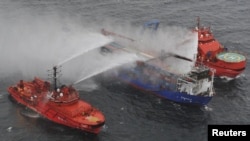
On November 21, the Russian cargo ship Sparta II, reportedly linked to Russia’s Defense Ministry and bound for Kaliningrad, was hit by drones, caught fire, and drifted into Finnish territorial waters.
Minutes later, a Russian helicopter violated Finnish airspace near Loviisa, raising questions about Moscow’s intentions and the risk of further escalation. Finnish Prime Minister Petteri Orpo said the war in Ukraine was spilling over into Finland’s immediate vicinity.
But Finnish MP and retired General Jarmo Lindberg, former chief of defense, who was re-elected on November 13 as chair of the steering board of the European Center of Excellence for Countering Hybrid Threats, believes the incidents need to be viewed in a broader military context.
In an interview with RFE/RL on November 22, Lindberg warned that Europe is already operating in a dangerous space between peace and war.
Ukraine Expands Its Reach In The Baltic
RFE/RL: A Russian cargo ship was hit by drones and drifted into Finnish waters, while a Russian helicopter briefly violated Finnish airspace near Loviisa. Can you walk us through what happened and explain whether you see the helicopter incursion as a deliberate test of Finland’s maritime and airspace defenses?

Jarmo Lindberg: Actually, I think it's a bit on the contrary. Obviously, Ukraine now has the capability to strike smaller targets and even mobile targets far away from Ukraine. A while ago, they struck a missile corvette nearby Finland, and now this is the second vessel that they have been able to target far away from Ukraine.
This time, it was the Sparta II cargo vessel which, based on the information available, was on its way to Kaliningrad. It was hit by possibly two drones, caught fire, and then drifted into Finnish territorial waters. Based on the information available, there was a brief incursion by a Russian helicopter. I don't know. Maybe they wanted to check firsthand what the situation of the vessel was. We don't know what the cargo is. The vessel is connected to the Russian Defense Ministry.
As of now, the vessel is being towed out of Finnish territorial waters. It had been burning, but they have been putting out the fire and say that the containers are still warm. But the situation is stable enough that they have started towing the vessel away.
RFE/RL: You have described the strike on the Sparta II as evidence of a new Ukrainian capability to hit small, moving targets in the Baltic Sea. Does this turn the Gulf of Finland’s shipping lanes into a new front line?
Lindberg: The front line in this area has already been in the area of the oil terminals at the eastern end of the Gulf of Finland, where Ukraine has been striking with a huge number of drones for several weeks, or even a month. The other thing is that Ukraine has been hitting Russian Navy vessels throughout the war in the Black Sea and has hit the Black Sea Fleet several times. So, judging from that, they have been able to hit maritime targets with their capabilities, and they have been hitting static targets, meaning oil terminals.
And, as you know, the different Internet companies and their storehouses several times, so kind of those fronts already exist. What is the change here? The change here is that they have a capability to hit targets far away from Ukraine that are not static targets, that are small, mobile targets in the Baltic area, in the Gulf of Finland. And that is something that has changed and that has demonstrated the new capability that the Ukrainians obviously possess now.
Moscow's Intentions And Europe's Hybrid War Dilemma
RFE/RL: Finnish, Estonian, and Russian vessels worked side by side to secure the damaged Sparta II. But why did a Russian helicopter enter Finnish airspace? Was it simply monitoring the ship, or was Moscow sending a message to Helsinki to pressure Kyiv to halt strikes against Russian targets in the Baltic?
Lindberg: No, I think that this is, you know, primarily reactionary, so that they check the ship that drifted into Finnish territorial waters, and they practiced it and then went away. So, you know, it is not easy to see that it is a kind of planned provocation. It is more like a reaction to what happened to the ship.
This is my judgment based on the open-source information that I have.
RFE/RL: You were recently re-elected to chair the steering board of the European Centre of Excellence for Countering Hybrid Threats. As Russian activities escalate from GPS jamming and undersea cable disruptions to sabotage involving explosives, where is the threshold between hybrid attacks and an act of aggression that could trigger NATO’s Article 5?
Lindberg: As you mentioned, there have been several incidents where the interesting point is the case of attribution: Who is behind the different attacks? We know that the GPS jamming is coming from Russia. We know that the instrumentalized migration that Russia used, pushing people across the border into Finland, well, it comes from Russia. They are easy to attribute.
Then there are situations where there are proxies, and the challenge is to say, okay, who eventually is behind these different actions?
And now, when you mentioned the latest action against the Estonian drone factory, Estonia was very fast in attributing it to Russia and the GRU. And then they said that they want to put a price on these actions, and then they said that they will close the eastern border of Estonia.
And the Finnish border with Russia has been closed now for three years, so this is not a price that the Estonians are willing to put on this action. There was the case of the drones in Leipzig. There have been other incidents where it's crossing, you know, the point where there may be physical damage or even human cost if explosives are being used.

And, you know, I am not the right person to say and define the exact red line. Then it's up to the nations, their governments, and, if it so be, the EU and NATO, who are saying whether such a dramatic action is crossing the threshold of war. That remains to be seen.
RFE/RL: Bottom line: Looking at the Sparta II burning off Finland's coast and Russian aircraft probing Finnish airspace, is Europe already at war with Russia in everything but name?
Lindberg: Well, that has been discussed already months ago, and, you know, the line was that we're not at war, but this isn't peace either anymore. So we are somewhere in between peace and war, and the definition of war is that you have to declare war, and no war has been declared.
So, we're somewhere in there, in between, in a gray-zone area.
Russia's Military Buildup On Finland's Border
RFE/RL: You have warned that Russia could eventually rebuild a larger military presence along Finland’s border than it had before the war. How far along are those preparations, and how much time does Finland have to prepare for the return of Russian forces to the Leningrad Military District?
Lindberg: Well, Russia has pretty much started up in Ukraine, and the large army garrisons east of Finland are empty. They deployed their forces early on to Ukraine. They have reactivated the Leningrad Military District, and they have constructed an organization that is larger than it used to be. The brigades have been upgraded into divisions, and, on top of that, there's an army corps to facilitate a larger military organization than existed east of Finland before the war.
And now the question is: Are we going to see, in the near future, military construction east of Finland that would, in a concrete way, facilitate the larger formations? That remains to be seen, but that takes a while.

And then, for Europe and Finland, it would be extremely important to have peace, to have a ceasefire, and to have permanent peace. In the countries that are bordering Russia, we are going to be asking: Where is Russia going next? And it is an, I would say, easy judgment to say that at least some of their formations will return to the bases from which they originally deployed to Ukraine. That is, you know, not a difficult thing to figure out.
So there is a possibility that one day they will return. Does it take two years, three years, five years? That is also hard to define exactly as it is now. It may take some years, but I would say it is a fairly safe bet that they will return to their origins.

