


16:43
25.4.2014

RFE/RL's Tatar-Bashkir Service reports that NGOs in Russia's Republic of Tatarstan have nominated the veteran leader of Crimean Tatars, Mustafa Dzhemilev, for the Nobel Peace Prize. The organizations’ leaders told RFE/RL that Dzhemilev, a dissident who was imprisoned by the Soviets over his campaign for the rights of Crimean Tatars, deserves the prize because of his insistence on a peaceful resolution of ethnic issues. Dzhemilev, 70, has said publicly that Crimean Tatars will not recognize Russia's annexation of the Crimean peninsula from Ukraine.
Russian officials this week dismissed reports, based on statements from the Mejlis, the Crimean Tatars' assembly, suggesting that Dzhemilev had been barred for five years from entering Crimea.
Groups supporting Dzhemilev's Nobel nomination include the Council of Tatarstan Elderlies, the Tatarstan National Assembly, Tatarstan's Anti-Nuclear Association, the Muslim Women's Association, and others. The groups have sent joint letters to the Nobel Prize committee and the Ukrainian government and intellectuals, asking them to support Dzhemilev's nomination.
16:37
25.4.2014
AFP and Reuters via our newsroom:
German Chancellor Angela Merkel says she told President Vladimir Putin that further sanctions against Russia may be necessary because Moscow has not done enough to implement the Geneva agreement on de-escalation of the Ukraine crisis.
Merkel, speaking in Berlin after talks with Polish Prime Minister Donald Tusk, said Russia has "the power" to persuade pro-Russian separatists to leave government buildings they occupy in eastern Ukraine.
But she said efforts by Moscow to bring the separatists on a "peaceful path" are lacking.
Merkel was expected to speak about further sanctions against Russia in a conference call April 25 with British Prime Minister David Cameron, French President Francois Hollande, Italian Prime Minister Matteo Renzi, and U.S. President Barack Obama.
Obama said he planned to discuss with European leaders the possibility of "sector sanctions" against Russia, possibly targeting the banking and energy spheres.
Merkel, speaking in Berlin after talks with Polish Prime Minister Donald Tusk, said Russia has "the power" to persuade pro-Russian separatists to leave government buildings they occupy in eastern Ukraine.
But she said efforts by Moscow to bring the separatists on a "peaceful path" are lacking.
Merkel was expected to speak about further sanctions against Russia in a conference call April 25 with British Prime Minister David Cameron, French President Francois Hollande, Italian Prime Minister Matteo Renzi, and U.S. President Barack Obama.
Obama said he planned to discuss with European leaders the possibility of "sector sanctions" against Russia, possibly targeting the banking and energy spheres.
16:37
25.4.2014
Here's our newsroom's story on the International Criminal Court's effort to determine whether a full investigation is warranted into possible criminality during the protests and unrest that prompted Viktor Yanukovych to flee Ukraine.
The ICC has launched a probe into possible crimes committed during the protests that led to the ouster of Ukrainian President Viktor Yanukovych.
The court said in a statement that chief prosecutor Fatou Bensouda (eds: a woman) has decided to open a preliminary investigation "into the situation" in Ukraine to determine if criteria exist for a full investigation.
Ukraine is not a member of the Netherlands-based International Criminal Court. But it has granted the court jurisdiction over any crimes that may have been committed between November 21, when protests against Yanukovych turned violent, and February 22, the day Yanukovych fled Kyiv.
More than 100 demonstrators were killed and hundreds of others injured during the antigovernment protests.
The court said if the prosecutor decides there is a strong basis for an investigation, she would ask the court to formally authorize a full probe.
The court said in a statement that chief prosecutor Fatou Bensouda (eds: a woman) has decided to open a preliminary investigation "into the situation" in Ukraine to determine if criteria exist for a full investigation.
Ukraine is not a member of the Netherlands-based International Criminal Court. But it has granted the court jurisdiction over any crimes that may have been committed between November 21, when protests against Yanukovych turned violent, and February 22, the day Yanukovych fled Kyiv.
More than 100 demonstrators were killed and hundreds of others injured during the antigovernment protests.
The court said if the prosecutor decides there is a strong basis for an investigation, she would ask the court to formally authorize a full probe.
16:34
25.4.2014
15:57
25.4.2014
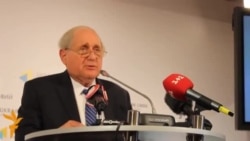
Speaking in Kyiv, U.S. Senator Carl Levin said that the political will exists in the U.S. Senate to urge President Barack Obama to implement stronger sanctions against Russian banks and other businesses in response to the crisis in Ukraine. (Video by RFE/RL's Ukrainian Service)

14:45
25.4.2014
French Foreign Minister Laurent Fabius, also in Tunis, said: "We are still discussing these types of sanctions against Russia. We are at level two of sanctions now. The sanctions taken must lower escalation and tensions in the region."
14:39
25.4.2014
Reuters quotes German Foreign Minister Frank-Walter Steinmeier as saying in Tunis today: "Time is running out to put a stop to this madness in Ukraine."
14:32
25.4.2014
Is there any real base for Russia to call new Ukraine govt 'illegitimate'? this clears a lot http://t.co/fmmkOjoW3Q pic.twitter.com/wj0fNsYv9B
— Maxim Eristavi (@MaximEristavi) April 25, 2014
14:20
25.4.2014
‘I had it pretty easy, because I was let go," says @SimonOstrovsky. The story we've all been waiting to read: http://t.co/KA32oLhvbt
— Jack Stubbs (@jc_stubbs) April 25, 2014
14:03
25.4.2014
Telephone conversation with Federal Chancellor of Germany Angela Merkel http://t.co/gAeMnXzdej
— President of Russia (@KremlinRussia_E) April 25, 2014