



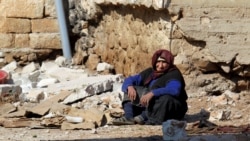
The home of a Russian pilot who was mistakenly named by some individuals on social media as one of the two crew of the downed Su-24 plane, and who was mistakenly reported as having been killed, is being guarded by police according to the pro-Kremlin news site Life News.
Sergei Rumyantsev was mistakenly named as being the navigator of the downed Su-24. Turkoman gunmen in Syria's Latakia province claimed initially that they had shot dead both crewmen, but the navigator was rescued alive in the early hours of this morning and later named as Konstantin Murakhtin.
Rumyantsev, who hails from Chelyabinsk, "phoned his family and said everything was OK with him," Life News claimed.
Analyst Michael Horowitz explains one reason why the Syrian border town of Azaz -- the target of Russian air strikes today -- is strategically important for the Syrian armed opposition, which holds it.
The Institute for the Study of War have published a handy interactive timeline of Russia-Turkey tensions over Syria.
In a possible message to Turkey, Russia has carried out air strikes today in Azaz, a strategic town on the Syria-Turkey border in the north of Syria's Aleppo province.
Claimed footage of the strikes were posted to YouTube by activists from the northern Aleppo town of Haritan.
Reuters has just reported that footage filmed at the Turkey-Syria border shows aid trucks burning after an apparent air strike.
This is the footage of the burning trucks that has been shared on YouTube by Syrian activists, who claim that the trucks contained merchandize and agricultural crops.
The strikes in Azaz come after Russian Prime Minister Dmitry Medvedev accused Turkey earlier today of purchasing oil directly from IS militants in Syria, in comments made in the wake of yesterday's downing by Turkey of a Russian Su-24 jet.
TASS has more from the rescued navigator of the downed Su-24 jet who has now been named as Konstantin Murakhtin.
Murakhtin said that Turkey gave no warning to the Su-24 before shooting it down.
He also insisted that the plane had never entered Turkish air space.
"No, that's impossible, not even for a second, especially since were were flying at an altitude of 6,000 meters, the weather was clear, as we say in our slang, a million on a million. Our entire flight until the moment the rocket hit was fully under my control. I could see very well both on the map and on the ground, where the border was and where we were.
We carried out military flights there several times, we know it like the back of our hand. We carried out military missions and returned on the return route to the air base. As a navigator I know every hill. I can orientate myself even without instrumentation."
The New York Times has some interesting insights from Turkey analysts over the reasons behind Turkey's decision to shoot down a Russian jet.
These include his frustration with Russia over a range of issues even beyond Syria, the Gordian knot of figuring out what to do with Syria itself and Turkey’s strong ethnic ties to the Turkmen villages Russia has been bombing lately in the area of the crash.
"I think Turkey was alarmed that Russia’s bombing of positions held by Turkey-backed rebels in northern Syria was hurting their positions and therefore Turkey’s future stakes in Syria," said Soner Cagaptay, a Turkish analyst at the Washington Institute for Near East Policy.
Moving to Tunisia, IS militants have now claimed responsibility for an attack yesterday on a presidential guard bus that killed 13 people.
The bomb exploded in one of the main streets of the capital Tunis. President Beji Caid Essebsi imposed a curfew in the city and a state of emergency nationwide. It was the third major attack in Tunisia this year.
Turkey says that its pilots warned the Russian jet 10 times before shooting it down. Russia is now claiming -- via the rescued navigator -- that there were no warnings at all.
This is what the Russian navigator who was rescued after parachuting out of the downed Su-24 jet had to say to journalists about whether Turkey had issued warnings to the plane before shooting it down, according to pro-Kremlin outlet RIA Novosti.
In actual fact, there were no warnings at all. Neither over the radio traffic or visually. There was no contact at all. Therefore we went out on our combat course in the normal way. You have to understand what speed a bomber is going at and what that of an F-16 fighter is. If they had wanted to warn us, they could have shown themselves, taken a parallel course. But there was nothing like that. And the rocket hit the tail of our plane suddenly. We didn't even notice it visually, so that we could have made an anti-missile maneuver.
The rescued navigator from the downed Russian Su-24 jet has said that the plane did not receive a single warning from Turkey, "either visually or via radio," RIA Novosti is reporting.