



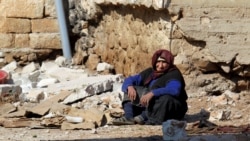
The IS group is holding a number of Albanian children whose fathers were killed fighting in Syria, and refusing to let them go home, the Balkan Investigative Reporting Network (BIRN) says.
BIRN has seen documents showing that 31 children including 23 minors were taken to Syria, and that some of them are now orphaned or fatherless.
Eva and Endri Dumani, aged nine and seven, are two of the 31 Albanian children left fatherless by the war in Syria.
Shkelzen Dumani was killed while fighting for [IS] on November 5, 2014, nine months after he took his children to Syria without informing his wife.
In Syria, Dumani changed his children’s names to Sara and Talha. Since his death, despite the efforts of the family and the Albanian authorities, his children have not been allowed to return home.
The IS group has executed a female journalist, Ruqia Hassan, in its Syrian stronghold of Raqqa, Syria Direct reports.
Better known by her pseudonym "Nisan Ibrahim," Hassan wrote about life under IS rule on her personal Facebook page and "often reported on airstrikes in Raqqa as they happened," Furat al-Wafaa, an independent citizen journalist formerly with the Raqqa is Being Slaughtered Silently media campaign, tells Syria Direct’s Ammar Hammou.
Syria Direct tweeted this photograph of Hassan.
The IS group in Libya is claiming responsibility for shooting down a MiG 21 military plane targeting militant groups near the eastern city of Benghazi.
However, Nasser al-Hassi, a spokesman for the Al-Karamah operations room in Libya, says that the plane went down because of a hydraulic system failure.
The pilot of the downed plane ejected, senior army commander Fadel al-Hassi told Reuters.
The destruction of Syria's chemical weapons stocks declared by the Syrian Arab Republic is complete, according to the Organization for the Prohibition of Chemical Weapons (OPCW).
OPCW's Director General, Ambassador Ahmet Üzümcü, said that the process "closes an important chapter in the elimination of Syria's chemical weapon program as we continue efforts to clarify Syria's declaration and address ongoing use of toxic chemicals as weapons in that country."
The IS group has set up departments to handle "war spoils," including slaves, and the exploitation of natural resources such as oil, Reuters reports.
The hierarchical bureaucracy, including petty rivalries between officials, and legal codes in the form of religious fatwas are detailed in a cache of documents seized by U.S. Special Operations Forces in a May raid in Syria that killed top IS financial official Abu Sayyaf. Reuters has reviewed some of the documents.
Islamic State theologians have issued an extremely detailed ruling on when “owners” of women enslaved by the extremist group can have sex with them, in an apparent bid to curb what they called violations in the treatment of captured women, Reuters writes.
The fatwa was among a huge trove of documents captured by U.S. Special Operations Forces during a raid targeting a top Islamic State official in Syria in May. Reuters has reviewed the document, which has not been previously published, but couldn’t independently confirm its authenticity.
Among the fatwa’s injunctions are bans on a father and son having sex with the same female slave; and the owner of a mother and daughter having sex with both. Joint owners of a female captive are similarly enjoined from intercourse because she is viewed as “part of a joint ownership.”
Reuters has shared a U.S.government translated copy of the fatwa.
AFP has a couple more small details of today's attacks by IS on oil facilities in northern Libya.
Bashir Bouhdhira, a colonel in the army loyal to Libya's internationally recognized government, said that Sidra was "attacked by a convoy of a dozen vehicles belonging to [IS]."
"They then launched an attack on the town of Ras Lanouf via the south but did not manage to enter."
IS has been trying to push east from the coastal city of Sirte to Libya's oil crescent area for several weeks.
The IS group in Libya has released images of its militants who it says were killed carrying out suicide attacks today in Sidra.
A storage tank that caught fire when IS militants attacked the Libyan oil port of Sidra today was close to the oil port of Ras Lanuf, Mohamed Elharari, a spokesman for the state-run National Oil Corp, has told Bloomberg.
“An oil storage tank caught fire and there was a big explosion,” Elharari said.
The Petroleum Facilities Guard (PFG), whose forces pushed IS militants back from Sidra in Libya today, have said that IS are now stationed 30 kilometers away waiting for the opportunity to launch a second attack on Libya's biggest oil port.
The PFG are led by Ibrahim al-Jadhran, a former commander who took part in the rebellion against Muammar Qaddafi in 2011.