



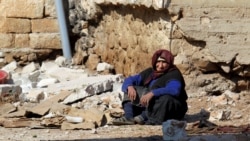
Turkish military hits Kurdish targets in northern Syria with missiles: Dogan
Turkey has stepped up its attacks on Syrian Kurdish militia positions in northern Syria, the Dogan news agency is reporting.
Whereas previously the Turkish military has fired only artillery shells at YPG positions near Azaz, now it has used Stinger and I-HAWK missiles.
U.S., Russia hold talks on Syria ahead of UN meeting: Reuters
U.S. and Russian military officials have held a meeting in Geneva ahead of a wider UN meeting this afternoon aimed at securing a cessation of hostilities in Syria, diplomats have said, according to Reuters.
The unannounced bilateral meeting was aimed at narrowing positions before the two powers jointly chair a United Nations meeting on the issue, they said, declining to give details.
Turkey continuing cross-border shelling against Syrian Kurds: Anadolu
An agreed-upon "cessation of hostilities" is set to start today -- amid reports of ongoing fighting.
Turkey's state-run Anadolu Agency reported late Feb. 18 that the Turkish military is continuing with its cross-border artillery shelling campaign against U.S.-backed Syrian Kurdish militia positions in northern Syria.
Anadolu said that the military was conducting intermittent artillery fire against YPG positions near the border town of Azaz.
No alternative to political solution in Syria: Kremlin
Kremlin spokesman Dmitry Peskov has said that Moscow is proceeding on the basis that there is no alternative to a political solution to the crisis in Syria, RIA Novosti is reporting.
"Everyone, including the President [Putin] is proceeding [on the basis of] the lack of an alternative to a political solution to this problem," Peskov told reporters at his daily press briefing this morning.
Peskov added that everyone, including Russia, wanted to preserve Syria's territorial integrity.
That concludes our live-blogging of the crisis surrounding Islamic State. Check back here tomorrow for more of our continuing coverage.
Churkin: Assad out of sync with Russia on Syria
Russia's envoy to the United Nations, Vitaly Churkin, has given an interview with Kommersant, in which he has made a number of comments about the Syrian crisis. I have translated some of the main points. (Churkin is rather long-winded, but I think it is worth reading his comments more or less in full to get an insight into his -- and Moscow's -- attitude towards Syria and Moscow's relationship with Damascus.)
Kommersant: You have already mentioned Syria. We were surprised by recent statements by Syrian President Bashar al-Assad regarding [his] determination to fight until victory and the impossibility of compliance with the truce. Do these new signals from Damascus run contrary to diplomatic agreements that have been reached with Russia's participation in the negotiations in Geneva and Munich? Does this not mean that Assad is undermining Moscow?
Churkin: You know, for a long time I have professed a certain, if I may say so, diplomatic and political philosophy....But in the early 1990s, I had to act as special representative of the Russian President and the Vice-Minister of Foreign Affairs engaged in the settlement of the Yugoslav crisis. Then we started a rather complicated game with the Bosnian Serbs, which moved from a confrontation with them, which is where Russia's involvement in this crisis situation started, to cooperation. But for me an immutable condition was that as long as we helped them to get out of this situation, they had to follow our advice.
We can and should, I think, expect the same from Damascus now. Russia has invested in this crisis in a very serious way,politically, diplomatically and now also militarily.
Therefore of course we would like Assad to also respond to this.
But at the same time, we should not attach too much importance to this or that statement, or dramatize them. You are completely correct...this is my personal opinion, I heard Assad's statements on TV...of course it is discordant with the diplomatic efforts that Russia is undertaking.
There is the Vienna process, the latest agreement of the International Syria Support Group, that talks about a cease fire, the cessation of military actions in the foreseeable future. This is what we are working on now.
But the Syrian President also operates according to a system of political coordinates. And here, I think, we should orient ourselves not towards what he says -- with all due respect to the statements of a person of such a high level -- but to what, at the end of the day, he does.
If the Syrian authorities, despite their internal political classifications and propaganda line, which they have to take, if they will follow the leadership of Russia in regulating this crisis, then they will have a chance to get out of it with dignity. If they somehow stray from this path -- again this is my personal opinion -- then this could lead to a very difficult situation.
Including for them. After all, whatever possibilities the Syrian army might have had, it was the effective operations of the Russian air forces allowed it to push their opponents out of Damascus. Now they may take Aleppo, the largest center in the north of the country. But if they proceed from the fact that a truce is not necessary, and [go on to] fight to the bitter end, then this conflict will last a very long time. And it's scary to imagine. Because this conflict is such a destructive force that already after its first year, it was difficult to imagine how it could continue. And yet it continues. Now half of Syria, if not more is in ruins. Half of the population are either refugees abroad or internally displaced persons.
Kommersant: You said that Russia has seriously invested into this story. But to what end? What result does Moscow want?
Churkin: Firstly, the most important task is to defeat terrorism. Russia's contribution to this fight is extremely important. The mere fact that after our words and political and diplomatic efforts our bombers followed, and carried out missile and bomb strikes on terrorists, that in itself is important.
Secondly, this can eventually lead to a political settlement. I think that if our aerospace forces had not gone into Syria, the positive diplomatic moves that we have seen, simply would not have happened. The most irreconcilable opposition [groups], which are supported by the well-known group of countries -- Turkey and Saudi Arabia -- in my estimation, believed in their hearts that they can"put the squeeze" on Damascus. This was one of the reasons for the continuation of the conflict. Now, I hope, they, and those who support them, will realize that you need a political solution. The Americans have already understood this.
And Damascus, I hope, understands that [the Munich agreement] is a unique chance to solve the conflict after five years of unrelieved failure. Let me remind you that on December 17 last year the UN Security Council managed for the first time within the framework of resolution №2254, to in the presence of Sergey Lavrov, to agree a political program to resolve the crisis in Syria.
Syria ground op must prioritize IS, Saudi minister tells AFP
Any participation by Saudi forces in a U.S.-led ground operation in Syria would focus on fighting the Islamic State group not President Bashar al-Assad, Saudi Arabia's foreign minister has told AFP.
IS currency a 'media stunt' activist tells Syria Direct
The Islamic State group never produced its much-publicized precious-metal currency and has in fact only produced a few "souvenir coins," activists in Raqqa told Syria Direct today.
Read the full report here.
Nevertheless, anti-IS activist Hani a-Rawi, a member of the Raqqa is Being Slaughtered Silently media campaign, told Syria Direct that IS “never banned the circulation of dollars.”
“IS even pays its fighters in dollars and prefers that taxes be paid in dollars as well,” said a-Rawi.
UK's Syria airstrikes killed or injured 'seven IS militants': BBC
Seven fighters from the IS group have been killed or injured by British air strikes in Syria, the Ministry of Defense estimates, according to the BBC.
By the end of January four attacks had resulted in IS casualties, figures released to the Huffington Post in a freedom of information request showed.
Invasion of Syria would mean end of peace process: Russia
Russia's Foreign Ministry spokeswoman Maria Zakharova has said that any invasion of Syria would spell an end to the peace process.
Zakharova said that Moscow hopes Turkey will remain committed to its obligations regarding a political settlement in Syria and refrain from military means, RIA Novosti reports.