



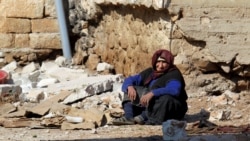
Suspected Russian air strikes have killed 32 civilians, half of them women and children, in three areas in northern Syria, the Syrian Observatory for Human Rights has said, AFP reports.
SOHR head Rami Abdel Rahman said warplanes bombarded Raqqa, IS's stronghold in Syria, as well as the towns of Azaz and Al-Bab in Aleppo province, on December 17.
Syrian Deputy Foreign Minister Faisal Mekdad has said that Russian air strikes in Syria have "weakened the opportunities of IS and other terrorists groups to act."
Mekdad made his comments in an interview with pro-Kremlin news website RIA Novosti.
"I think that the result of the Russian actions is evident across all of Syria," Mekdad said.
"[Turkish President] Erdogan, Saudi Arabia, Qatar are trying to prove that they are different from [IS], at the same time as strikes by Russian jets are really weakening the terrorists, and this is evidenced by the numerous areas liberated in Hama, Latakia, Idlib and Aleppo. There are significant successes, and soon this will be even more noticeable."
Mekdad also praised Russia's deployment to Syria of its S-400 air defense systems, saying that this safeguarded the Russian air force and the Syrian army.
The Washington Post has more on U.S. Defense Secretary Ash Carter's visit to Afghanistan today, and on the growing threat posed by the IS group in that country, particularly in Nangahar province.
A senior defense official, speaking to reporters en route to Afghanistan on condition of anonymity, said the Islamic State presence was seen by Taliban leaders as a a threat and added a “new dynamic” to an already challenging situation.
...
“Nangahar is the region that most distresses us now,” Gen. Dawlat Waziri, senior spokesman for the Afghan Ministry of Defense, said in an interview Thursday. He said Afghan forces had defeated [IS] in several other provinces and are now aggressively fighting them in four districts of Nangahar, where they have killed between 300 and 400 militants in recent months.
Syrian President Bashar al-Assad has given a wide-ranging interview to Dutch public broadcaster NOS.
A video of the interview is available on NOS's website this morning.
Syrian state news agency SANA has a transcript of the interview on its website.
On the issue of the U.S.-led coalition bombing IS targets in Syria, Assad said this was illegal without the permission of his government.
Assad: This is illegal. This is against the international law. We are a sovereign country. If you are serious about fighting terrorism, what is the obstacle for that government to call the Syrian government, to say “let’s cooperate in fighting terrorism?” The only obstacle is that the Western policy today towards Syria is “we need to isolate this state, that president, so we cannot deal with him.” Okay, you cannot reach anything then.
Assad was asked why he thought militants from countries like the Netherlands were going to fight alongside groups like IS in Syria.
Assad: The most important question is: why did you have them in Europe? Coming, that’s natural; when you have chaos, when Syria has been turned into a hotbed for terrorism because Europe and Turkey and Saudi Arabia and Qatar and those countries supported terrorists in different ways, of course you’re going to have chaos, and it’s going to be a nexus for terrorism. That’s natural for this, how to say, fertile soil, to attract terrorists from the rest of the world. But the question: why did you have them in Europe? You didn’t deal with terrorism in a realistic base.
...
I think it’s about two things, if you ask me about why. First of all, the European governments didn’t do their job to integrate these people in their societies; they lived in a ghetto. When you live in a ghetto, you’re going to be an extremist. The second one, many European officials have sold their values for the petrodollar, and they allowed the Wahabi Saudi institutions to pay money and to bring this dark and this extremist ideology to Europe, and that’s why now you are exporting terrorists to us. We don’t export, actually, they came to Syria, and then they go back to Europe.
...
And the three criminals who committed the attacks in Paris, all of them lived in Europe; Belgium and France and others. They didn’t live in Syria
Syrian Deputy FM: Erdogan 'Selling Syrian & Iraqi Oil'
By accusing Syria of buying oil from the IS group, Turkish President Erdogan is "trying to remove a shadow from his own family," Syrian Deputy Foreign Minister Faisal Mekdad has said.
In an interview this morning with pro-Kremlin news agency RIA Novosti, Mekdad said Turkey was "distorting the picture" regarding IS oil sales.
Erdogan and his family were "working with Syrian and Iraqi oil, selling it on the Turkish internal market and in several other countries. We are ready to throw [Erdogan] a challenge -- let him present just one piece of evidence for his words," Mekdad said.
Mekdad said that Damascus was buying oil as needed from "friendly states" including Iran, which was sending three oil tankers via sea to Syria every month.
A gunman in Mali has killed three people outside a Christian radio station in the city of Timbuktu, local officials say.
"At least one Catholic" was killed in the attack as well as a radio presenter, a local government official said.
A senior official in the governor's office told AFP blamed the shooting on Islamist extremists and said it was a "jihadist attack aimed at dividing Muslims and Catholics."
The radio station, Tahanite, was banned from broadcasting any Bible-related programming during the 2012 occupation of Timbuktu by Al-Qaeda linked militants, AFP report.
The UK government's @UKagainstDaesh Twitter account, which tweets updates on the UK's involvement in the campaign against the IS group, says that the Iraqi government has launched a campaign to help reduce civilian casualties in the city of Ramadi.
Iraqi troops are currently fighting to liberate Ramadi, the capital of Iraq's Anbar province, from the IS group.
Baghdadi is advising civilians in Ramadi how to stay safe around IS bombs and mines.
A common IS tactic when pushed out of an area is to booby trap buildings including civilian homes.
Iran's Foreign Minister, Mohammad Javad Zarif, has called on the international community to "join hands to put into effect an immediate end to the bloodshed" in Syria.
Zarif made his comments in an opinion piece in The Guardian today, hours before the UN and the International Syria Support Group (ISSG) -- a group of Western and regional states overseeing the Syrian peace process -- meet in New York.
Iran is a staunch ally of Syrian President Bashar al-Assad, whom the United States and other countries say must step down.
But Zarif criticized the "preconditions" that he said were hampering a political solution in Syria and which he said "do not represent the wishes of the Syrian people; rather, they reflect the agendas of outside actors."
Russian President Putin made a similar argument in a press conference yesterday.
Zarif implicitly criticized Saudi Arabia, saying that "those who have denied their own population the most rudimentary tenets of democracy, such as a constitution and elections, are now self-declared champions of democracy in Syria."
The Iranian foreign minister also criticized those he said were "sponsoring terrorists," repeating an argument that Moscow has made that the West has differentiated between "good" and "bad" terrorists:
Indeed, it is alarming that some are oblivious to how bands of villains such as [IS] or al-Qaeda’s multiple incarnations and reincarnations are a common threat to all of us, including their patrons. It is delusional to believe that sponsoring these terrorists, directly or through their newborn ideological siblings, can ever be an asset or leverage to achieve even short-term political objectives. Yet those who support militant extremism are not only continuing to do so, but they sponsor terror with impunity. They even use their political patronages and web of lobbyists to seek to legitimize such assistance, and its recipients, by differentiating between “good terrorists” and “bad terrorists”.
While terrorism "has no religion, no nationality or ethnic background," Zarif said that it has "backers with known addresses and horrific agendas."
Some Muslims in France are taking the government to court, accusing it of illegal acts in the name of preventing another terror attack, Reuters report.
Following the November 13 attacks in Paris that killed 130 people, France declared a state of emergency giving authorities extra powers to conduct raids and place people under house arrest. France has since carried out hundreds of police raids on homes, mosques, hotels and restaurants.
But at least 20 complaints have been filed since the state of emergency was declared, mostly alleging that the government has acting illegally in placing people under house arrest for reasons that are not justified.