



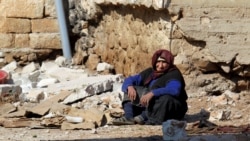
U.S. Army Col. Steve Warren, the spokesman for the U.S.-led anti-IS coalition, has also commented in his press briefing today about the recent heavy clashes by IS militants near Haditha in Iraq's Anbar province.
Warren says that Iraqi Security Forces have repelled or regrouped and counterattacked against all IS advances near Haditha.
U.S. Army Col. Steve Warren -- spokesman for the U.S.-led anti-IS coalition -- has also commented on Operation Tidal Wave, the operation to target IS-controlled oil installations, which the group is using as a source of funding.
The spokesman for the U.S.-led coalition against IS says that around 2,500 IS militants were killed in U.S.-led air strikes in Iraq and Syria in December.
In the Iraqi city of Ramadi, recently retaken from the IS group, Sunni tribal fighters and local police will take over security duties from the Iraqi army and counter terrorism service, the spokesman for the U.S.-led coalition says.
The American Enterprise Institute (AEI)'s Critical Threats update today has this to say on IS's attacks on Libya's oil crescent:
The Islamic State in Iraq and al Sham (ISIS) Wilayat Barqa may be close to success in its campaign to seize Libyan oil infrastructure. The group advanced eastward from its base in Sirte, seizing Bin Jawad and launching suicide vehicle-borne improvised explosive device attacks on Libya’s two largest oil export ports, al Sidra and Ras Lanuf. If ISIS Wilayat Barqa can effectively consolidate its territorial gains, it will likely continue to advance eastward and seek control of major oil fields.
But is IS in Libya likely to succeed in seizing control of Sidra and Ras Lanuf?
While the clashes on January 4 and 5 certainly caused significant damage -- a total of seven oil tanks are ablaze as a result of the assault by IS -- the extremists did not manage to overrun Sidra and were repelled by the Petroleum Facilities Guard (PFG), despite launching two suicide car bombs.
The PFG said today that IS had retreated and were trying to regroup for another attack, but claimed that if (more likely when) this happened it would not be as strong.
The situation in three Syrian villages besieged by Syrian government and allied Hizballah forces is "extremely dire," the International Committee of the Red Cross (ICRC) has warned, the BBC is reporting.
In Madaya near Damascus, activists say that civilians have died because of a lack of food and medicines. An activist in Madaya told the BBC that people are "eating stuff off the ground. They're eating cats and dogs."
As the International Committee of the Red Cross warn of dire conditions in Syrian towns near Damascus besieged by pro-government forces, Syria Direct have spoken to civilians living in the rebel-controlled town of Azaz in northern Syria, who are trying to cope amid freezing temperatures, snow and rain in a town where diesel and electricity prices are skyrocketing.
Abu Hussein and his family live in a cement house, and as such, are better off than many of the 57,000 residents of Azaz.
"There are people living in tents--how can they take care of themselves?" asks Abu Hussein.
"In this despicable situation, no one knows what to do," Abu Hussein said.
"I swear to God, I never imagined in my life that people would die from the cold."
Syrian government and rebel fire has killed around 20 civilians and wounded dozens more in Damascus and the nearby rebel-held East Ghouta region, state news agency SANA and an activist group report.
SANA is reporting that eight people were killed and 25 injured in mortar attacks by the Jaish al-Islam faction who fired on residential neighborhoods in Damascus from East Ghouta.
The Britain-based Syrian Observatory for Human Rights says that the attack on Damascus followed government shelling on Douma in East Ghouta in which five civilians were killed. Seven more were reported dead in air strikes on two other East Ghouta towns.
Sky News says that it has been shown "the strongest evidence yet" that the British-accented masked militant in the latest IS propaganda video is British terror suspect Siddhartha Dhar a.k.a. Abu Rumaysah.
Sky says that voice analysis of the video has revealed "distinctive features" that support claims the militant is Dhar.
Dr Frederika Holmes, who has more than 25 years' experience as an independent consultant in forensic and phonetic analysis of speech and language samples, said: "There was considerable overlap in accent features across the two samples, and both samples could be plausibly within the range of a single speaker."
The IS group has built a research center devoted to launching attacks in the West using driverless cars and rehabilitated anti-aircraft missiles, new footage from inside the terror group reveals, The Guardian reports citing footage obtained by Sky News.