



The Brussels apartment where police found traces of explosives, handmade belts and a fingerprint belonging to Paris attacks fugitive Saleh Abdeslam may be where Abdeslam -- still on the run -- hid out after the November 13 attacks, the BBC is reporting.
IS claimed responsibility for the attacks, which killed 130 people.
There appears to be some confusion over which attack in Libya IS has claimed responsibility for.
The Washington Post is reporting that IS has claimed responsibility for the attack in Zliten that targeted a police base.
However, the statement published on Twitter by IS sympathizers says the attack was carried out "near Ras Lanuf," by Abu al-Abbas al-Muhajir, indicating that IS is referring to the attack at Ras Lanuf and not at Zliten, which is some 500 km away. The statement does say that the attacker targeted a "apostate soldiers."
AFP reports that IS has claimed responsibility for yesterday's suicide car bombing at a checkpoint in Ras Lanuf in Libya's oil crescent.
The report notes that EU foreign affairs chief Federica Mogherini is set to hold talks today in Tunis with Libyan politicians including Fayez al-Sarraj, named in the UN-brokered national unity deal as prime minister designate.
The UN's Libya envoy Martin Kobler tweets that he regrets not being among the thousands who have attended the funerals for the terror attack in Zliten.
An IS militant executed his mother in public in the Syrian city of Raqqa because she had encouraged him to leave the group, the Britain-based Syrian Observatory for Human Rights has reported.
The woman was in her 40s and had told her son, 20, that the U.S.-led coalition against IS would wipe out the militant group. The woman had asked her son to leave Raqqa, IS's Syrian stronghold with her.
However, the woman's son informed IS of her comments and on January 6, son executed her in front of hundreds of people.
In Iraq, Turkish troops on a training mission have repelled an attack by IS militants, Turkish officials say.
At least 17 IS militants were killed in fighting on January 7 at the Bashiqa military base in Iraq's Nineveh province, where around 150 Turkish troops have been deployed to train local Iraqi forces.
The European Union has welcomed Syrian President Bashar al-Assad's decision to allow humanitarian access to the town of Madaya, and called for a halt to all attacks on civilians in the conflict.
"The decision of the Syrian regime to allow humanitarian access in Madaya is a first step in the right direction," Federica Mogherini, the EU's foreign policy chief, and the bloc's Commissioner for Humanitarian aid and Crisis Management, Christos Stylianides, said in a joint statement today, Reuters reports.
According to Medicins Sans Frontieres (MSF), Syrian government forces have imposed a siege in Madaya, near the border with Lebanon, since July. Around 20,000 residents of the town are facing "life-threatening deprivation" and 23 patients in an MSF-supported health center have died of starvation since January 1 including six babies under one year old.
MSF operations director Brice de le Vingne said the situation was "now catastrophic" and a "clear example of the consequences of using siege as a military strategy."
The IS group's affiliate in Sinai appears to have taken responsibility for an attack on a tourist bus yesterday in Egypt's Giza.
Egypt's Interior Ministry said that no one was hurt in the attack but an eye witness said that the attack was more organized than the ministry had described.
The witness, Jaber Jabarin, an Arab Israeli, said that the attackers fired flares, fired at the bus, then fired birdshot at a hotel and tried to throw Molotov cocktails at the bus. The attackers then fired at the hotel with live bullets, Jabarin claimed.
Turkey's President Erdogan has accused Russia of not fighting the IS group in Syria, saying that Syrian Turkomans have claimed Russia is bombing their villages.
Turkey has made similar accusations previously.
Relations between Russia and Turkey chilled since Turkey shot down a Russian Su-24 jet near the Syrian border in November.
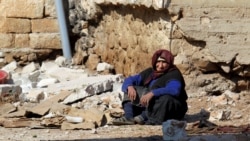
Photos of the checkpoint at Ras Lanuf in Libya's oil crescent that were targeted by an IS suicide car bomb on January 7.