



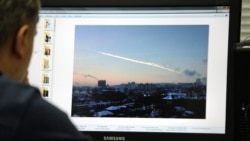
How often does Earth experience the kind of meteorite strike that just hit Russia? @megangarber knows: theatln.tc/VYQngS
— J.J. Gould (@jj_gould) February 15, 2013
"99 percent of the time" scientists have no idea that large asteroids that could hit earth are coming. rendezvous.blogs.nytimes.com/2013/02/15/ear…
— Christopher Mims (@mims) February 15, 2013
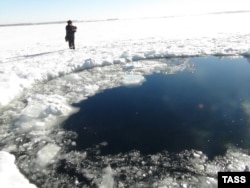
A few local fisherman got a bit of a surprise on a lake near Chelyabinsk. Lifenews.ru heads out there (w/non-embeddable video)
We are going to slow down coverage on the live blog. There will still be an interview or two as well as more reactions from Russia posted, but not at the pace of what we did in the morning as events unfolded. Thanks to everyone for watching, reading, and sending their videos. -- RFE/RL's web team
Sergei Smirnov, a senior astronomer at the Central Astronomical Observatory of the Russian Academy of Sciences in Pulkovo near St. Petersburg, during a live interview with Russian state television, Rossia 24.
Smirnov was asked if there was a link between the Chelyabinsk meteorite and the approaching asteroid 2012 DA 14, which was expected to skim the Earth later on Friday:
"It is clear now that they had different orbits and their orbital planes were inclined considerably. The asteroid that we expect in a few hours is approaching the Earth from the Southern Hemisphere side, in other words its general trajectory lies from south to north, while the Chelyabinsk bolide came from east to west."
Smirnov was also asked whether it had been possible to foresee the appearance of the meteorite:
"Unfortunately the object was not big enough to be detected ahead of time by currently available means at a long distance but big enough to cause a lot of destruction after it broke through toward the Earth."
Smirnov was asked if there was a link between the Chelyabinsk meteorite and the approaching asteroid 2012 DA 14, which was expected to skim the Earth later on Friday:
"It is clear now that they had different orbits and their orbital planes were inclined considerably. The asteroid that we expect in a few hours is approaching the Earth from the Southern Hemisphere side, in other words its general trajectory lies from south to north, while the Chelyabinsk bolide came from east to west."
Smirnov was also asked whether it had been possible to foresee the appearance of the meteorite:
"Unfortunately the object was not big enough to be detected ahead of time by currently available means at a long distance but big enough to cause a lot of destruction after it broke through toward the Earth."
Reuters: The spectacle deeply frightened many Russians, with some elderly women declaring that the world was coming to an end.
NASA statement on Russian meteor:
"According to NASA scientists, the trajectory of the Russian meteorite was significantly different than the trajectory of the asteroid 2012 DA14, making it a completely unrelated object. Information is still being collected about the Russian meteorite and analysis is preliminary at this point. In videos of the meteor, it is seen to pass from left to right in front of the rising sun, which means it was traveling from north to south. Asteroid DA14's trajectory is in the opposite direction, from south to north."
The Moscow Times:
"By early afternoon, several websites were already selling "fragments of meteorite."
"I'm selling it because it's useless to me. There are several scratch marks, but in general it's in excellent condition," wrote one Internet user calling himself Alexei and claiming to be from Magnitogorsk in the Chelyabinsk region.
The U.S. National Oceanic and Atmospheric Administration (NOAA) has published a GIF image that shows -- from space -- the vapor trail from the meteor hitting Earth's atmosphere as it plummeted toward Chelyabinsk. It's made up of eight images taken at 15-minute intervals.
In seemingly but not actually related news, scientists say the 46-meter-across asteroid dubbed 2012 DA14 has safely bypassed Earth at a distance of around 28,000 kilometers in the closest recorded flight of a space object of that size. The smaller meteor that hurtled into Chelyabinsk was traveling in the opposite direction of 2012 DA14, so scientists dismissed the notion that the two events might be related.