

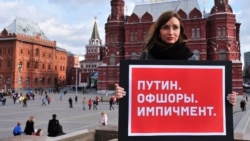
BBC has another piece on the fact that average Russians just don't care about the Panama leak or about any allegations of corruption within the ruling elite of President Vladimir Putin. Their correspondent, Steve Rosenberg, had this exchange with a woman in Elektrostal, an industrial town about two hours from Moscow:
At a newspaper kiosk I ask sales assistant Nadezhda what she thinks of the Panama Papers, and claims of a money laundering ring close to the Kremlin.
"I have a very negative attitude… towards you!" Nadezhda replies.
"That's a pity," I respond, "I don't have a negative attitude towards you."
"It's nothing personal," explains Nadezhda. "You seem quite a decent person. It's your country I don't like and its scheming. All these 'investigations' are a waste of time and money. We know what you're up to."
Yesterday, RFE/RL had this video in which the montage of Russian "opinions" about the revelations speaks volumes with the single word "Nyet."
Clifford Gaddy of the Brookings Institution has his own conspiracy-theory take on the Panama leaks. Putin says it was a CIA plot -- but what if it was really a Kremlin plan to rock global capitalism?
In sum, my thinking is that this could have been a Russian intelligence operation, which orchestrated a high-profile leak and established total credibility by “implicating” (not really implicating) Russia and keeping the source hidden. Some documents would be used for anti-corruption campaigns in a few countries—topple some minor regimes, destroy a few careers and fortunes. By then blackmailing the real targets in the United States and elsewhere (individuals not in the current leak), the Russian puppet masters get “kontrol” and influence.
If the Russians are behind the Panama Papers, we know two things and both come back to Putin personally: First, it is an operation run by RFM, which means it’s run by Putin; second, it’s ultimately about blackmail. That means the real story lies in the information being concealed, not revealed. You reveal secrets in order to destroy; conceal in order to control. Putin is not a destroyer. He’s a controller.
Reuters reports that the U.S. Treasury Department has accelerated plans to issue a long-stalled rule "forcing banks to seek the identities of people behind shell-company account holders."
In mid-2014, Treasury's anti-money laundering unit, the Financial Crimes Enforcement Network (FinCEN), issued a proposed rule on beneficial ownership. Differences of opinion between the various financial regulators vetting the rule and an obligatory analysis of costs to industry has slowed the process, as has pushback from the banking industry.
The FinCEN rule is expected to require only that banks and brokerage firms request information from customers regarding beneficial owners, but not require them to verify that information through investigation.
USA Today found a Mossack Fonseca partner company in a tiny office in the center of Cheyenne, Wyoming.
Within that suite, however, is yet another company: AAA Corporate Services Inc., which serves as M.F. Corporate Services Wyoming LLC's registered agent, according to state records. Under Wyoming law, any business established in the state must have a physical presence to receive legal papers and other documents.
Wednesday, inside AAA Corporate Services' second-floor office, stacks of hand-addressed envelopes sat neatly on general manager Linda Gaynor's desk, awaiting the afternoon mail pickup.
Gaynor acknowledged her company serves as an agent for many out-of-state companies but declined further comment.
This hard-hitting op-ed on The Guardian website gives voice to some of the outrage that people in the United States feel reading about the Panama leak, considering the country has been debating for ages whether it can afford infrastructure repair or raising the minimum wage.
But while working and middle-class families pay their taxes or face consequences, the Panama Papers remind us that the worst of the 1% have, for years, essentially been stealing access to Americans’ common birthright, and to the benefits of our shared endeavors.
Worse, many of those same global elite have argued that we cannot afford to provide education, healthcare or a basic standard of living for all, much less eradicate poverty or dramatically enhance the social safety net by guaranteeing every American a subsistence-level income.
Here is the video of part of Russian President Vladimir Putin's response on April 7 to a question about the Panama leak's allegations of personal corruption and corruption among his senior officials, with English subtitles:
RFE/RL's senior Russia analyst Brian Whitmore devoted his regular Daily Vertical video commentary to the Panama papers and how they are being played -- or ignored -- in Russia:
The Panama papers continue to rock the government of British Prime Minister David Cameron. One of those implicated in possible tax evasion by the leak is the chancellor of the exchequer, George Osborne. This tweet of his from 2014 is making the rounds again now, reminding us again that the Internet never forgets:
The HuffPost has a round-up of what people are doing with this tweet.
ICYMI, this April 4 piece from The New York Times public editor, Margaret Sullivan, is interesting. She talks about why the Times was not part of the consortium of journalists that broke the leaks story and why it has been so slow to produce its own stories.
Writing in Salon, Andrew O'Hehir adds that perhaps the Times was not invited to the party because "the Gray lady has a long and tormented relationship to the powers of big government and big capital, which largely speaks for itself."
Vice has a rundown of the conspiracy theories generated by the Panama leak so far, for those who refuse to face the fact that it is about corruption, money laundering, and unethical tax evasion.