


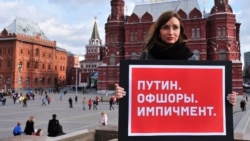
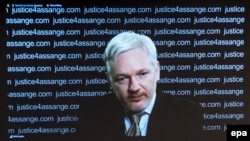
Al-Jazeera talks about how the Panama Papers leak is being covered, including comment from WikiLeaks's Julian Assange.
ICYMI, this commentary by Guardian economics journalist Aditya Chakrabortty from April 10 is getting a lot of social-media attention today.
But the risk is that all this will descend into a morass of semi-titillating detail: a string of revelations about who gave what to whom, and whether he or she then declared it to the Revenue. The story will become about “handling” and “narrative” and individual culpability. That will be entertaining for those who like to point fingers, perplexing for those too busy to engage in the detail – and miss the wider truth revealed by the leak which forced all this into public discussion.
Because at root, the Panama Papers are not about tax. They’re not even about money. What the Panama Papers really depict is the corruption of our democracy.
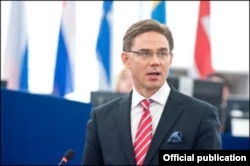
European Commission Vice President Jyrki Katainen says tax avoidance is "a cancer of market economies."
Gizmodo looks at how Mossack Fonseca might have been hacked.
For a company good at hiding money, Mossack was apparently terrible at hiding data. Wordfence says Mossack’s emails were stored on the very same server that could be easily accessed through the Revolution Slider exploit—after uploading a short script to Mossack, the emails were there for the taking. It would be like keeping all your money in a single checking account and having your PIN be 1-2-3-4. Wordfence also claims that, until very recently, there was no firewall protecting Mossack’s site, a security measure that might have been able to stop or at least limit the amount of data that was leaked.The Guardian today is writing about what kinds of results the Panama Papers leak might produce. Can it produce better dialogue and cooperation between developed and developing countries?
The Panama Papers offer empirical evidence of the cost of tax evasion, shedding light on a number of tax-related stories in Africa, including missing taxes from oil revenue in Uganda, secrecy surrounding diamond mining in Sierra Leone, and hidden players in Angola’s sovereign wealth fund.
Aggressive tax avoidance is not just a problem for developing countries. There is aheightened awareness in Europe and elsewhere of the millions lost because of complex tax deals and havens. The decade-defining refugee crisis, mainly due to the war in Syria, has also focused minds on international and domestic needs for additional financing.
Ryding says she has noticed more civil servants speaking in favour of an intergovernmental tax body, but the official EU position has not shifted.
Malta Today reports on the growing pressure on Maltese Prime Minister Joseph Muscat stemming from the Panama Papers leak.
Although Joseph Muscat has now acknowledged the Panama scandal as a serious issue that threatens to undermine his own credibility, he is still clearly responding to the controversy in the traditional way politicians have always faced crises in this country.
Labour’s first response was to try and turn the tables on the Opposition, by dragging up corruption cases that surfaced during or after the Nationalist administration. Separately, the Prime Minister has also urged us to consider the ‘good things’ achieved under his administration: the reduction in utility bills, economic growth, record employment levels, civil liberties, etc.
All this indicates that Muscat has not yet understood the longer-term implications of this scandal. This is no longer a question of the ‘us against them’ style of politics we have grown accustomed to in Malta; nor can it be reduced to a minor blemish, to be counterbalanced by other achievements.
Sympathy for Britain's prime minister?
A schematic on money laundering:
And here's another Reuters item -- this time on Germany's response to the Panama leaks:
Germany Suggests Plan To Combat Tax Havens
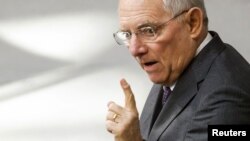
BERLIN, April 10 (Reuters) - German Finance Minister Wolfgang Schaeuble gave details of a plan on Sunday to combat tax havens including creating an international network of registers that list the actual owners of companies.
A huge leak of documents from the Panama-based law firm Mossack Fonseca has shown how offshore firms are used to stash the wealth of the rich and powerful, embarrassing several world leaders.
Germany made closer international cooperation on tax evasion a priority during its presidency of the G7 economic powers in 2014/15.
Schaeuble told the public broadcaster ARD that if company registers listing the owners of firms were networked internationally, it would be possible to find all the people hiding behind offshore companies.
In the European Union, such registers have already been agreed as part of a fourth directive on money laundering that must be implemented at the national level by mid-2017.
Schaeuble also pointed to an agreement on automatically swapping tax information, which around 100 countries have now joined. It is due to come into effect in 2017. He said the Panama Papers were ratcheting up the pressure on those that had not joined, such as the United States, to sign up.
A government paper seen by Reuters showed other elements of Schaeuble's 10-point plan, including urging Panama and all other holdouts to join the tax data exchange agreement.
The paper said the Global Forum of the Organisation for Economic Cooperation and Development (OECD) should act as a supervisor to check that states were exchanging data and come up with effective sanctions for negligent or uncooperative countries.
It also showed that Schaeuble wanted the various national and international blacklists of non-compliant tax havens to be standardised, with an international organisation such as the OECD taking the lead.
Schaeuble said statutes of limitations for tax offences should only start once a taxpayer had fulfilled his or her obligation to provide information.
Banking watchdogs across Europe have begun checking whether lenders have ties to the Panama Papers but Schaeuble said German banks had "largely put things in order already", adding: "We have made a lot of progress in recent years."
The paper also said it was "not the task of banks to encourage aggressive tax avoidance" and said those that offered tax-saving schemes should be obliged to disclose these to tax authorities.
It said tougher administrative measures were needed to hold firms to account because effective prosecution of misconduct often failed as negligence by an individual could not be proved.
It also said tougher rules to combat money laundering had been introduced in Germany's financial sector in recent years and such progress was also needed in the commercial sector.
(Reporting by Michelle Martin and Matthias Sobolewski; Editing by Kevin Liffey)