


Good morning! RFE/RL resumes its Panama Papers Live Blog coverage with this OCCRP piece on what the leak tells us about the Czech Republic.
The small Czech Republic looms large on the global scale of offshore business schemes. More than a quarter-million documents in the Mossack Fonseca trove have a Czech connection, while nearly 300 Czech clients and shareholders appear in the Panama Papers.
Among them are people prosecuted and sentenced for financial crimes, lobbyists, diamond traders or people linked to the biggest privatization and corruption scandals of the past two decades.
Money laundering requires a cooperative bank. Agents at Mossack Fonseca liked using a Czech bank called eBanka, now closed, on its list of banks who do not take the anti-money laundering resolutions too seriously. Such banks are willing to be flexible about rules and open bank accounts for murky companies from notorious tax-haven destinations such as the Pacific islands of Niue or Vanuatu. The list includes not only small regional or obscure banks, but also big international and respected banking houses.
In this respect, eBanka was one of the least discerning banks in the country. In one Mossack Fonseca email, an agent spelled it all out:
“Please understand that there is practically no bank in the World anymore, which still opens bank accounts in the name of offshore companies without the knowledge about the real ‘ultimate beneficial owner’ (UBO). Not even Panamanian banks do this, let alone Hong Kong. A major part of my work revolves around finding banks which have fairly relaxed conditions, but I have only come across one bank in the Czech Republic which opens accounts without info regarding the UBO (…) The only bank where we ever managed to open an account without naming the UBO at all was eBanka (Czech Republic).”U.K. Chancellor George Osborne has made public his 2014-15 tax return, in response to the Panama Papers scandal.
Mr Osborne said he had decided to publish his tax return this year in an unprecedented show of transparency, after David Cameron released details of his financial affairs back to 2010 after it was disclosed his father had run an offshore trust.
The Prime Minister's decision to release the information put increasing pressure on Mr Osborne to give details of his own affairs.
Earlier on Monday, a Downing Street spokeswoman said Mr Cameron was of the view that the Chancellor should also release his tax returns.
She said: "Those in charge of the nation's finances should show transparency too."
Labour Party leader Jeremy Corbyn also released his tax return this afternoon.
The address in the U.S. state of Delaware that is the official home address of more than 285,000 shell companies.
Anti-secrecy advocates say the building is prime evidence that Delaware has become a corporate haven that’s comparable to more well-known, offshore locales.
“If you imagined a building with 1,000 corporations in it, you’d imagine a building like the Empire State building,” said Richard Phillips, a senior policy analyst with Citizens for Tax Justice. “But apparently 285,000 companies claim [1209 North Orange Street] is their address.”
“What this shows is this is not really the address of companies that are doing real business. This is the address of a lot of companies that are just shell companies,” he added. “In this case, it doesn’t even look like they have mailboxes. They just claim that address as the places they’re doing business, even though they’re not doing business there.”
British journalist Peter Kellner writes for Prospect that we need to stop using the term "tax avoidance."
Let us ban the term “tax avoidance.” Instead, decide which of two terms to apply. We should say “tax planning” when describing activities in keeping with the spirit of the law, and “tax dodging” to describe activities that are technically legal but designed to circumvent the spirit of the law. “Tax planning” includes opening an ISA account, putting money into a pension fund—and giving your son £200,000 more than seven years before you die. “Tax dodging” is the kind of thing the comedian Jimmy Carr, among others, confessed to a few years ago. The scheme used by Carr was called K2, which sees earners “quit” their jobs and sign employment contracts with offshore shell companies. These companies then pay them lower salaries but “loan” them money in addition. These loans can be written down as tax liabilities.
Reuters now reporting that New Zealand will review its foreign-trust laws in the wake of the Panama Papers revelations.
New Zealand has long been identified by lawyers and legal experts as offering a trust regime popular with the offshore trust business because its foreign trusts are not subject to tax. The country's tax department recommended in 2014 that there be a review of taxation of foreign trusts.
Former PricewaterhouseCoopers chair John Shewan had been asked to conduct the review and would have to report back to the government by June 30.
In the initial wake of the Panama Papers release the government initially denied New Zealand might have problems with its trust regimes.
FYI, here is Suddeutsche Zeitung's aggregation page of all its Panama Papers coverage in English.
Economist Mohamed El-Erian argues that the Panama Papers leak will make centrist government much more difficult.
The Panama Papers are yet another blow to the political establishment. They amplify popular resentment toward governments that already are perceived by a significant segment of the population as turning a blind eye to tax-dodging. That anger is stoked by disclosures that some high-ranking officials also availed themselves of the shelters. And though no laws were broken in most cases, the documents will feed the perception that the privileged are allowed to play by different rules.
Indeed, for many, the Panama Papers are reminiscent of a broader phenomenon that played out in the run-up and the aftermath of the 2008 global financial crisis: The perception of a system run and managed by a political establishment that serves the rich and connected and fails to hold these elites accountable for the damage they cause to the rest of society. There is still notable residual resentment that very few bankers were brought to justice for their role in a financial debacle that caused significant misery and almost tipped the world into a devastating multiyear depression.
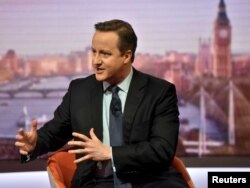
Reuters reports that British Prime Minister David Cameron says his government will accelerate its planned tax-avoidance legislation.
"This government has done more than any other to take action against corruption in all its forms, but we will go further," Cameron will tell parliament, according to advance excerpts of his statement circulated by his Downing Street office.
"That is why we will legislate this year to hold companies who fail to stop their employees facilitating tax evasion criminally liable."
The plan was announced by finance minister George Osborne in March 2015, but previously the commitment was to introduce the legislation by 2020, Downing Street said.
Forbes thinks about how China might respond to the Panama Papers:
That response shows that the Panama Papers will change China in just one plain way: Communist leaders will pick up their politically reliable tune that foreigners are out to get them, and to amplify it they may strike back at someone with economic weaponry.
And
China blames Western media for making the Panama Papers a sensation. Some 300 journalists were involved in investigating the documents, says an April 5 commentary by China’s Global Times online (it avoids mentioning what the papers say about Chinese leaders). The report ropes China’s perennial favorite blame target the United States, as well. “The Western media has taken control of the interpretation each time there has been such a document dump, andWashington has demonstrated particular influence in it. Information that is negative to the U.S. can always be minimized, while exposure of non-Western leaders…can get extra spin,” the commentary says. Watch for Beijing to make it harder than it already is for Western journalists to operate in China.